Japan’s School Route From Yōchien to Daigaku
Follow the April-entry school sequence, the Grade 9 high-school selection point, and the academic or applied routes that open afterward.
Early Childhood
Selected stamp: Early Childhood. Choose another stamp to update the route card.
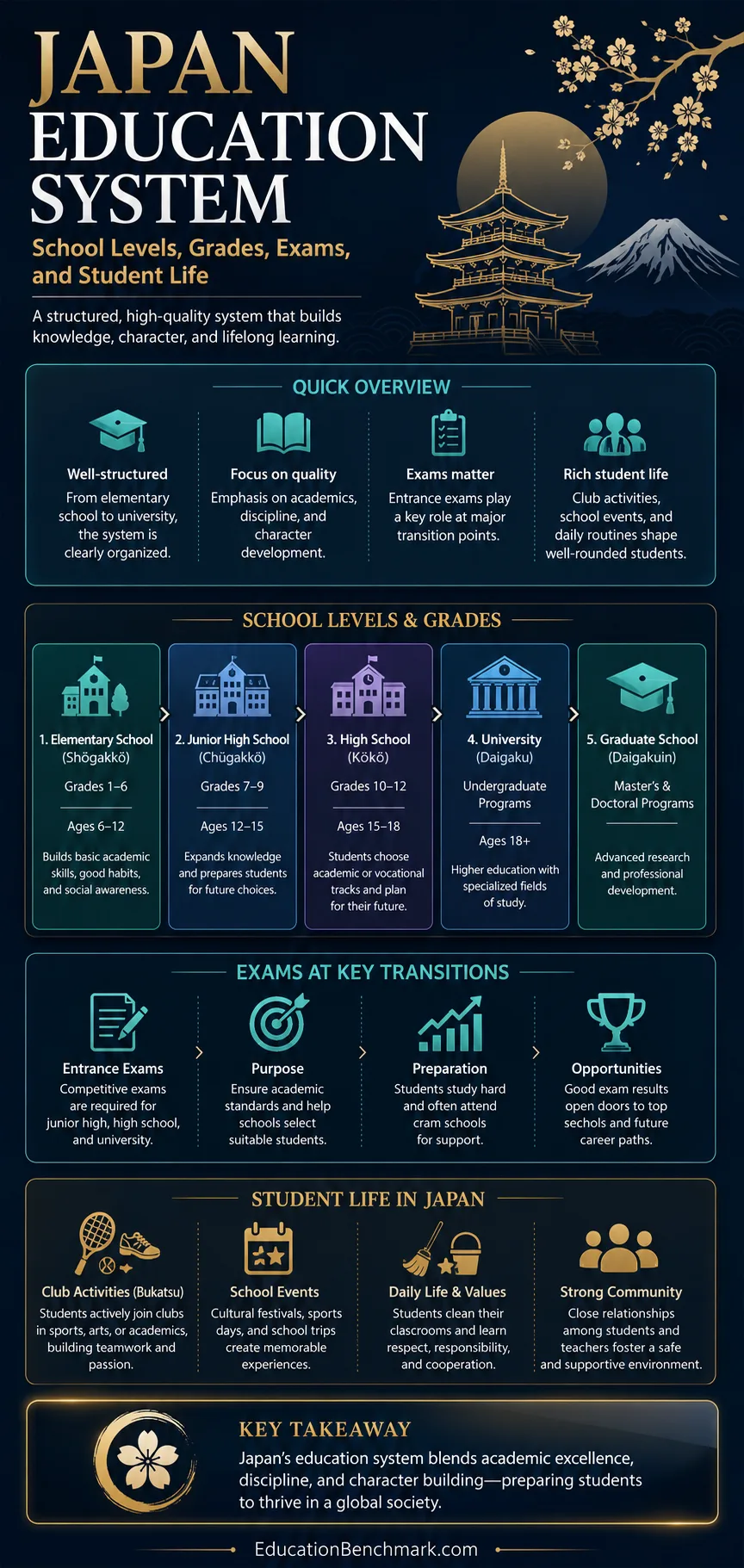
Japan’s education system is often reduced to the phrase 6–3–3–4: six years of elementary school, three of junior high, three of senior high, and a typical four-year university degree. That outline is accurate, but it hides the points that shape a student’s route. The first nine years are compulsory. Senior high school requires selection, school records gain weight during junior high, and post-secondary admission is decided by institutions rather than by one universal placement score. MEXT sets national standards, while prefectures, municipalities, schools, and universities make many of the choices that families encounter in practice.[a]
The academic year for elementary and secondary schools runs from April 1 to March 31. Children are grouped by the Japanese school-year eligibility rule rather than by calendar year alone, so two children born in the same calendar year may belong to different grades. Integrated forms also exist: a gimu-kyōiku-gakkō combines Grades 1–9, while a chūtō-kyōiku-gakkō combines lower and upper secondary education.[b]
Seen as a whole, Japan is best described as a nationally standardized but locally administered system. The school route is stable across the country, yet entrance procedures, course availability, school calendars within the national year, and local services are not identical. A current country profile from Education by Country also presents the system through this national–local relationship and the nine-year compulsory core.[c]
First major branch
The Grade 9 Exit: Japan’s First High-Stakes Branch
Compulsory schooling ends after junior high, but most students continue into an upper-secondary route that requires an application or selection process.
Students follow a broad academic curriculum, often with subject choices shaped by university plans or employment goals.
Schools may offer agriculture, industry, commerce, nursing, home economics, or mixed general-and-specialized study.
A five-year college of technology route combines upper-secondary-level study with advanced technical education.
Each prefecture or school publishes the method it will use; no single formula applies to every applicant in Japan.
The phrase kōkō nyūshi refers broadly to senior high school entrance selection. Public high-school procedures are commonly organized at prefectural level, while private and national schools set their own requirements. Written tests may be combined with the junior-high record, known in admission contexts as the chōsasho, plus interviews, essays, practical tests, or recommendation-based selection.
This is not early tracking in the same institutional sense as Germany’s separate lower-secondary school types. Japanese students normally share a common compulsory route through Grade 9. The branching happens when they choose a senior high school, course, Kōsen, or another approved option. School prestige, course focus, commuting distance, club strength, and later entrance preparation can all influence that choice.
School sequence
From Shōgakkō to Kōtō Gakkō: Grades, Ages, and Attendance
Age ranges are typical. A child’s exact grade depends on the April-based school-year cutoff and prior schooling.
| Stage | Local term | Grades or duration | Typical ages | Compulsory status | Usual next step |
|---|---|---|---|---|---|
| Early childhood | Yōchien; nintei kodomoen | One to three years | About 3–5 | No | Elementary school |
| Elementary school | Shōgakkō | Grades 1–6 | About 6–12 | Yes | Junior high school |
| Junior high school | Chūgakkō | Grades 7–9 | About 12–15 | Yes | Senior high, Kōsen, or another upper-secondary route |
| Senior high school | Kōtō-gakkō; commonly kōkō | Usually three years | About 15–18 | No | Higher education, professional training, or work |
| College of technology | Kōsen | Five years after junior high | About 15–20 | No | Employment, advanced course, or university transfer |
| University | Daigaku | Usually four years | Usually 18+ | No | Employment or graduate study |
Table analysis
- The legal compulsory period is the six years of elementary school plus three years of junior high school.
- Senior high school belongs to the normal route but remains outside statutory compulsory education.
- Kōsen starts at the same transition point as senior high school and continues for five years.
Promotion within compulsory education is normally based on school participation and learning over the year rather than on a national pass-or-fail examination. The route becomes more selective at the transition into senior high school. Full-time senior high programs usually last three years; part-time and correspondence formats may take three years or longer. Japan also has six-year secondary schools and nine-year compulsory education schools, so the familiar 6–3 pattern describes the main route rather than every institution.
Who decides what
MEXT Standards, Local Boards, and What Schools Control
Japan combines national curriculum standards with local administration and school-level organization.
The Ministry issues the Courses of Study, establishes school-system rules, authorizes textbooks, and sets broad institutional standards.
Local authorities manage schools, staffing responsibilities, facilities, enrollment arrangements, and many operational details within national law.
Timetables, events, club offerings, classroom practices, and parts of assessment vary while the curriculum remains tied to national standards.
The Courses of Study are national curriculum standards for kindergarten through upper secondary education. They define subject aims and expected learning while leaving schools to organize lessons around staffing, local needs, and approved timetables. MEXT states that these standards are intended to maintain a common level of education throughout the country.[d]
Students study Japanese language, mathematics, science, social studies, physical education, music, art, and other subjects appropriate to the stage. Moral education, the Period for Integrated Studies, foreign-language learning, and tokkatsu—special activities such as classroom responsibilities, student councils, clubs, and school events—also form part of school education. Textbooks are not chosen as unrestricted commercial materials: schools use MEXT-authorized or MEXT-authored textbooks under the national textbook system.[e]
Where the National Curriculum Still Allows Variation
A common curriculum does not make every school day identical. Municipal calendars, lesson pacing, elective offerings, integrated-study projects, club schedules, and entrance preparation differ. Private schools may express a distinct educational mission, but recognized schools still operate within Japanese school law and curriculum requirements relevant to their category.
Selection sequence
From Chōsasho to the Common Test: How Selection Works
Japan has several entrance gates, but it does not use one national exam to assign every student to a school or university.
-
1
Junior-high record
Course grades, attendance-related information, activities, and other school-reported evidence may enter the chōsasho used in senior high selection.
-
2
Senior high entrance selection
Public-school tests are commonly prefecture-based; private, national, integrated, and specialized schools may use different examinations or recommendation routes.
-
3
Upper-secondary preparation
Students build subject records and choose courses that fit employment, professional training, or higher-education plans.
-
4
Common Test for University Admissions
Universities that use the test decide which scores they require and how those scores enter their own selection process.
-
5
Institution-specific decision
A university may add its own written exams, interviews, essays, document screening, recommendations, or a combined method.
The Common Test for University Admissions (Daigaku Nyūgaku Kyōtsū Test) is administered nationally by the National Center for University Entrance Examinations. Its official site publishes the current exam outline, participating-university information, schedules, past questions, and annual instructions.[f]
The test is often misunderstood as Japan’s sole university entrance examination. In reality, each institution sets its admission policy. A university can use Common Test scores, its own academic examination, interviews, document review, or several of these together. Recommendation-based selection and broader evidence-based application routes sit alongside general selection. Requirements differ by university, faculty, and admission year.[g]
Kōsen, Specialized Courses, and Senmon Gakkō
Japan’s applied routes do not begin at one single point. Some students enter a specialized senior high course in fields such as industry, commerce, agriculture, fisheries, nursing, or home economics. Others choose an integrated course that mixes general and specialized subjects. These remain upper-secondary programs and lead to an upper-secondary completion credential.
Kōsen is structurally different. A college of technology admits students after junior high and usually provides five years of continuous technical education. The curriculum combines general subjects with engineering, experiments, workshops, design, and practical study. Graduates can enter employment, continue in an advanced course, or transfer to a university under the receiving institution’s rules.
Senmon gakkō usually refers to a professional training college offering post-secondary courses after senior high school. Programs prepare students for occupational fields through applied instruction. Approved courses may award the titles Diploma or Advanced Diploma, and some support university transfer or entry to further study. Japan’s recognized higher-education landscape therefore includes universities, junior colleges, Kōsen, and professional training colleges rather than universities alone.[h]
Route comparison
How the Main Applied Routes Differ
What a Japanese School Day Usually Includes
School life includes more than subject lessons. A typical day may begin with a homeroom meeting, move through several class periods, include lunch and cleaning, and end with another short meeting before after-school activities. In many elementary and junior high schools, students take turns serving lunch and help clean classrooms and shared spaces. These routines are treated as part of school participation rather than as separate services performed entirely by adults.
Tokkatsu, or special activities, gives formal space to classroom organization, student councils, school events, and group responsibilities. Sports days, cultural festivals, entrance and graduation ceremonies, field trips, safety drills, and volunteer activities may appear in the annual calendar. Club activities—bukatsu in everyday speech—can be athletic, musical, cultural, scientific, or technical. Participation patterns differ by school and age, and club schedules can be demanding at some secondary schools.
Uniforms are common at junior and senior high schools, though they are not universal. Elementary pupils may carry standardized bags or wear school-designated items without having a full formal uniform. Rules on hair, footwear, phones, commuting, and clothing come from the school rather than from one nationwide student dress code.
MEXT’s illustrated account of basic education shows lunch, cleaning, classroom activities, student councils, clubs, ceremonies, cultural events, athletic events, and school trips as recurring parts of school life. It also warns that examples differ between schools and regions.[i]
Juku Is Outside the Formal School Route
Juku are private after-school learning services. Some focus on routine subject support; others prepare students for selective entrance examinations. Attendance is not a legal stage of Japanese education, and experiences vary by family resources, location, age, and target school. OECD analysis treats juku as shadow education that can strengthen preparation while also raising concerns about household cost and unequal access.[j]
Grades, Promotion, and the Meaning of School Records
Japan does not use a single national grading scale in exactly the same way at every level. Elementary reports often combine achievement judgments with written comments and observations about participation. Junior and senior high schools use structured subject grades, but the reporting scale, calculation method, wording, and treatment of assignments or tests can differ by school and local authority.
During junior high, grades can matter beyond the report card because internal records may form part of senior high selection. This is why the term naishin is frequently heard in discussions about high-school admission. It refers informally to internal school evaluation or the record used in selection, but applicants should check the precise prefectural document and formula rather than assume that one national weighting applies.
National assessments in compulsory education are used to examine learning conditions and achievement at system level. They are not graduation examinations that award or deny the elementary or junior-high credential. Classroom tests, term examinations, projects, practical work, and teacher judgment remain part of everyday assessment.
School providers
Public, National, Private, and International Schools
Provider type affects admissions, fees, school culture, and curriculum choices, but the labels should not be read as a simple quality ranking.
At compulsory levels, public schools generally serve local attendance areas. Families moving within Japan should verify the municipal enrollment process, especially when language support, special educational needs, or a transfer from an overseas curriculum is involved. Private and national schools may begin selective admission earlier, including at elementary or junior-high level.
The term international school describes many different institutions. A school may offer the International Baccalaureate, another country’s curriculum, or an independent program. Its status under Japanese law, recognition of completion, access to Japanese universities, and eligibility for particular support schemes are separate questions. The school’s accreditation and the receiving university’s admission policy should be checked directly.
After upper secondary
Daigaku, Junior College, Kōsen, and Professional Training Routes
The institution type affects program length, qualification, teaching style, and transfer possibilities.
| Institution | Typical entry point | Usual length | Main award or outcome | Admission pattern |
|---|---|---|---|---|
| University | Upper-secondary completion or equivalent | Usually four years | Bachelor’s degree | Institution-defined selection; Common Test may be used |
| Professional and vocational university | Upper-secondary completion or equivalent | Usually four years | Professional bachelor’s degree route | Institution-defined selection with practical orientation |
| Junior college | Upper-secondary completion or equivalent | Usually two or three years | Associate degree | Institution-defined selection |
| Kōsen | Junior-high completion | Five years | Associate title; technical progression | College entrance selection after Grade 9 |
| Professional training college | Usually upper-secondary completion | Varies by approved course | Diploma or Advanced Diploma in approved programs | Institution and program requirements |
University admission is best read as a set of routes rather than a single exam ladder. A national or public university may combine the Common Test with a second-stage examination. A private university may use its own exam, Common Test scores, school recommendation, or several separate application rounds. The same applicant may therefore prepare different subject combinations and documents for different institutions.
Students planning a transfer from Kōsen, a junior college, or professional training college need to examine the receiving institution’s policy. Prior study does not convert automatically into the same number of university credits everywhere. Program approval, qualification title, completed subjects, and faculty-level rules all matter.
Where Japanese Education Rules Vary
The national school structure changes slowly, but operational details can change every admission year. Prefectures revise high-school selection schedules and weighting. Universities publish new subject requirements and application routes. Schools adjust calendars, clubs, device rules, support services, and course offerings. Professional qualifications may also depend on a regulator outside the education institution.
- For compulsory-school enrollment, check the municipality or local board of education.
- For public senior high admission, use the current prefectural education authority instructions.
- For private or national schools, read the school’s latest application booklet.
- For the Common Test, use the National Center for University Entrance Examinations.
- For university admission, confirm the faculty-level requirements issued for the intended entry year.
- For international-school recognition or overseas qualifications, verify both the school’s status and the receiving institution’s policy.
Education Benchmark is an independent informational guide and is not affiliated with any ministry of education, school authority, exam board, university, government agency, or official ranking organization. The descriptions here explain the system; they do not replace current instructions from the responsible school, board of education, prefecture, examination body, university, or qualification authority.
Reference record
Sources and Verification
Official and institutional pages were selected for school structure, curriculum, admissions, qualifications, and student-life context.
- [a] MEXT: Overview — Used for the 6–3–3–4 structure, compulsory stages, typical ages, and upper-secondary course forms. (Reliable because it is the official English overview of Japan’s education ministry.)
- [b] Overview of the Japanese Education System — Used for the April–March academic year and integrated school forms. (Reliable because NIC-Japan is Japan’s national information center for academic recognition.)
- [c] Japan Education System (2026): Structure, Quality, and Performance — Used as an independent country-level cross-check of the school sequence and national–local administration model. (Reliable for this purpose because it is a dedicated education-system reference page with stated update information and linked source support.)
- [d] Improvement of Academic Abilities (Courses of Study) — Used for the role of national curriculum standards and their application across school levels. (Reliable because it is an official MEXT curriculum page.)
- [e] Japan’s School Textbook — Used for textbook authorization and required use within recognized Japanese schools. (Reliable because it is an official MEXT explanation of the textbook system.)
- [f] Common Test for University Admissions: Official Overview — Used to identify the official administrator and current information channel for the Common Test. (Reliable because it is the National Center for University Entrance Examinations.)
- [g] Admission to Higher Education Institution — Used for institution-led admissions, Common Test use, original university exams, interviews, and document screening. (Reliable because NIC-Japan provides official recognition and system information.)
- [h] Types of Higher Education Institutions — Used for universities, junior colleges, Kōsen, professional training colleges, program lengths, and progression routes. (Reliable because it is maintained by Japan’s national academic-recognition information center.)
- [i] Basic Education in Japan: Chi, Toku, Tai — Used for typical school-day routines, cleaning, lunch, special activities, clubs, and annual events. (Reliable because it is an official MEXT education brochure.)
- [j] Education Policy in Japan — Used for the role of juku, family-funded learning, student well-being, and equity context. (Reliable because OECD education reviews use national evidence and international policy analysis.)