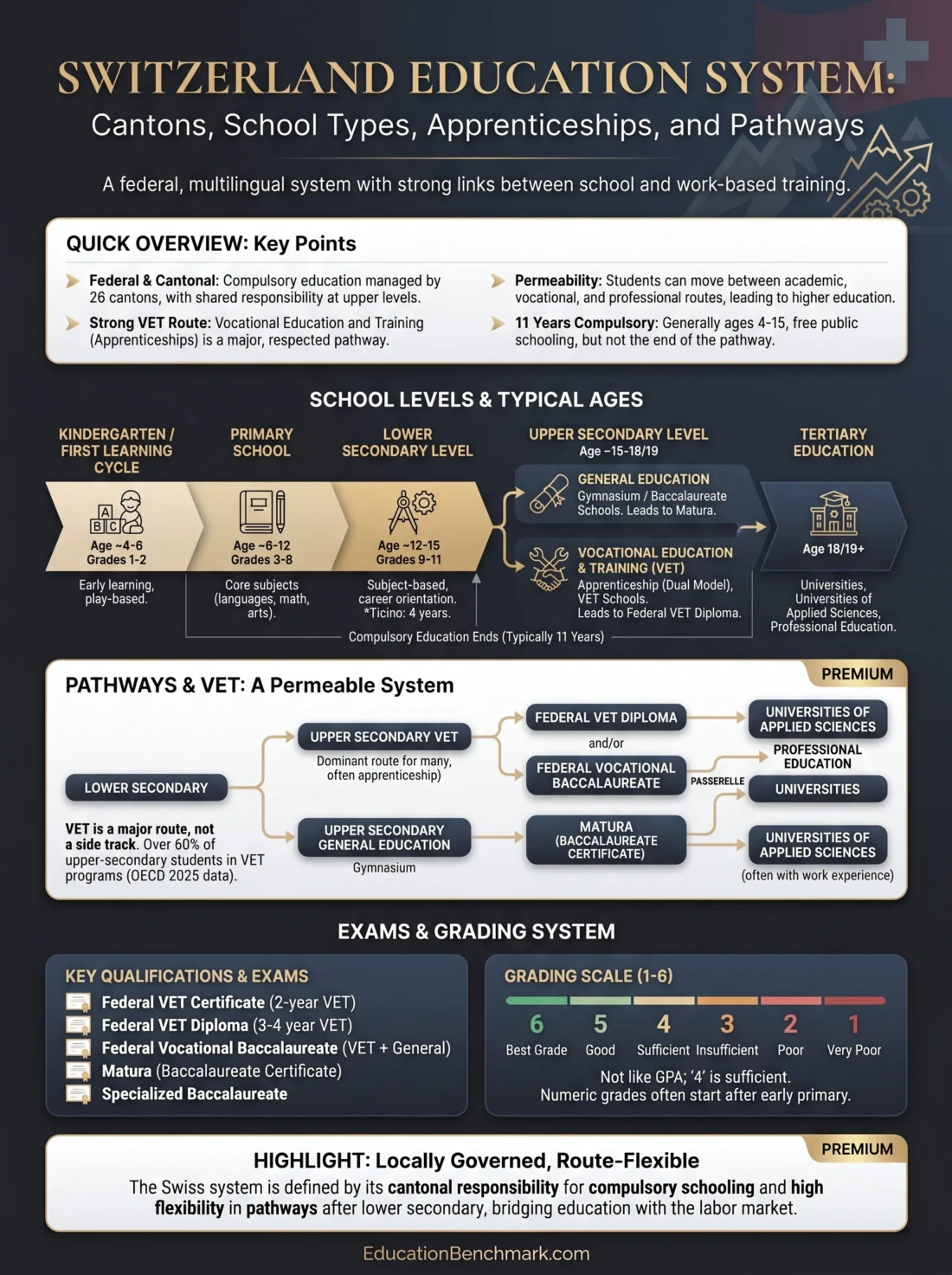
Switzerland’s Canton-to-Career School Route
A branching map of compulsory schooling, cantonal selection, apprenticeships, Matura qualifications, and tertiary destinations.
Cantonal Rules
Selected stamp: Cantonal Rules. Choose another stamp to update the route card.
Switzerland does not operate one uniform school system from Bern. The 26 cantons hold the main responsibility for compulsory education, while municipalities run many local schools and the Confederation shares duties in vocational education, recognised Matura qualifications, and higher education. That division explains why the broad route is recognisable nationwide but school names, selection rules, calendars, and transitions can look different from one canton to another. [a]
The normal route begins with kindergarten or a first learning cycle, continues through primary and lower secondary education, and then branches. Some students enter a Gymnasium, some attend a Fachmittelschule, and many begin vocational education and training through an apprenticeship. These are not sealed tracks. Swiss qualifications are designed to permit later movement, although a transfer may require work experience, an additional Matura, a supplementary examination, or institution-specific admission.
Governance map
How Swiss Cantons Shape the School Route
National coordination creates shared reference points, but cantonal law determines much of the school experience.
The federal level regulates vocational and professional education and works with the cantons on Matura recognition and higher education coordination.
Cantons set school structures, curricula, assessment practice, supervision, and many rules for upper-secondary admission.
Municipalities commonly provide primary schools and manage local delivery within cantonal requirements.
Employer and professional organisations take part in training content, workplace learning, and vocational qualification processes.
The Eleven-Year Compulsory Route and Typical Ages
Compulsory education generally starts at age four and lasts eleven years. Primary level includes two years of kindergarten or a first learning cycle and normally covers eight years in total. Lower secondary usually lasts three years; Ticino uses a four-year scuola media structure. The exact cut-off date, entry arrangements, and stage labels must be checked with the canton. [c]
| Stage | Typical age | Usual duration | Route meaning |
|---|---|---|---|
| Kindergarten or first learning cycle | About 4–6 | Usually 2 years within primary level | The formal start of compulsory education in most cantons. |
| Primary classes | About 6–12 | Usually 6 further years | Builds the record used for promotion and later secondary placement. |
| Lower secondary, Sekundarstufe I | About 12–15 | Usually 3 years; 4 in Ticino | May use ability groups or separate models and leads to upper-secondary choices. |
| Upper secondary general education | About 15–18 or 19 | Depends on canton and programme | Includes Gymnasium and upper secondary specialised schools. |
| Vocational education and training | Often begins around 15 or 16 | 2, 3, or 4 years | Combines occupational training with school-based learning in most programmes. |
The school year normally begins in late summer, but holiday dates and detailed calendars are cantonal. Public compulsory schools are free, and residence commonly determines the local public school. Private and international schools operate alongside the public system, yet they must comply with the legal requirements that apply in their canton.
Sekundarstufe I: Selection Without One National Exam
Switzerland has no single nationwide examination that assigns every pupil to an upper-secondary route. Lower secondary organisation can be integrated, cooperative, or divided into different performance levels. Cantons and schools may consider report grades, teacher recommendations, overall assessments, entrance tests, interviews, or combinations of these measures.
Grading is commonly based on a 1–6 scale: 6 is the highest grade, 4 is sufficient, and marks below 4 are insufficient. Reports are often issued twice a year, and learning behaviour or work habits may also appear in the evaluation. Promotion, movement between ability levels, and access to a Gymnasium remain subject to cantonal rules. [d]
What Readers Often Confuse
A lower secondary track is not the same as a permanent career decision. Students can move between levels, use bridge-year programmes, enter VET after school-based study, or qualify for higher education later through a vocational or specialised Matura and supplementary routes.
Upper-secondary decision
Gymnasium, Apprenticeship, or Fachmittelschule?
The main routes differ in learning setting, qualification, and the most direct next step.
Broad school-based study leads to the gymnasiale Maturität and normally direct access to university-level academic study.
A training company, vocational school, and inter-company courses prepare learners for an EBA or EFZ occupational qualification.
General education and field-related preparation lead toward health, social work, education, arts, or other applied fields.
A transitional programme can support students who need more time before an apprenticeship or another upper-secondary programme.
How the Swiss Apprenticeship System Works
Vocational education and training is a mainstream upper-secondary route, not a separate remedial sector. A typical dual apprenticeship divides learning among a host company, a vocational school, and inter-company courses. The learner is both a student and an apprentice under a training contract. Occupational requirements are set through federal VET ordinances and training plans, while cantons supervise implementation and companies provide workplace training.
Two-year programmes lead to the Federal VET Certificate, commonly abbreviated as EBA in German, AFP in French, and CFP in Italian. Three- and four-year programmes lead to the Federal VET Diploma, commonly EFZ, CFC, or AFC. Learners in the longer programmes may also work toward the Federal Vocational Baccalaureate, either during the apprenticeship or after completing it. [e]
- EBA/AFP/CFP: a two-year vocational qualification that can lead directly to work or, in suitable occupations, to a shortened EFZ/CFC/AFC route.
- EFZ/CFC/AFC: a three- or four-year vocational diploma that supports skilled employment and later professional or applied higher education.
- Berufsmaturität: the Federal Vocational Baccalaureate, adding advanced general education to an EFZ route and normally opening related universities of applied sciences.
- Passerelle: a supplementary examination route that can allow holders of a vocational or specialised Matura to enter Swiss universities.
Admission to an apprenticeship is decentralised. Students apply to training companies, and employers select candidates using school reports, applications, interviews, trial placements, aptitude checks, or occupation-specific measures. This makes the search for a Lehrstelle different from automatic school placement.
Matura Qualifications and What They Open
The word Matura does not refer to one interchangeable certificate. Switzerland uses several recognised baccalaureate routes, each connected to a different upper-secondary programme.
Qualification ladder
Three Matura Routes Compared
The academic Matura includes recognised subject requirements, school performance, a Matura essay, and final examinations. At least five subjects are examined, including the first language, a second national language, mathematics, the specialised subject, and another subject. Cantons run the schools, while federal-cantonal recognition makes the certificate valid across Switzerland. [f]
The Fachmittelschule route sits between purely academic schooling and occupational training. It offers general education with preparation for areas such as health care, social work, education, communication, design, or the arts. A three-year specialised school certificate can lead to a college of higher education in the relevant field. An additional one-year Fachmaturität, including practical or field-specific requirements, can provide direct access to selected universities of applied sciences or teacher-education programmes. [g]
Universität, Fachhochschule, Pädagogische Hochschule, and Professional Education
Swiss tertiary education has both higher-education institutions and tertiary professional education. The higher-education side includes cantonal universities, the two federal institutes of technology, universities of applied sciences, and universities of teacher education. Professional education serves qualified workers seeking advanced occupational or leadership credentials through professional education institutions and federal examinations.
Tertiary destinations
Matching the Qualification to the Institution
The gymnasiale Maturität is the standard entry qualification. Doctoral study is offered in the university sector.
A vocational Matura linked to the field is the usual route; other qualifications may require relevant work experience.
Admission depends on the teaching level and qualification route, with recognised alternatives available in defined cases.
Experienced vocational graduates can pursue professional colleges, federal diplomas, and advanced federal diplomas.
The standard entry qualification differs by institution type, but alternative routes preserve permeability. A university generally expects an academic Matura or a supplementary university aptitude route. A university of applied sciences usually expects a vocational Matura connected to the study field, while academic-Matura holders commonly need relevant practical experience. [h]
International Qualifications and Institution-Led Admission
Foreign school-leaving certificates are assessed against university-specific requirements. Recognition is not a single automatic nationwide decision for every applicant. Universities may require a particular subject mix, minimum grades, proof of university eligibility in the home country, an entrance examination, or additional documents. The published swissuniversities country tables for the 2026/27 academic year also state that each university’s legal rules remain decisive. [i]
Language requirements also matter. Degree programmes may be taught in German, French, Italian, English, or more than one language, and applicants can be asked for formal proof. Medicine, arts, sport, and other capacity-limited or aptitude-based programmes may use extra procedures. Admission should therefore be checked directly with the institution and programme for the intended academic year.
Language Regions, Curricula, and School Vocabulary
The language of schooling is normally German, French, Italian, or Romansh according to the region. Compulsory education does not use one national curriculum. Cantons coordinate through language-region curricula: Lehrplan 21 in German-speaking and multilingual cantons, Plan d’études romand in French-speaking Switzerland, and Piano di studio in Ticino. Primary structures may also be described through local cycle terminology rather than a simple kindergarten-plus-grade sequence. [j]
Swiss terminology
The Same Route in Different National Languages
Verification Across Canton Authorities
National overviews explain the common structure, but a practical decision depends on the canton and institution. Families should verify the local school-entry cut-off, language of instruction, lower-secondary model, Gymnasium admission procedure, apprenticeship application process, holiday calendar, and recognition of prior schooling with the relevant cantonal education department or school.
University applicants should check the current programme page and admissions office rather than relying only on a general country profile. Rules can change by academic year, qualification, nationality, residence status, study field, and capacity. Education Benchmark is an independent informational guide and is not affiliated with any ministry of education, school authority, exam board, university, government agency, or official ranking organization.
Sources and Verification
- [a] General information – EDK — Used for the division of responsibilities among the Confederation, cantons, municipalities, and professional organisations. (Reliable because EDK is the official conference of cantonal education ministers.)
- [b] Switzerland Education System (2026): Structure, Quality, and Performance — Used as an independent country-level reference for the federal, multilingual, and pathway-based character of the system. (Reliable as a specialised education-country reference that identifies its scope and sources.)
- [c] Compulsory education – EDK — Used for the eleven-year compulsory period, typical starting age, primary duration, and Ticino exception. (Reliable because it is an official EDK system page.)
- [d] Lower secondary level – EDK — Used for lower-secondary assessment, report practice, and the 1–6 grading scale. (Reliable because it is an official EDK description of cantonal lower-secondary education.)
- [e] Vocational Education and Training (VET) — Used for EBA and EFZ programme lengths, qualification names, and the vocational Matura option. (Reliable because SERI is the Swiss federal authority responsible for education, research, and innovation policy.)
- [f] Baccalaureate schools – EDK — Used for academic Matura assessment, examination subjects, and recognition rules. (Reliable because it is the official EDK description of baccalaureate schools.)
- [g] Upper secondary specialised school – EDK — Used for Fachmittelschule fields, certificate progression, and Fachmaturität access. (Reliable because EDK regulates nationwide recognition of these schools and qualifications.)
- [h] Institutions for higher education – EDK — Used for Swiss institution types and their usual admission qualifications. (Reliable because it is an official EDK overview prepared with federal education authorities.)
- [i] Admission requirements by country – swissuniversities — Used for the 2026/27 foreign-qualification admission context and the institution-led nature of final decisions. (Reliable because swissuniversities is the rectors’ conference of accredited Swiss higher education institutions.)
- [j] Primary level – EDK — Used for language-region curricula, first-cycle organisation, and cantonal primary variation. (Reliable because it is an official EDK page on primary education.)