
Luxembourg School Route Passport
A route map built around Luxembourg’s Cycle 4 orientation, multilingual lycée choices, 7e–1re sequence, and academic or vocational qualifications.
Cycle 4 Orientation
Selected stamp: Cycle 4 Orientation. Choose another stamp to update the route card.
Luxembourg’s education system is shaped less by a single sequence of grades than by the interaction of learning cycles, languages and secondary-school routes. A pupil may encounter Luxembourgish, German and French before reaching the lycée years, then move through a national ESC or ESG programme, a European curriculum, another international route or vocational training. Understanding where those routes separate—and where they still reconnect—is more useful than treating the system as a simple primary-to-high-school ladder.
Lycée grade decoder
Why Luxembourg Lycée Runs From 7e Down to 1re
The national secondary sequence uses descending class numbers, with 1re as the final year rather than the first.
| Luxembourg class | Position in secondary school | Usual role |
|---|---|---|
| 7e | Year 1 | Entry into secondary education |
| 6e | Year 2 | Lower secondary |
| 5e | Year 3 | Final lower-secondary year |
| 4e | Year 4 | Start of upper secondary |
| 3e | Year 5 | Upper-secondary specialisation |
| 2e | Year 6 | Penultimate secondary year |
| 1re | Year 7 | Final year and school-leaving stage |
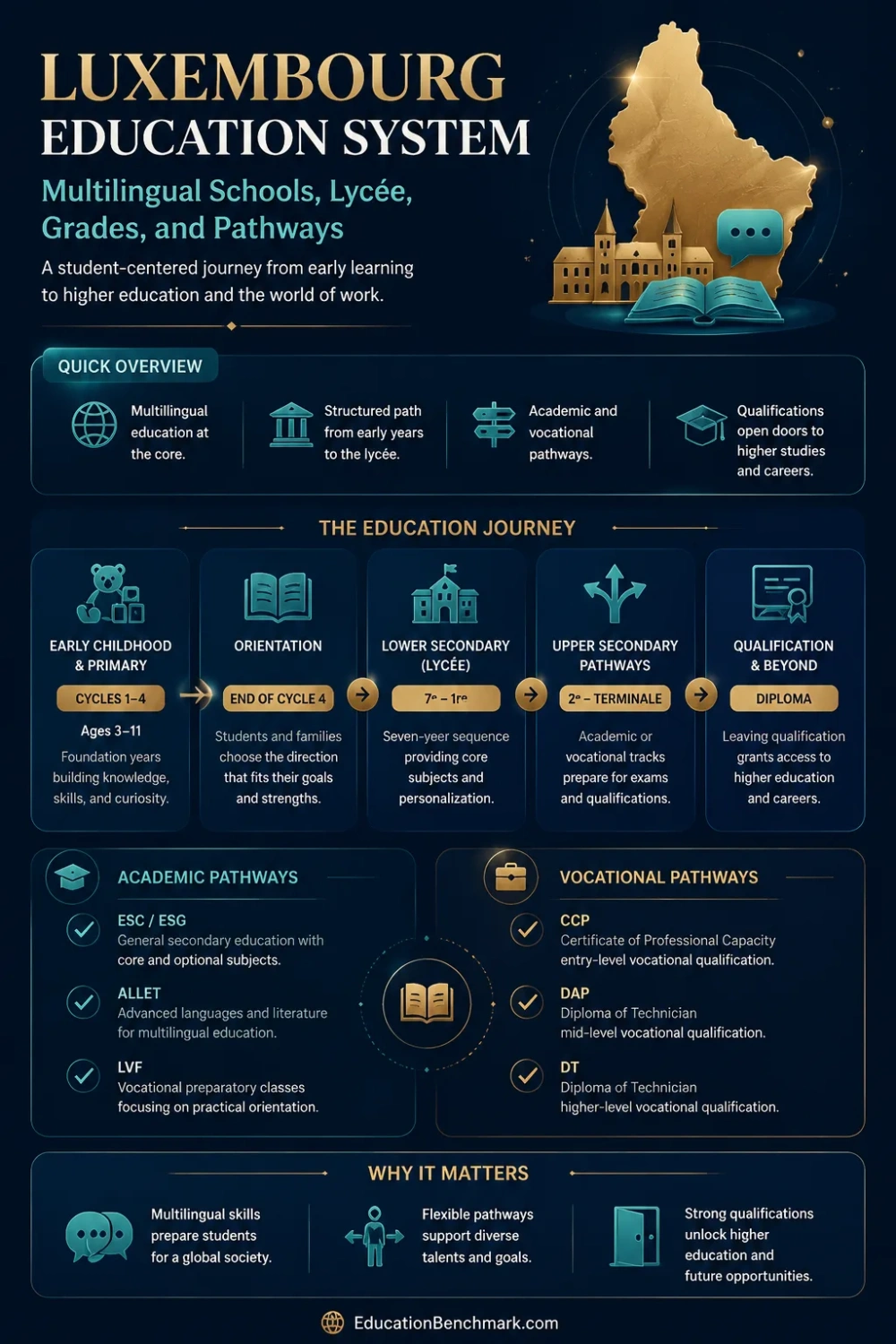
Public secondary schools generally receive pupils from about age 12, and an uninterrupted national secondary course lasts seven years. The Ministry divides public secondary provision into classical secondary education (ESC), general secondary education (ESG), European education and several international or cross-border options. The 2026/2027 school year also changes the upper boundary of compulsory schooling: the obligation extends to age 18 from the start of that school year.[a]
A student moving from 7e to 6e has progressed one year. The same logic continues until 1re, so a smaller class number means a later stage of secondary education.
Elementary route
Cycles 1–4 Before the Lycée Decision
Luxembourg groups elementary schooling into learning cycles with defined competence goals rather than treating every year as a separate grade stage.
| Stage | Typical ages | Place in the route |
|---|---|---|
| Cycle 1 early education | 3–4 | Optional first year |
| Cycle 1 preschool | 4–5 | Compulsory preschool stage |
| Cycle 2 | 6–7 | Primary learning cycle |
| Cycle 3 | 8–9 | Primary learning cycle |
| Cycle 4 | 10–11 | Final primary cycle and secondary orientation stage |
Children who are 3 before 1 September may attend the optional first year of Cycle 1. Compulsory elementary attendance begins for children who are 4 before 1 September. Cycles 2, 3 and 4 normally cover two years each, although a cycle may take less or more time in exceptional cases when a pupil reaches the defined socles de compétences at a different pace.[b]
Elementary governance is shared rather than entirely municipal or entirely national. Municipalities handle areas such as infrastructure and local school organisation, while teachers are appointed by the State and allocated to municipalities. Primary education is also divided into regional directorates.
Secondary selection point
Cycle 4 Orientation: How the First Major Branch Is Decided
The move into lycée is based on a structured orientation process rather than one stand-alone entrance examination.
The teacher and parents begin discussing the pupil’s progress, interests and possible secondary routes.
School performance and national épreuves communes contribute to the orientation picture.
The parents and class teacher make the final orientation decision together where agreement is reached.
The decision may lead toward ESC, ESG or another suitable secondary-school option.
The procedure begins during the first year of Cycle 4. The official orientation process considers the pupil’s work, acquired competences, interests and aspirations, together with results from the épreuves communes. Psychological assessment can also contribute when parents choose that option. If the parents and teacher cannot agree, an orientation commission examines the case.[c]
This is why describing the Luxembourg transition as an “exam after primary school” misses much of the mechanism. National testing provides evidence, but the final route is built through a broader school-and-family orientation procedure.
Luxembourgish, German, French, and the New Literacy Choice
Multilingual education in Luxembourg does not mean that every subject is taught equally in three languages throughout schooling. The function of each language changes with the stage, programme and class. Luxembourgish has an early role in communication and oral development; German and French have traditionally carried much of literacy and subject teaching; English enters later and becomes central in some international routes.
A major primary-school change begins with the 2026/2027 school year. During Cycle 1.2, parents can choose German or French as their child’s literacy language. The reform changes the traditional assumption that the first literacy route in the national system must always be German, while maintaining the wider multilingual model.[d]
Selecting French or German as the literacy language does not turn the national school route into a single-language programme. Other languages remain part of the pupil’s education as multilingual learning develops.
The language pattern changes again in secondary school. In regular 7e ESC classes, German is the teaching language for most subjects, while mathematics and French are taught in French. In 6e ESC, pupils choose English, Latin or, at one school, Chinese; pupils choosing Latin or Chinese begin English in 5e. From 4e onward, French becomes the teaching language in ESC. ESG follows its own subject and language arrangements, including routes designed for different German and French proficiency profiles.[e]
National secondary routes
ESC and ESG Are Not Simply “Academic” and “Vocational”
The two national lycée routes differ in structure, but both can support continued education beyond secondary school.
ESC is a seven-year secondary course with lower classes from 7e to 5e and upper classes from 4e to 1re. The 4e year functions as a transition toward later specialisation. Current ESC sections cover areas such as modern languages, mathematics and information technology, natural sciences, economics, arts, music, humanities, communication, entrepreneurship, cognitive sciences and sustainability-related study. At the end of 1re, the classical route leads to the diplôme de fin d’études secondaires classiques.
ESG has a wider applied dimension but should not be reduced to vocational schooling. Its lower stage includes an orientation route as well as a preparatory route for pupils who have not yet acquired the required competence base. The preparatory route is modular and can support progression into orientation classes or vocational programmes such as DAP or CCP. Upper ESG then divides into different study areas and can culminate in the general secondary school-leaving diploma.
Beyond the standard national class
Public European Schools, Cambridge, ALLET, and French-Medium Classes
Luxembourg’s public offer includes several routes that respond to different curriculum and language profiles.
Luxembourg has six international state schools following the European Schools curriculum, open to pupils without tuition fees and offering French-, English- and German-speaking sections that can lead to the European Baccalaureate. Public secondary provision also includes the English-language Cambridge route at International School Michel Lucius, International Baccalaureate options, and the German-Luxembourgish Schengen route. Within national secondary education, ALLET, Français Plus and French-medium classes respond to different language profiles.[f]
Language Support for Newly Arrived Pupils
A pupil arriving from another country does not necessarily have to enter the same German-dominant lower-secondary class as a pupil who completed the national elementary route. Welcome and integration classes, language support and international programmes create other entry points. Placement depends on age, previous schooling, academic level and language profile rather than nationality alone.
This distinction matters in Luxembourg because language readiness and academic readiness are not the same question. A pupil may be strong in mathematics and other subjects while still needing intensive German or French support.
Assessment and certification
The 60-Point Scale and the 1re School-Leaving Exam
A score of 30 has an important meaning, but it should not be confused with an automatic guarantee of yearly promotion or graduation.
General secondary assessments use a 60-point scale, with 30 points as the basic threshold for a successful test.
Students completing the principal ESC and ESG diploma routes take the leaving examination at the end of 1re.
General secondary marks are established from 1 to 60 points, and a test is successfully completed at 30 points or above. Term or semester marks are built from assessed work, while annual results feed into promotion decisions. The 30-point threshold is therefore best read as a basic assessment threshold, not as a universal rule saying that every student with 30 in one test automatically advances.[g]
At the end of 1re in ESC and ESG, students take the national school-leaving examination for the secondary diploma. The examination covers six subjects, with written and oral components under the official rules. For examined subjects, the final subject mark combines the annual mark and examination performance, with the annual mark accounting for one third and the examination mark for two thirds. The diploma gives access to higher studies and can also support entry into professional life.[h]
“30 out of 60 is a pass” describes the basic result of an assessment. Promotion to the next class and final certification depend on the wider rules applying to the pupil’s programme and results.
Professional education
CCP, DAP, and DT Form Luxembourg’s Vocational Credential Ladder
The three main vocational qualifications lead to different occupational and further-study possibilities.
Develops basic vocational and social skills for entry into working life, with later DAP progression possible in the same field.
Prepares a qualified worker and can connect to further training, upper ESG or a master craftsman route.
Provides a more advanced technical profile and can support higher technical study when the required preparatory modules are completed.
The usual duration is three years for DAP and four years for DT. CCP courses may run for two or three years depending on the training. Delivery can involve an apprenticeship or internship arrangement, with the balance between school and workplace learning determined by the programme. A CCP holder can continue toward a DAP in the same specialisation, while DAP and DT routes provide their own further-training possibilities.[i]
The vocational side of Luxembourg education is therefore not a single terminal track. It contains qualifications with different levels of occupational preparation and several progression points, including movement into further vocational study or eligible higher technical education.
How the Main Luxembourg Routes Connect
The structure becomes clearer when the major routes are followed from a pupil’s decision point rather than from school names alone.
- National academic route: Cycle 4 orientation → ESC → lower classes 7e–5e → upper classes 4e–1re → classical secondary diploma → higher education.
- General secondary route: Cycle 4 orientation → ESG → lower orientation route → upper ESG division and section → general secondary diploma → higher education or professional progression.
- Vocational route: lower secondary preparation → suitable CCP, DAP or DT programme → recognised vocational qualification → employment and, where the qualification allows, further training or study.
- European public route: admission to a state international school → European Schools curriculum → European Baccalaureate → higher-education applications.
- Language-adapted national route: language profile assessment → ALLET, Français Plus, LVF or another suitable class → progression into the relevant national secondary programme.
These routes should not be read as permanently sealed lanes. Luxembourg uses orientation, language support, preparatory classes and qualification progression to create more than one route toward later study or employment. The exact transfer available to an individual pupil depends on the programme, achieved competences and school-level rules.
Where Luxembourg School Rules Need Fresh Verification
Several parts of the system can change by school year or programme: compulsory-schooling rules, language routes, literacy implementation, available lycée sections, examination procedures and international-school provision. Families making an enrolment, placement or qualification decision should check the relevant ministry, school or examination information for the school year concerned.
Education Benchmark is an independent informational guide and is not affiliated with any ministry of education, school authority, exam board, university, government agency, or official ranking organization.
French terminology also appears throughout the Luxembourg system even when information is read in English. Terms such as enseignement secondaire classique, enseignement secondaire général, épreuves communes, voie de préparation, CCP, DAP and DT are not decorative labels; they identify different routes, assessments or qualifications and should be preserved when checking official documents.
Sources and Verification
- [a] Secondary education – Education system – Education nationale, Enfance et Jeunesse – Luxembourg — Used for the seven-year secondary cycle, public secondary routes and the extension of compulsory schooling to age 18 from 2026/2027. (Reliable because it is an official Luxembourg Ministry of Education source.)
- [b] Organisation – Education system – Education nationale, Enfance et Jeunesse – Luxembourg — Used for Cycle 1–4 ages, compulsory elementary entry, flexible cycle duration and the State-municipality division of responsibilities. (Reliable because it is an official Luxembourg Ministry of Education source.)
- [c] Transition from primary education to secondary education – Education system – Education nationale, Enfance et Jeunesse – Luxembourg — Used for the Cycle 4 orientation process, épreuves communes, joint orientation decision and disagreement procedure. (Reliable because it is the ministry’s direct explanation of the primary-to-secondary transition.)
- [d] The Luxembourgish Education System – An Overview — Used for the 2026/2027 German-or-French literacy-language choice in Cycle 1.2 and primary multilingual context. (Reliable because it is a current official ministry publication describing the Luxembourg school system.)
- [e] Learning practices – Education system – Education nationale, Enfance et Jeunesse – Luxembourg — Used for ESC teaching-language changes, language choices and the structure of lower ESG and preparatory education. (Reliable because it is the ministry’s official secondary learning and curriculum information.)
- [f] School offer – Education system – Education nationale, Enfance et Jeunesse – Luxembourg — Used for public European education, Cambridge qualifications, ESC structure and language-specific routes including ALLET, Français Plus and French-medium classes. (Reliable because it is the ministry’s current school-offer page.)
- [g] Assessment in general secondary education — Used for the 1–60 secondary grading scale and the 30-point successful-test threshold. (Reliable because Eurydice is the European education information network maintained through national education-system reporting.)
- [h] School leaving exam – Education system – Education nationale, Enfance et Jeunesse – Luxembourg — Used for the 1re school-leaving examination, exam composition, weighting of annual and examination marks, and diploma access to higher studies. (Reliable because it is the ministry’s official school-leaving examination page.)
- [i] Diplomas – Education system – Education nationale, Enfance et Jeunesse – Luxembourg — Used for CCP, DAP and DT definitions, usual durations and progression possibilities. (Reliable because it is the ministry’s official vocational-diploma reference.)