Dutch Routes After Primary School
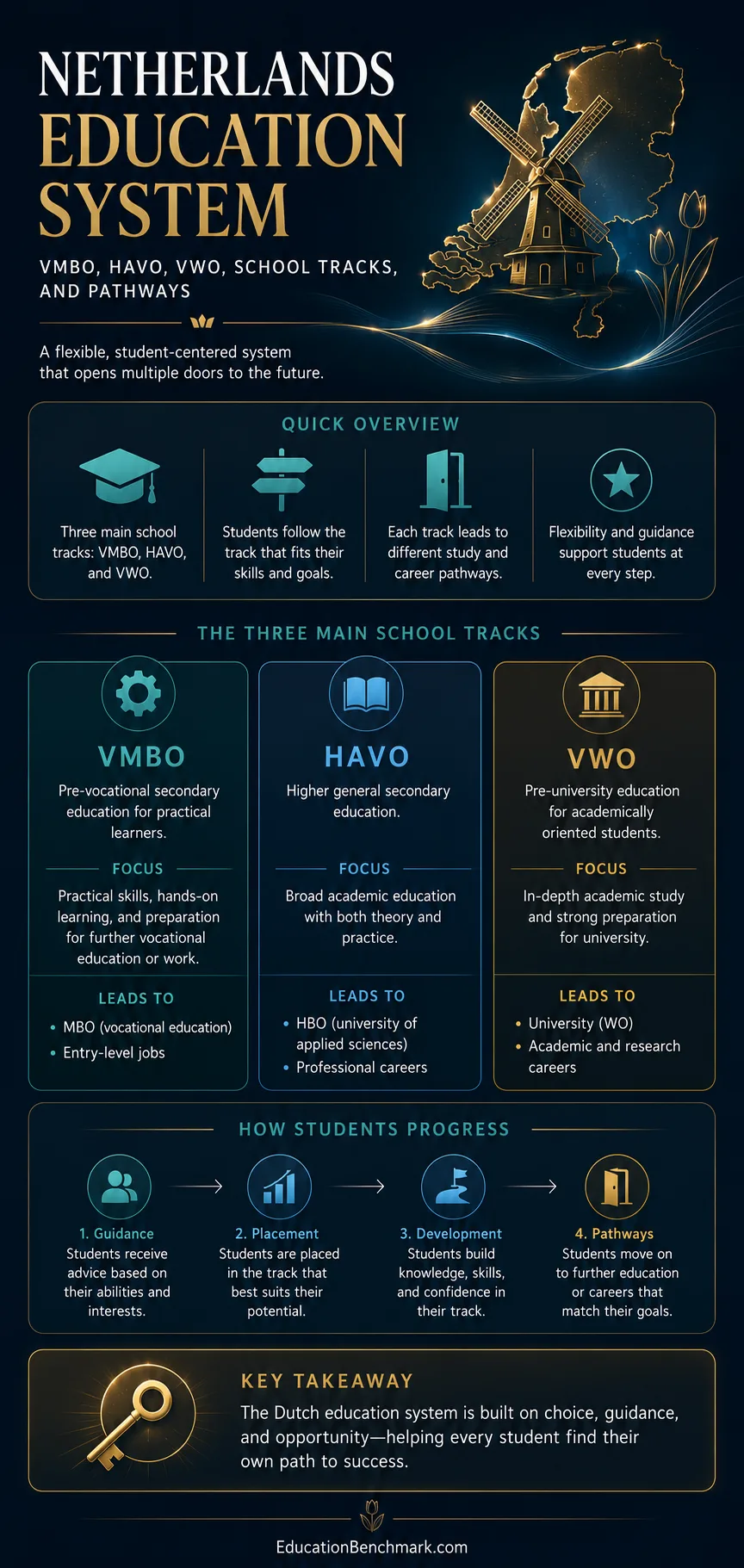
School advice opens three secondary tracks, followed by connected routes into MBO, HBO, and WO.
School Advice
Selected stamp: School Advice. Choose another stamp to update the route card.
The Dutch education system separates pupils into different secondary routes after primary school, but it is not a sealed ladder. VMBO, HAVO, and VWO indicate different programme orientations, pacing, subject depth, and usual destinations. Pupils may later transfer, add a higher secondary diploma, or move through MBO and HBO before reaching further study.
The first route decision
The Group 8 Decision: Schooladvies and the Doorstroomtoets
Secondary placement begins with professional school advice rather than a single national score.
In groep 8, the final year of primary school, the basisschool first issues a provisional schooladvies. Pupils then take the doorstroomtoets, a national transition test used as a second source of evidence. If the test indicates a higher route, the primary school normally adjusts the advice upward; it may keep the earlier advice only when it explains why an adjustment would not serve the pupil. Secondary schools place pupils according to the final advice and cannot use extra general ability tests to lower that placement. [a]
The school considers attainment, development, classroom observations, work habits, and other pupil information.
Advice may name one level, such as HAVO, or a combination such as HAVO/VWO.
The test provides a second national measure and may support an upward revision.
The secondary school accepts the advised level, then decides the precise class within its own provision.
A recommendation such as VMBO-TL/HAVO or HAVO/VWO allows the secondary school to place a pupil in a mixed bridge class when that option exists. The school’s class structure may therefore delay the final route choice.
Ages and route length
From Groep 1 to the Three Secondary Tracks
Age ranges describe the usual uninterrupted route; individual entry, repetition, acceleration, and transfer can change them.
Children may enter primary school at age four and must attend from age five. [b] Full-time compulsory attendance applies through age 16, followed by a qualification duty for many 16- and 17-year-olds until they obtain a basic qualification such as HAVO, VWO, or MBO level 2. [c]
The usual route consists of eight primary groups, then four years of VMBO, five years of HAVO, or six years of VWO. Nuffic’s diploma descriptions also show how each secondary qualification connects to the next formal level. [d] An independent country profile describes the same system as early secondary differentiation followed by vocational, applied, and research-oriented progression routes. [e]
| Stage | Dutch term | Typical age | Normal duration | Usual next step |
|---|---|---|---|---|
| Primary education | Basisonderwijs, groepen 1–8 | About 4–12 | 8 years | VMBO, HAVO, VWO, practical education, or a combined class |
| Pre-vocational secondary | VMBO | About 12–16 | 4 years | MBO; HAVO is possible from eligible VMBO routes |
| Senior general secondary | HAVO | About 12–17 | 5 years | HBO; VWO is also possible |
| Pre-university secondary | VWO | About 12–18 | 6 years | WO or HBO |
The end of compulsory attendance and the end of a school route are not always the same. A VMBO diploma is a recognised secondary qualification, yet it is not itself the basic qualification used for the post-16 qualification duty. The usual continuation is therefore MBO, HAVO, or another approved route.
Pre-vocational secondary education
Inside VMBO: Four Leerwegen and the Profile Choice
VMBO is one school type with four learning pathways, not one uniform programme.
VMBO lasts four years. During the route, the balance between general subjects and occupation-oriented study differs by leerweg. Pupils choose a learning pathway by the end of year 2. VMBO-BB and VMBO-KB include substantial vocational content, VMBO-GL combines general and vocational study, and VMBO-TL is largely general and theoretical. Theoretical VMBO is still often called mavo in ordinary conversation. [f]
Profiles Within VMBO
In the basic, middle-management, and combined pathways, pupils may choose from ten vocational profiles, including construction and interior, production and energy, mobility and transport, media and ICT, maritime and technology, health and welfare, economics and enterprise, hospitality and recreation, green studies, and services and products. VMBO-TL uses four broader profiles: technology, health and welfare, economics, and green studies. Schools do not necessarily offer every profile.
VMBO-GL and VMBO-TL graduates may continue to HAVO when they have passed the final examination with an extra general subject. Without that extra subject, the receiving school may apply its own admission conditions. This makes subject planning in the final VMBO years relevant for pupils who want to keep the HAVO route open.
General secondary routes
HAVO and VWO: Four Profielen, Different Destinations
HAVO and VWO share a profile system, but their duration and main higher education destinations differ.
HAVO lasts five years and mainly prepares pupils for HBO. VWO lasts six years and mainly prepares pupils for WO. In the upper phase, both routes use four subject profiles: cultuur en maatschappij (culture and society), economie en maatschappij (economics and society), natuur en gezondheid (nature and health), and natuur en techniek (nature and technology). [g]
| Feature | HAVO | VWO |
|---|---|---|
| Full Dutch name | Hoger algemeen voortgezet onderwijs | Voorbereidend wetenschappelijk onderwijs |
| Normal duration | 5 years | 6 years |
| Profile choice | C&M, E&M, N&G, or N&T | C&M, E&M, N&G, or N&T |
| Main destination | HBO at a hogeschool | WO at a university; HBO also remains available |
| Further secondary option | Progression to VWO | VWO is the highest regular secondary route |
School Examinations and Central Examinations
VMBO, HAVO, and VWO diplomas are awarded through track-specific examination programmes. Many subjects combine a school examination component with a national central examination, while some subjects are completed through school assessment alone. Passing rules include conditions for the average central examination result and for specified core subjects; the exact requirements depend on the route and examination year. The College voor Toetsen en Examens publishes the official rules and schedules through Examenblad. [h]
HAVO and VWO are the tracks. C&M, E&M, N&G, and N&T are upper-phase subject packages inside those tracks. Programme admission in higher education may depend on both the diploma level and the subjects completed.
Transfer routes
HAVO–VWO Transfers and Diploma Stacking
The tracked structure permits later movement, though the timing and curriculum fit matter.
A pupil with a HAVO diploma may continue to VWO without extra admission conditions and normally enters year 5 of VWO. [i] Transfers can also occur within the upper phases of HAVO and VWO. Schools decide which completed assessments or subjects can carry over because course overlap, teaching sequences, and examination plans are not identical. [j]
This route adds a VWO diploma before entry to WO or another destination.
The school reviews curriculum overlap, completed work, and possible subject exemptions.
A transfer may require catching up in subjects or assessment components not completed in the earlier route.
Movement before the final diploma is less uniform than movement based on a completed qualification. Promotion standards, bridge classes, and internal transfer policies appear in the school guide or examination regulations. A route that exists nationally may therefore look different in two secondary schools.
Vocational progression
From VMBO to MBO: Levels 1–4, BOL, and BBL
MBO is the main continuation after VMBO and combines occupational study with practical training.
MBO, or middelbaar beroepsonderwijs, has four qualification levels. Level 1 is an entry or assistant route, level 2 provides basic vocational training, level 3 prepares students for independent occupational work, and level 4 includes middle-management and specialist programmes. Prior education determines which level a student may enter. A level 4 MBO diploma gives access to HBO. [k]
An entry programme for students who do not meet the prior-qualification conditions for levels 2–4.
A basic vocational qualification and one of the credentials counted as a basic qualification.
Training for occupations in which graduates carry out work with greater independence.
A higher MBO qualification leading to skilled work and eligibility for HBO.
BOL and BBL Describe How MBO Is Delivered
Students also choose between two learning modes. In the school-based pathway, BOL, professional practice accounts for at least 20% and no more than 60% of the programme. In the work-based pathway, BBL, students spend at least 60% of the programme in professional practice. Both routes lead to the same type of recognised MBO diploma when the same qualification is completed. [l]
Most learning time is organised through the MBO institution, alongside required workplace practice.
The workplace carries the larger share of the programme, supported by lessons at the MBO institution.
Higher education routes
HBO and WO: Applied and Research-Oriented Higher Education
The Dutch higher education system has two main sectors with different teaching aims and normal entry diplomas.
HBO is higher professional education, usually delivered by a hogeschool or university of applied sciences. WO is research-oriented education delivered by universities. HBO bachelor’s programmes normally take four years, while WO bachelor’s programmes normally take three years. Associate degree programmes form a shorter HBO route, and both sectors may offer master’s programmes. [m]
The normal entry routes are HAVO, VWO, or MBO level 4, subject to programme requirements.
The normal direct route is VWO, though institutions may accept other qualifications through defined admission routes.
Diploma Level Is Only Part of Admission
A qualifying diploma does not guarantee entry to every programme. A course may require a particular HAVO or VWO profile, specified subjects, a portfolio, an aptitude process, or selection under numerus fixus. Current national guidance uses Studielink for applications and lists 1 May as the standard bachelor’s application date and 15 January for numerus fixus programmes. Applicants should verify the date, diploma conditions, and selection method for the intended academic year directly with the institution. [n]
The distinction should not be read as a simple quality ranking. HBO centres professional preparation and applied learning; WO centres academic disciplines, research methods, and theory-led study.
School governance
Public-Authority and Bijzondere Schools Under One Funded System
School identity and school funding do not follow the same public-private divide found in many countries.
The Netherlands distinguishes public-authority schools from privately run bijzondere scholen, which may be based on a religious, philosophical, or educational ethos. Both categories can receive public funding when they meet statutory conditions. Public-authority schools are open to all and are not based on a particular belief; municipalities must ensure access to sufficient public education. [o]
This division explains why two publicly funded schools may differ in educational approach, religious identity, bilingual provision, combined bridge classes, VMBO profiles, or internal promotion rules while still operating within national law.
Where details may differ
What Must Be Checked for a Specific Pupil or Programme
The national route labels are stable, but the route available to one pupil depends on the school and programme. A secondary school may not offer every VMBO profile, every foreign language, gymnasium, bilingual teaching, or every mixed bridge class. Promotion standards and internal transfers also appear in school-level documents.
Higher education conditions can change by programme and intake year. Profile requirements, subject prerequisites, selection methods, language evidence, and application dates should be checked with the hogeschool, university, Studielink guidance, or the relevant official authority before an application is submitted.
Education Benchmark is an independent informational guide and is not affiliated with any ministry of education, school authority, exam board, university, government agency, or official ranking organization. School placement, examinations, diploma rules, and admissions can change, so decisions should be confirmed through the responsible school, institution, examination body, or government education source.
Sources and Verification
- [a] Schooladvies toelating voortgezet onderwijs | Rijksoverheid.nl — Used for provisional advice, the doorstroomtoets, upward revision, and secondary placement rules. (Reliable because it is a specific Dutch central government education page.)
- [b] Registering a child with a primary school | Government.nl — Used for primary school entry from age four and compulsory attendance from age five. (Reliable because it is an official Government of the Netherlands page.)
- [c] Youth and employment | Government.nl — Used for the qualification duty to age 18 and the credentials counted as a basic qualification. (Reliable because it is an official Government of the Netherlands page.)
- [d] Primary and secondary education | Nuffic — Used for stage duration, typical ages, diploma names, profiles, and normal progression. (Reliable because Nuffic is the Dutch organisation for internationalisation and diploma information.)
- [e] Netherlands Education System (2026): Structure, Quality, and Performance — Used as a secondary cross-check for the overall route description and comparative reading. (Reliable as an independent country-focused education reference, but not a substitute for official rules.)
- [f] Hoe zit het vmbo in elkaar? | Rijksoverheid.nl — Used for VMBO duration, the four leerwegen, profiles, and the VMBO-to-HAVO condition. (Reliable because it is a specific Dutch central government education page.)
- [g] Senior general secondary education (HAVO) and pre university education (VWO) | Government.nl — Used for HAVO and VWO duration, purpose, lower phases, and upper-phase subject structure. (Reliable because it is an official Government of the Netherlands education page.)
- [h] Exameneisen | 2026 — Used for current central examination passing conditions and route-specific examination checks. (Reliable because Examenblad is the official central examination portal of the College voor Toetsen en Examens.)
- [i] Hoe zit de havo in elkaar? | Rijksoverheid.nl — Used for progression from a completed HAVO diploma to VWO. (Reliable because it is a specific Dutch central government education page.)
- [j] Kan ik binnen de bovenbouw overstappen tussen havo en vwo? | Rijksoverheid.nl — Used for upper-phase transfers and school decisions on exemptions or carried assessment. (Reliable because it is a specific Dutch central government education page.)
- [k] Uit welke mbo-opleidingen kan ik kiezen? | Rijksoverheid.nl — Used for the four MBO levels, programme types, admission relationships, and the role of level 4 qualifications. (Reliable because it is an official Dutch government education page.)
- [l] Secondary vocational education | Nuffic — Used for the BOL and BBL workplace proportions and diploma equivalence. (Reliable because Nuffic provides institutional education-system and diploma descriptions.)
- [m] Higher education | Nuffic — Used for the HBO–WO distinction, associate degrees, normal bachelor’s duration, and common entry diplomas. (Reliable because Nuffic provides institutional descriptions of the Dutch education system and qualifications.)
- [n] Studiekeuze en toelating – Onderwijs | Rijksoverheid.nl — Used for Studielink, standard application timing, numerus fixus timing, and programme selection. (Reliable because it is current Dutch central government higher education guidance.)
- [o] Public-authority and private schools | Government.nl — Used for school categories, equal public funding conditions, and municipal responsibility for public-authority provision. (Reliable because it is an official Government of the Netherlands page on freedom of education.)