
Kazakhstan Route Passport: Lyceums, NIS, UNT, and Admission
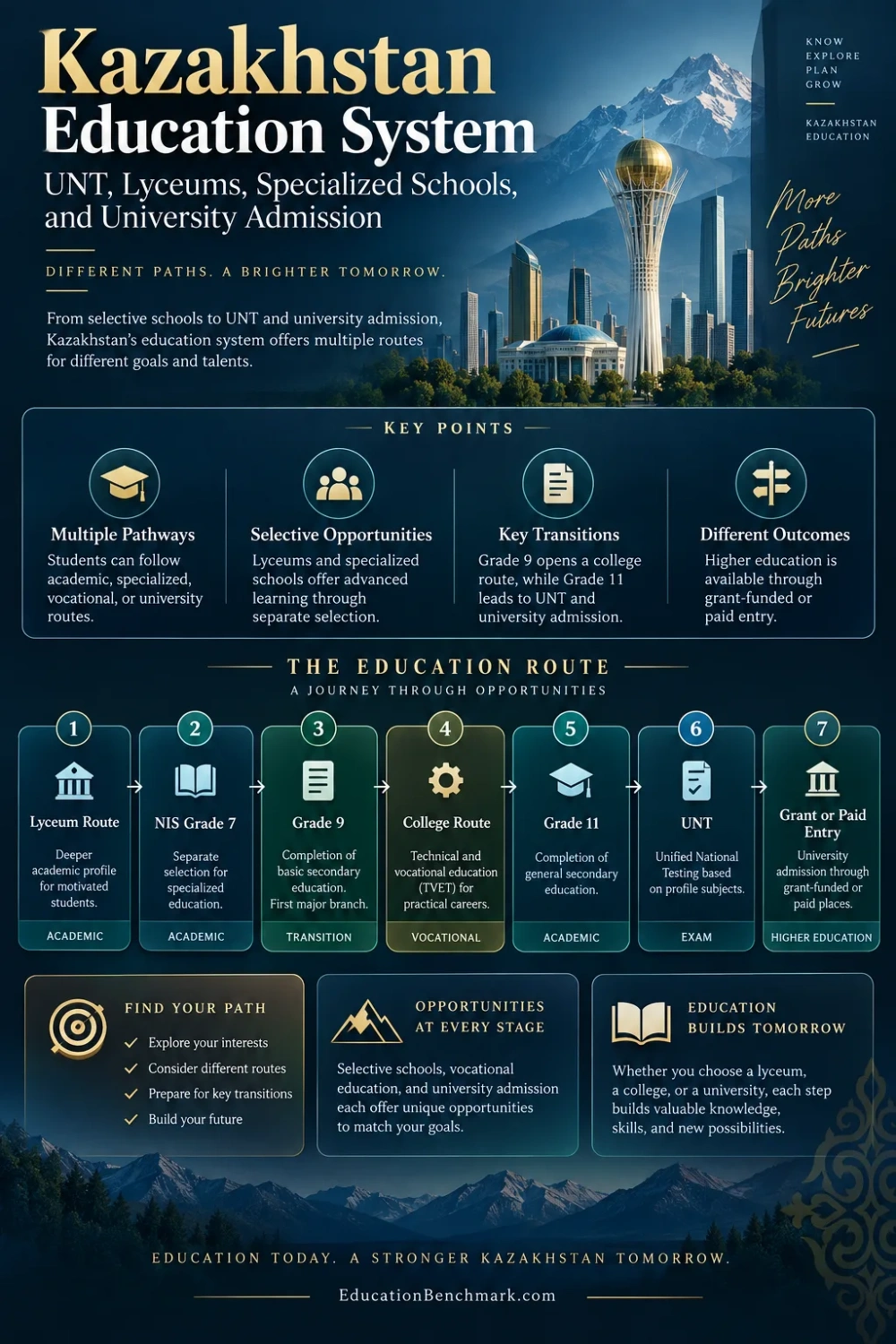
The route branches before university: selective schools can reshape secondary study, Grade 9 opens a college route, and UNT choices narrow higher-education options.
Lyceum Route
Selected stamp: Lyceum Route. Choose another stamp to update the route card.
Kazakhstan’s education route becomes clearer when three processes are kept separate: moving through school, entering selective schools, and qualifying for higher education. A learner may stay in a mainstream school, enter a lyceum or another specialized institution, or compete for a place in Nazarbayev Intellectual Schools. Later, school completion and the Unified National Testing (UNT) serve different purposes, and university admission adds its own program-matching and score rules.
The most useful way to read the system is therefore as a sequence of decision points rather than a single straight line. Grade 9 opens a technical and vocational route, selective schools can use different admissions, Grade 11 leads to school completion, and the UNT controls much of the standard undergraduate entry route.
School route
The Grade 9 Split in Kazakhstan’s 1–4 / 5–9 / 10–11 Route
Kazakhstan’s government education portal places primary education in Grades 1–4, basic secondary in Grades 5–9, and general secondary in Grades 10–11(12). It also states that secondary education is compulsory and that children enter Grade 1 from age six. [a]
| Stage | Grades or entry point | What follows |
|---|---|---|
| Primary education | Grades 1–4; Grade 1 from age 6 | Progression into basic secondary education |
| Basic secondary education | Grades 5–9 | General secondary school or a technical and vocational route |
| General secondary education | Grades 10–11(12) | School completion, then higher education or another post-school route |
| Technical and vocational education | After basic or general secondary education | Occupational qualification, employment, or possible further study |
The parenthetical “12” in official descriptions should not be turned into a blanket claim that every learner follows a universal twelve-grade path. For most readers, the more useful transition is Grade 9: it is where the ordinary school route can continue into general secondary education or branch into technical and vocational education.
School types
Lyceum, Gymnasium, and Specialized School Are Not Interchangeable Labels
Kazakhstan’s education law defines a lyceum as an institution offering general and additional programs in basic and general secondary education with enhanced, in-depth natural-mathematical study suited to students’ aptitudes and abilities. The same law recognizes secondary school, gymnasium, lyceum, and specialized school as distinct types of secondary education organization. [b]
Admission rules reinforce these differences. For Grades 10 and 11, lyceum and gymnasium admission is governed by the institution’s charter rather than the normal service-area rule used for ordinary schools. Admission to specialized educational organizations is competitive, while some named school networks have their own procedures. The model rules also treat Bilim-Innovation lyceums separately from the standard one-round selection used by other specialized educational organizations. [c]
This makes the school name informative, but not sufficient. The exact grade of entry, testing method, available places, and subject profile must be checked at the institution level.
NIS Grade 7 Selection: What the 2026–2027 Competition Measured
Nazarbayev Intellectual Schools (NIS) use a separate Grade 7 selection process for the presidential Orken educational grant. For the 2026–2027 intake, documents were accepted from January 5 to February 9, 2026, and selection testing was scheduled for March 27–28. The test ran over two days and assessed mathematics, quantitative reasoning, natural science, and language literacy. [d]
NIS selection
Two Testing Days, Two Different Skill Sets
Mathematics: 40 items in 60 minutes. Quantitative Reasoning: 60 items in 30 minutes. Natural Science: 20 items in 30 minutes.
Sixty items are completed in 120 minutes across the first language, second language, and English reading-literacy sections.
Threshold does not mean a guaranteed NIS place. For the Orken competition, the 2026–2027 booklet required at least 140 of 400 points in Mathematics and 120 of 300 in Quantitative Reasoning. Candidates who met those section thresholds still had to rank highly enough on total score within the number of grants available.
Final Attestation in Grades 9 and 11 Is Not the UNT
Kazakhstan separates school-level final attestation from the university-entry test. In the 2025–2026 school year, Grade 9 final attestation consisted of four written examinations scheduled from May 29 to June 11, 2026. Grade 11 final attestation ran from June 2 to June 15 and consisted of five examinations, including an oral exam. [e]
Two different gates
School Completion and University Admission Serve Different Purposes
Used to complete the relevant secondary-education level and obtain the school completion document when requirements are met.
Used in the standard undergraduate admission route, including eligibility for the state educational grant competition.
The distinction matters because a school graduate is not using one test for both purposes. Final attestation closes the school stage; the UNT is then evaluated under higher-education admission rules.
UNT 2026: 120 Questions, 140 Points, and Two Profile Subjects
The 2026 UNT format remained unchanged: three mandatory subjects plus two profile subjects, 120 questions in total, a maximum score of 140, and 240 minutes of testing time. The main UNT ran from May 10 to July 10, 2026. Applicants in the main session could test twice and use one of the resulting certificates for the state-grant competition or paid admission. [f]
UNT structure
How the 120 Questions Are Divided
History of Kazakhstan: 20. Reading Literacy: 10. Mathematical Literacy: 10.
Profile Subject 1: 40. Profile Subject 2: 40.
The question count and the maximum score are different measures; the complete test contains 120 questions but can yield 140 points.
The two profile subjects carry more than scoring weight. They also determine which degree-program groups can be selected later.
Program eligibility
The Two UNT Profile Subjects Define Which Degree Groups Are Open
Kazakhstan’s e-government university-enrollment service states that an applicant may choose only educational program groups whose profile-subject combination matches the combination shown on the UNT certificate. The service applies a related matching rule to shortened study routes based on vocational and special disciplines. [g]
The chosen combination becomes part of the applicant’s UNT record.
Only program groups matched to that combination remain selectable under the standard route.
A matching combination is necessary, but the applicant must still meet the applicable score and university requirements.
A high total score therefore cannot repair a profile-subject mismatch for a program group that requires a different combination. This is one of the main reasons the UNT subject decision belongs earlier in the university-planning sequence than the final application itself.
An UNT “Pass Score” Has Three Layers
For the 2026 admission cycle, the national floor was 65 points for national universities and 50 for other universities. Higher field thresholds applied to Pedagogical Sciences and Law at 75 points and Healthcare at 70. Applicants also needed at least 5 points in History of Kazakhstan and each profile subject, plus at least 3 in Reading Literacy and Mathematical Literacy. Universities were allowed to set higher thresholds for individual educational program groups. [h]
- Subject minimums: a total score is not enough if one of the required UNT sections falls below its own minimum.
- National overall threshold: the institution type or field of study sets the next floor.
- University or program threshold: an institution can require more than the national minimum for a particular program group.
A 72-point score shows why the layers matter. It is above the 65-point national-university floor and the 50-point floor for other universities, but it is below the 75-point national threshold for Pedagogical Sciences and Law. It could also be below a university’s own program threshold. Clearing one layer does not clear every layer.
Nor does an eligible score guarantee a state educational grant. The grant route adds competition after the applicant has already satisfied the subject combination and threshold rules.
From Main UNT to Enrollment: The 2026 Admission Calendar
The 2026 undergraduate cycle placed the main UNT between May 10 and July 10, the state educational grant application window from July 13 to July 20, grant results by August 10, and final university enrollment by August 25. These dates describe the 2026 cycle and should not be treated as permanent annual dates. [i]
- Complete the school route. A Grade 11 graduate first completes the applicable final-attestation requirements.
- Take the main UNT. The 2026 main session allowed two attempts.
- Keep the usable certificate. The applicant uses an eligible result for the next admission step.
- Match the profile subjects. The educational program group must correspond to the UNT profile combination.
- Check every score layer. Subject minimums, the national threshold, and any university-set threshold all matter.
- Choose the funding route. An eligible applicant may enter the state-grant competition or follow the applicable paid-admission route.
- Complete enrollment. The university still requires its admission documents and any program-specific examinations or conditions.
For the standard school-graduate route, minimum eligibility, university eligibility, and grant success are three different outcomes. Confusing them can make a score look more decisive than it really is.
Where Kazakhstan Admission Rules Still Vary
Several parts of the route cannot be reduced to one national number or one school rule. Lyceums can apply institution-level charter rules; specialized schools can use competitive selection; NIS publishes its own cycle; universities can raise program thresholds; and programs requiring creative or special preparation can add separate examinations.
- Check the current school or network notice before relying on an older lyceum, specialized-school, or NIS admission pattern.
- Check the current UNT cycle before relying on prior-year testing dates or application windows.
- Confirm that the UNT profile-subject combination still matches the intended educational program group.
- Check the university’s own threshold and any creative or special examination requirement after the national minimum has been met.
Education Benchmark is an independent informational guide and is not affiliated with any ministry of education, school authority, exam board, university, government agency, or official ranking organization. School-selection rules, UNT conditions, program-group mappings, grant procedures, and university thresholds can change, so decisions affecting an application should be checked against the responsible school, testing body, university, or government education service.
Sources and Verification
- [a] Education in Kazakhstan — Used for the school-stage structure, Grade 1 entry age, compulsory secondary education, and the Grade 9/TVET branch. (Reliable because it is an official Government of Kazakhstan information page.)
- [b] On Education – “Adilet” LIS — Used for the legal definition of a lyceum, recognized secondary-school types, and specialized education context. (Reliable because Adilet is Kazakhstan’s official legal information system.)
- [c] On approval of the Model Rules for Admission to studies in educational organizations, implementing general educational curricula of primary, basic secondary and general secondary education – “Adilet” LIS — Used for lyceum, gymnasium, and specialized-school admission rules. (Reliable because it is an official legal text in Kazakhstan’s Adilet system.)
- [d] Information booklet for candidates and their parents about administration of the competitive selection of students for Grade 7 of Nazarbayev Intellectual schools for the 2026–2027 academic year — Used for NIS Grade 7 testing dates, test sections, timing, and Orken grant thresholds. (Reliable because it is an official Nazarbayev Intellectual Schools admissions booklet.)
- [e] Final Attestation — Used for the 2025–2026 Grade 9 and Grade 11 final-attestation schedule and exam counts. (Reliable because it is an official gov.kz education authority page.)
- [f] Applications for the Main UNT 2026 Will Begin on April 11 — Used for the 2026 UNT structure, question counts, maximum score, test duration, main testing period, and two-attempt rule. (Reliable because it is an official Ministry of Science and Higher Education announcement.)
- [g] Acceptance of documents and enrollment in higher and (or) postgraduate education institutions for study in higher education programs — Used for the rule linking UNT profile-subject combinations to selectable educational program groups. (Reliable because it is Kazakhstan’s official e-government enrollment service.)
- [h] Kazakhstan Universities Begin Accepting Applicant Documents on June 20 — Used for 2026 national UNT thresholds, section minimums, and the rule allowing universities to set higher program thresholds. (Reliable because it is an official Ministry of Science and Higher Education announcement.)
- [i] Undergraduate Applicant’s Guide — Used to verify the 2026 main UNT, state-grant application, grant-result, and enrollment dates in an active university admissions calendar. (Reliable because it is the current admissions guide of Satbayev University.)