
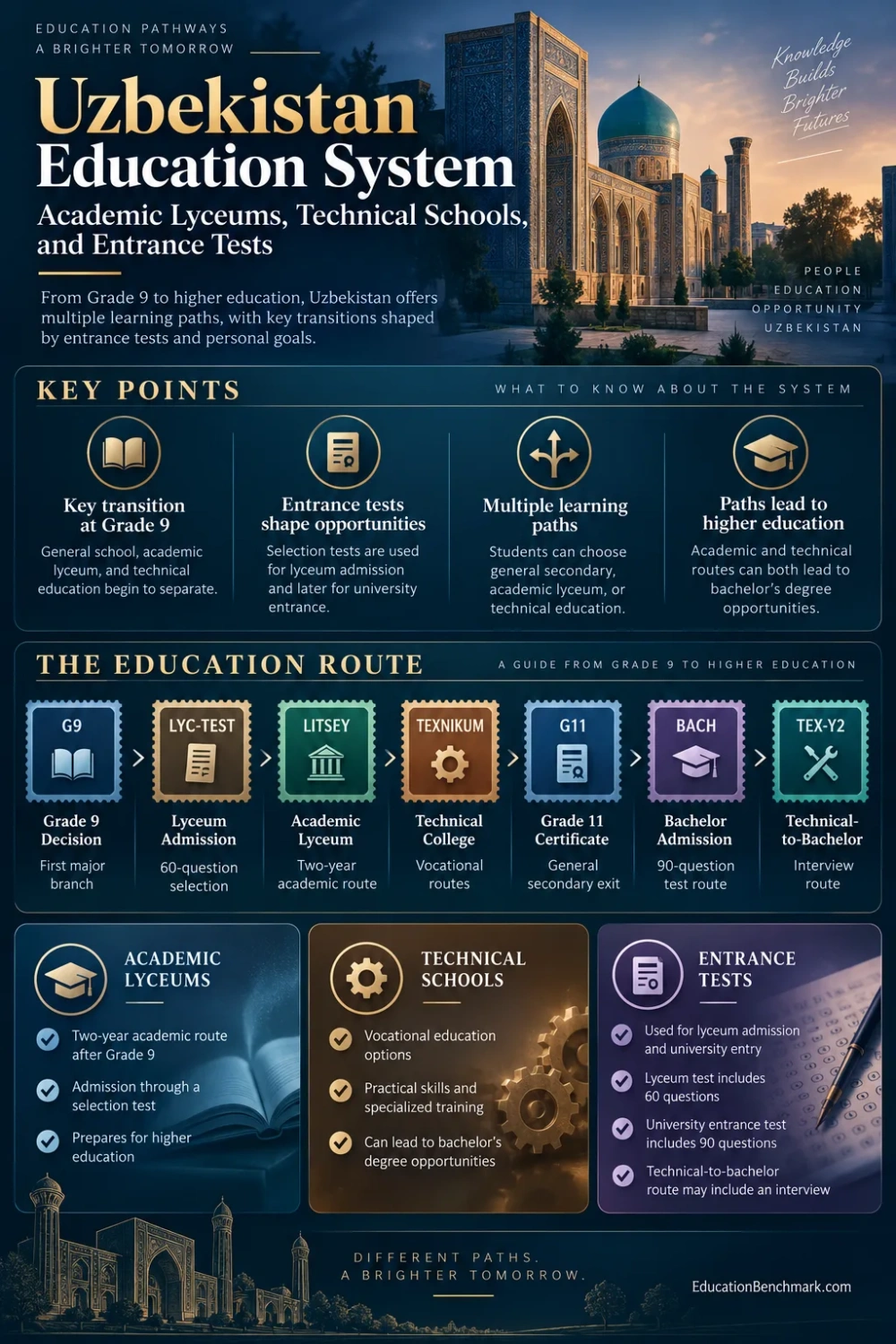
Uzbekistan Route Passport: Grade 9 to Higher Education
The main route turns at Grade 9, where general school, academic lyceum, and technical education begin to separate before later admission choices.
Grade 9 Decision
Selected stamp: Grade 9 Decision. Choose another stamp to update the route card.
Uzbekistan’s education route becomes most distinctive after Grade 9. A student can remain in general secondary school, compete for a place in an academic lyceum, or enter an eligible technical-education route. Those choices are not simply different names for the same upper-secondary stage: they use different admission rules, emphasize different kinds of study, and connect to higher education in different ways.
General secondary school starts with Grade 1 in the year a child turns seven under the national school-admission rule.[a] For the later stages most relevant here, official certification distinguishes a basic secondary education certificate after Grade 9 from a general secondary education certificate after Grade 11.[b]
Grade 9 Is the Main Branching Point
Grade 9 is where the Uzbek route begins to branch in a way that matters for later admission. Continuing in the same general secondary school leads toward Grades 10 and 11. Applying to an academic lyceum creates a more selective, subject-focused academic route. Technical education provides a separate vocational direction, but its admission base is not uniform: current programs include routes for both Grade 9 and Grade 11 graduates.
Grade 9 decision map
Three Routes That Begin to Separate After Grade 9
The routes are parallel choices rather than consecutive steps. A student normally follows one main upper-secondary path at a time.
Remain in general secondary education, complete Grade 11, and later use the relevant higher-education or vocational admission route.
Compete through the academic lyceum entrance process, then study for two years in an approved academic direction.
Choose an occupation-focused program where Grade 9 entry is available, including selected technical and international programs.
This makes Grade 9 more than a school-completion checkpoint. It is also a routing point. The appropriate next step depends on the student’s intended type of study and on the admission rules attached to the chosen institution or program.
Academic Lyceum: A Two-Year Route After Grade 9
An academic lyceum, or akademik litsey, is a two-year upper-secondary route built around deeper study in selected subjects. Official university-linked lyceums describe two-year directions in areas such as foreign languages and social-humanities, while other lyceums offer combinations centered on mathematics, physics, biology, chemistry, languages, law, or related academic fields.[c]
The academic lyceum should not be confused with an ordinary general school or with a technical college. General school keeps the broad Grade 10–11 route. The lyceum concentrates more heavily on an approved academic direction. A texnikum is primarily vocational and can include workplace-linked or occupation-specific education.
Upper-secondary choice
General School, Academic Lyceum, and Texnikum Compared
Academic lyceums are therefore best understood as an academically concentrated alternative to staying in the ordinary Grade 10–11 route, not as a university qualification and not as a vocational college.
How the 2026/2027 Academic Lyceum Entrance Test Works
For 2026/2027 admission, the Ministry of Higher Education, Science and Innovation set a 60-question entrance test with a maximum score of 146. Forty questions come from two subjects tied to the chosen study direction, while 20 questions assess intellectual ability.[d]
Academic lyceum test
2026/2027 Scoring Structure
The two academic subjects depend on the direction selected by the applicant.
| Test component | Questions | Points per correct answer | Maximum points |
|---|---|---|---|
| Direction subject 1 | 20 | 3.1 | 62 |
| Direction subject 2 | 20 | 3.1 | 62 |
| Intellectual ability | 20 | 1.1 | 22 |
| Total | 60 | — | 146 |
The Subject Pair Depends on the Chosen Direction
There is no single subject pair used by every academic lyceum applicant. The two high-value subject components correspond to the approved direction. A mathematics-physics route, for example, does not use the same subject pairing as a biology-chemistry or foreign-language route.
Preference Order Affects Placement
The test score is only one part of placement. For 2026 admission, applicants were considered according to their first, second, and third academic-lyceum preferences. A score sufficient for the first choice places the result there; otherwise the system checks the second and then the third choice. If two or more applicants tie for the final available place in the same direction, all of them are admitted under the published rule.[e]
Placement sequence
How the Three Lyceum Preferences Are Read
- First choice: if the score reaches the required level, placement is determined for that direction.
- Second choice: considered when the score is insufficient for the first choice but sufficient for the second.
- Third choice: considered when the first two choices are out of reach but the third is attainable.
This structure makes the order of choices meaningful. Two applicants with the same overall score can face different placement outcomes if they list different lyceums or directions in a different order.
What “Technical School” Means in Current Uzbek Admissions
The Uzbek term texnikum is often rendered as technical college on official English-language government pages. Current policy also uses the specific English label Advanced Vocational Skills Technical Schools for a group of institutions admitting Grade 9 graduates. The wording matters because “technical school” is not one single admission category with one national entry rule.
Some Technical Routes Start After Grade 9
For 2026/2027, written examinations were held for Grade 9 graduates applying to 14 Advanced Vocational Skills Technical Schools with 1,400 places and to international education programs at 21 technical schools with 1,710 places. The published examination period was August 26–28, 2026.[f]
This current Grade 9 route is one reason it is inaccurate to describe all Uzbek technical education as something that begins only after Grade 11.
Grade 11 Opens a Much Larger Technical-College Admission Route
For applicants holding general secondary education at Grade 11 level, the 2026/2027 cycle covered initial, secondary, and specialized secondary vocational programs in full-time, evening, and dual forms. The approved parameters covered 641 technical colleges and 134,960 places, of which 61,550 were state-funded. The distribution was 87,700 full-time places, 4,440 evening places, and 42,820 dual places.[g]
2026/2027 technical admissions
The Grade 11 Route Includes Several Study Formats
Institutions included in the published Grade 11-based admission parameters.
Approved places across the covered vocational programs and study formats.
A substantial route combining technical education with a dual study format.
Places identified as state-funded in the published admission parameters.
Admission also differs by program. The 2026/2027 announcement states that entrance tests for other Grade 11-based technical colleges are conducted as written examinations. Full-time local programs in medical technical colleges use a separate competition process linked to higher-education selection results, while evening, dual, and international medical-technical programs follow their stated vocational admission process.
Grade 9 and Grade 11 Final Exams Are Not Entrance Tests
Uzbekistan uses final state attestation to complete school stages, but these examinations should not be confused with academic lyceum admission or bachelor admission. For the 2025/2026 school year, Grade 9 final attestation included language and literature or the state-language examination, mathematics, History of Uzbekistan, and physical education. Grade 11 students had compulsory language, mathematics, and History of Uzbekistan examinations plus a required elective examination chosen from the approved subject list.[h]
What readers often confuse
School Completion and Competitive Admission Serve Different Purposes
Confirms completion of the relevant school stage and contributes to the student’s school-leaving record.
Determines competition for a selected academic lyceum, bachelor program, or technical program where an entrance examination applies.
A Grade 9 student can therefore complete final state attestation and still face a separate academic lyceum admission test. The same distinction applies at Grade 11: completing general secondary school does not itself allocate a university place.
Bachelor Admission Uses 90 Questions and a 189-Point Maximum
For the 2026/2027 admission cycle, the standard bachelor entrance test contains 90 questions across five subjects. Thirty questions cover three compulsory subjects for every applicant: native language, mathematics, and History of Uzbekistan. The other 60 questions come from two subjects associated with the selected bachelor program. The maximum possible score is 189.[i]
Bachelor admission test
2026/2027 Question and Point Structure
The two program subjects vary according to the bachelor field selected in the admission system.
| Component | Questions | Points per correct answer | Maximum points |
|---|---|---|---|
| Native language | 10 | 1.1 | 11 |
| Mathematics | 10 | 1.1 | 11 |
| History of Uzbekistan | 10 | 1.1 | 11 |
| Program subject 1 | 30 | 3.1 | 93 |
| Program subject 2 | 30 | 2.1 | 63 |
| Total | 90 | — | 189 |
The compulsory native-language component can be taken in Uzbek, Russian, or Karakalpak under the published 2026/2027 criteria. The two program-specific subjects account for 156 of the 189 available points, so the chosen bachelor direction determines most of the possible test score.
“Test First, Then Choose” Changes the University Application Sequence
State higher-education admission follows a two-stage process. For 2026/2027, Stage 1 ran from June 5 through June 25 and covered test registration, subject combination, language of instruction, and testing region. Applicants whose route included a professional or creative examination also selected the institution where that examination would be taken.[j]
Stage 2 takes place within 15 days after admission testing is fully completed. This is when applicants choose the higher-education institution, bachelor program, form of study, and admission priority. The sequence is therefore different from a system where an applicant fixes one university-program choice before sitting the main national test.
Bachelor admission sequence
The Score Comes Before the Final Program Choice
- Register for testing: select the subject combination, test language, and testing region.
- Complete the relevant examinations: standard testing and any applicable professional or creative examination.
- Choose after testing: select the institution, bachelor program, study form, and admission priority during Stage 2.
- Compete for placement: the final outcome reflects the score, selected priorities, available places, and applicable admission rules.
This two-stage design also helps explain why school-leaving examinations and university admission must be treated separately. One certifies completion of school; the other allocates places through a later competitive process.
A Texnikum Can Still Lead Into a Bachelor Program
A technical-college qualification does not always end the higher-education route. In the 2026 admission process, successful technical-college graduates could apply for admission to the second year of a corresponding bachelor program through an interview. Eligible graduates had to have semester grades of 4 or 5, with at least 50% of grades at 5; the threshold was 85% for medical fields. An interview average of at least 67 points was required for recommendation to fee-contract admission from the second year.[k]
The rule applies only where the technical field corresponds to an eligible bachelor program and does not cover every higher-education institution. The published exclusions include higher military and paramilitary institutions, Tashkent State University of Law, and foreign or non-governmental higher-education organizations operating in Uzbekistan and their branches.
Technical-to-higher route
The Interview Route Is Conditional, Not Automatic
The academic record must meet the stated grade conditions for the relevant applicant category.
The published route requires an average interview score of 67 or higher.
Successful applicants may be recommended for fee-contract study beginning from the second bachelor year.
Two Reforms Should Not Be Confused With the Current Grade Structure
The New Preparation Stage Does Not Simply Add a Grade 12
A 2026 reform provides for the one-year school-preparation program to become the first stage of compulsory general secondary education. From the 2027/2028 academic year, children who complete the preparatory groups are expected to receive a state-issued electronic certificate, with the information entered into their later general secondary education certificate.[l]
This should not be read as a simple instruction that every student now attends a newly numbered Grade 12 after Grade 11. The reform concerns the formal status of the preparation year before Grade 1, while the current certificate system still identifies Grade 9 and Grade 11 as the two secondary-school certification points.
Unified Grade 9 and Grade 11 State Exams Have Been Announced as a Reform Direction
Uzbekistan has also announced a move toward unified state examinations for Grades 9 and 11, with Grade 9 results intended to help route students toward vocational education or continued higher-education preparation. The announcement also stated that recognized international language and subject certificates would be considered in final examinations.[m]
The distinction between an announced reform and the examinations actually used in a given school year matters. The 2026 final state attestation rules were still published with specific Grade 9 and Grade 11 subject examinations. Admission rules should therefore be checked for the exact year in which a student is applying.
Where official details may vary
Admission Rules Are Published by Cycle and Program
Academic lyceum subject combinations, technical-college places, examination dates, university subject pairs, study formats, funding categories, and special progression routes can change between admission cycles. Institution-level requirements can also differ within the same broad route.
Education Benchmark is an independent informational guide and is not affiliated with any ministry of education, school authority, exam board, university, government agency, or official ranking organization. Students making an admission decision should verify the current cycle with the responsible government body, testing agency, school, lyceum, technical college, or university.
Sources and Verification
- [a] General Secondary School Admission — Used for the rule that children enter Grade 1 in the year they turn seven. (Reliable because it is official government education guidance.)
- [b] Electronic Certificates of General Secondary Education — Used for the Grade 9 basic secondary and Grade 11 general secondary certificate structure. (Reliable because it is official government guidance based on the national certificate regulation.)
- [c] Academic Lyceum — Tashkent State University of Oriental Studies — Used to verify the two-year academic-lyceum study period and examples of academic directions. (Reliable because it is an official public university page describing its academic lyceum.)
- [d] #admission2026 #academic_lyceum — Used for the 2026/2027 academic lyceum test structure, question counts, and 146-point maximum. (Reliable because it is an official Ministry of Higher Education, Science and Innovation admission announcement.)
- [e] Procedure for Determining Academic Lyceum Admission Test Results Based on Preference Order — Used for first-, second-, and third-choice placement logic and the rule for tied applicants at the final place. (Reliable because it is an official ministry admission notice.)
- [f] Written Exams Have Begun at Technical Schools! — Used for the 2026 Grade 9 written-exam routes in Advanced Vocational Skills Technical Schools and international programs. (Reliable because it is an official Vocational Education Agency announcement.)
- [g] Admission to Vocational Education Institutions for Applicants With General Secondary Education — Used for Grade 11-based technical-college admission, study formats, written examinations, and 2026/2027 admission-place figures. (Reliable because it is an official Vocational Education Agency announcement.)
- [h] Final State Attestation Exam Dates for Grades 9 and 11 in 2026 — Used for the subjects assigned to Grade 9 and Grade 11 final state attestation in the 2025/2026 school year. (Reliable because it is an official Ministry of Preschool and School Education announcement.)
- [i] Number of Test Questions and Assessment Criteria for the 2026/2027 Academic Year Bachelor’s Admission — Used for the five-subject, 90-question bachelor admission test and the 189-point scoring structure. (Reliable because it is an official Ministry of Higher Education, Science and Innovation announcement.)
- [j] Attention Applicants! — Used for the two-stage 2026/2027 bachelor admission sequence, June registration period, and post-test program selection. (Reliable because it is an official announcement from the national assessment agency.)
- [k] Admission to the 2nd Year of Study for Technical School Graduates Based on an Interview Has Begun — Used for the academic-record requirements, interview threshold, second-year entry rule, and exclusions. (Reliable because it is an official digital-government publication from the national assessment agency.)
- [l] Further Improvements to the Preschool Education System Discussed — Used for the reform making the one-year preparation program the first stage of compulsory general secondary education and the planned electronic certificate from 2027/2028. (Reliable because it is an official government publication.)
- [m] Respect for the Teachers and Opportunities for the Youth – Foundation of the Country’s Future — Used for the announced move toward unified state examinations for Grades 9 and 11 and the intended use of results in student routing. (Reliable because it is an official publication of the President of Uzbekistan.)