Czech School Route Passport
A Czech route map built around basic school, early Gymnázium entry, secondary admissions, vocational credentials, Maturita, and tertiary study.
Základní škola
Selected stamp: Základní škola. Choose another stamp to update the route card.
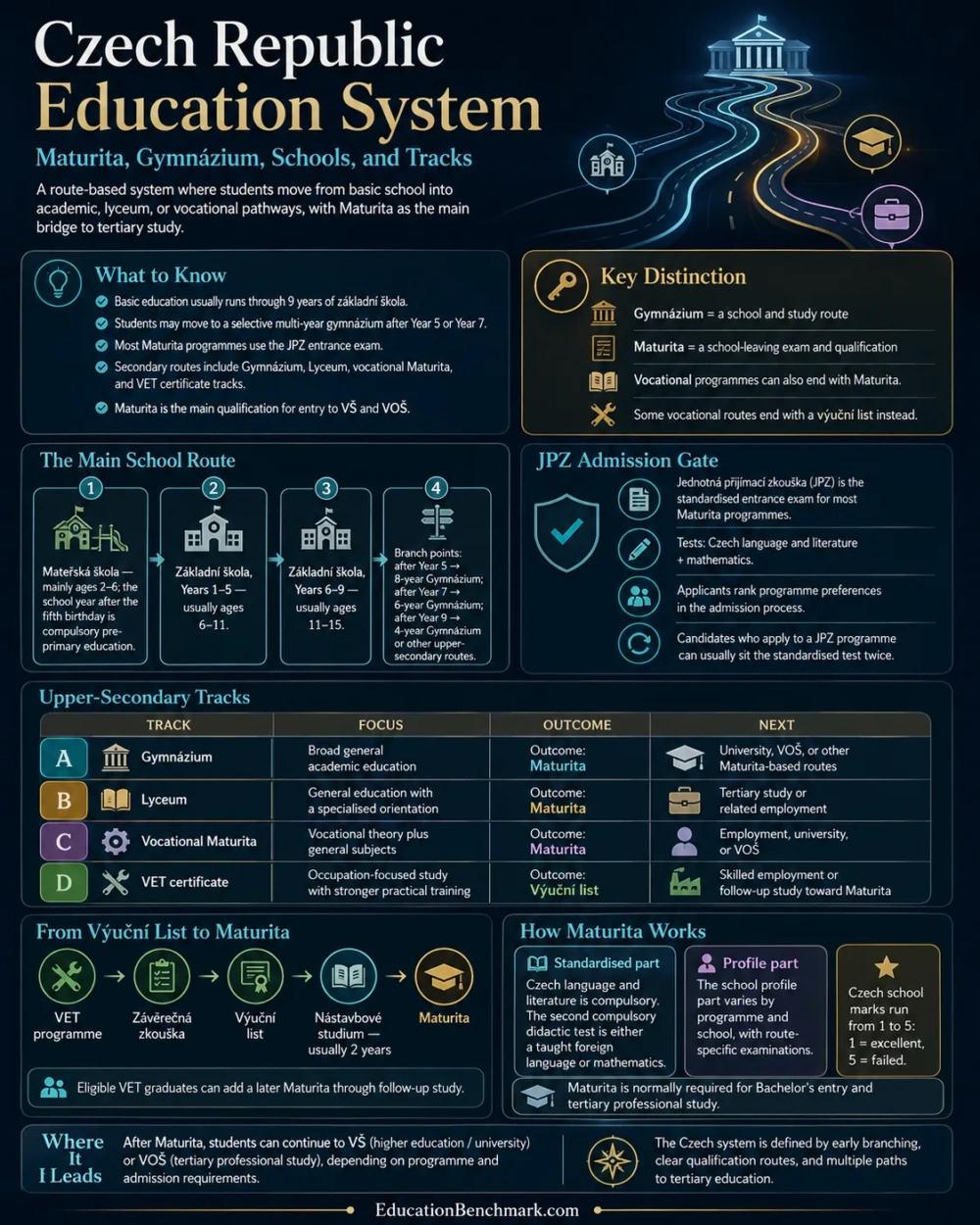
Czechia’s school system is best understood as a route with several branching points rather than a single ladder. Nine years of basic education normally run through základní škola, but some pupils move after Year 5 or Year 7 into a selective víceleté gymnázium. After compulsory schooling, students can enter general, lyceum, Maturita-bearing vocational, or VET-certificate programmes. The qualification that connects most secondary routes to tertiary study is the maturitní zkouška, usually called Maturita. [a]
A useful distinction runs through the whole system: Gymnázium is a school and study route; Maturita is an examination and qualification outcome. A vocational programme can also finish with Maturita, while another vocational route may finish with a výuční list. That difference matters more than the label “vocational” by itself.
Early secondary tracking
How Students Can Leave Základní Škola for Víceleté Gymnázium
The Czech route can branch before Year 9, which is why six-, eight-, and four-year Gymnázium programmes coexist.
The programme begins while the pupil is still completing compulsory lower-secondary education.
The first part replaces the remaining years that would otherwise be completed at základní škola.
This is the standard general upper-secondary route entered after basic education.
An eight-year Gymnázium does not mean eight extra years after basic school. Its lower years correspond to the final four years of basic education; the six-year version covers the final two basic-school years before continuing into upper-secondary study. The route therefore changes where the pupil completes lower-secondary education, not the total number of compulsory school years.
What Readers Often Confuse
The English word “gymnasium” can suggest a sports hall. In Czech education, gymnázium is a general academic secondary school. A multi-year Gymnázium may also educate pupils who are still completing compulsory schooling.
Basic-school route
The Standard Route Through Základní Škola
Basic education combines a first stage and a second stage, with early Gymnázium entry available at defined transition points.
| Stage | Typical age or entry point | Years | Route meaning |
|---|---|---|---|
| Mateřská škola | Mainly ages 2–6 | Pre-primary | The school year following the fifth birthday is compulsory pre-primary education. |
| Základní škola — first stage | Usually ages 6–11 | 1–5 | Most pupils remain in basic school; Year 5 can lead to an eight-year Gymnázium application. |
| Základní škola — second stage | Usually ages 11–15 | 6–9 | Year 7 can lead to a six-year Gymnázium application; Year 9 is the main upper-secondary transition. |
| Víceleté gymnázium — lower level | After Year 5 or Year 7 | Corresponding lower-secondary years | Compulsory lower-secondary education continues inside a selective general secondary school. |
Compulsory schooling is normally aligned with the nine-year basic-education route. Upper-secondary education is not itself compulsory, even though progression to secondary school is the normal next step. This makes Year 9 the main transition for most pupils, while the Year 5 and Year 7 Gymnázium gates create earlier academic selection for a smaller route.
Secondary selection
The JPZ Gate Into Maturita Programmes
The Jednotná přijímací zkouška (JPZ) is the standardised entrance examination used in the first admission round for most secondary programmes that lead to Maturita. It tests Czech language and literature and mathematics and its applications. In the general rule, the JPZ result must account for at least 60% of the overall admission evaluation; sports-training Gymnázium programmes use a lower minimum share. Talent-exam fields and specified special cases follow different arrangements. [b]
The application system also matters because applicants do not simply collect independent offers and choose later. Under the current process, an applicant can list up to three ordinary secondary programmes plus up to two programmes with a talent examination or a conservatoire, and the choices are ranked by preference. Applications can be submitted electronically through DiPSy or on the prescribed paper form. A candidate who applies to a programme requiring the JPZ can normally sit the standardised test twice, regardless of the number of applications. [c]
This preference logic makes the order of programmes part of the placement process. The school still publishes its admission criteria and may add permitted school-level criteria or its own examination where applicable, but the national test and ranked application structure create a common admissions layer across Maturita programmes.
Secondary choices
Gymnázium, Lyceum, and Vocational Tracks Compared
The credential attached to the field of education is more informative than the school name alone.
| Route | Main orientation | Typical secondary outcome | What can follow |
|---|---|---|---|
| Gymnázium | Broad general academic education | Maturita | University, VOŠ, or other routes requiring Maturita |
| Lyceum | General education with a specialised or vocational orientation | Maturita | Tertiary study or employment related to the field |
| Vocational Maturita programme | Vocational theory with general subjects; some programmes include practical training | Maturita | Employment, university, or VOŠ |
| VET certificate programme | Occupation-focused study with a stronger practical component | Výuční list after the VET final examination | Skilled employment or, where eligible, follow-up study toward Maturita |
Czech upper-secondary fields are grouped into categories that help explain these differences. General Gymnázium courses belong to category K. Category M contains vocational Maturita programmes and also lyceum fields, where the share of general education is higher and study is oriented strongly toward later tertiary education within a specialisation. Category L also leads to Maturita but includes practical training. Category H contains three-year VET-certificate programmes, while category E includes two- or three-year VET-certificate programmes designed for learners with particular educational needs. [d]
A lyceum should not be treated as another name for Gymnázium. Technical, economics, pedagogical, health-care, science and other lyceum fields combine broad general study with a defined orientation. Gymnázium is more purely general-academic. This difference also appears later in the school-controlled part of Maturita.
School Name Is Not the Whole Qualification
Czech secondary schools can offer more than one registered field and more than one qualification level. A name such as střední odborná škola may indicate a vocational profile, but the actual field determines whether the programme ends with Maturita, a VET certificate, or another secondary outcome.
Vocational progression
From Výuční List to Maturita: Nástavbové Studium
A VET certificate can be an employment qualification and, for eligible graduates, a step toward a later Maturita.
Occupation-focused study combines school learning with vocational preparation.
Passing the final VET examination leads to the relevant certificate documents and výuční list.
Follow-up study normally lasts two years and is designed to add Maturita-level secondary education.
Successful completion can reopen routes that require secondary education completed with Maturita.
Nástavbové studium is the formal follow-up route for applicants who have completed qualifying three-year programmes with a VET certificate. It normally lasts two years and ends with Maturita. The result is not a replacement of the original vocational qualification: a graduate can hold both the výuční list and secondary education completed with Maturita. Eligibility depends on the preceding field and the follow-up programme, so not every certificate route should be treated as identical. [e]
School-leaving examination
Maturita: State Tests and the School Profile Part
Maturita is nationally regulated, but the complete examination package is not identical for every student.
Czech language and literature is compulsory. The second compulsory test is either a taught foreign language or mathematics.
Czech and, where relevant, foreign-language profile components are joined by compulsory examinations set according to the study programme.
The profile part is where the student’s route becomes visible. Gymnázium students normally take two or three compulsory profile examinations. Lyceum students also take two or three, with at least one in the vocational area. In upper-secondary vocational education and conservatoires, the profile package contains three compulsory examinations, including vocational theory and a practical examination or graduation thesis with defence. Other permitted forms include oral and written examinations.
How Czech Grades Relate to Maturita Results
Ordinary upper-secondary school marks run from 1 to 5: 1 is excellent, 2 very good, 3 good, 4 satisfactory, and 5 failed. The direction is easy to misread for readers used to systems where a larger number means a stronger grade.
The standardised Maturita didactic tests are assessed centrally and reported as passed or failed together with a percentage result. The profile part uses school-based examination grading. A normal report-card mark and a result on the common Maturita test are therefore not the same kind of measurement. [f]
2026 Maturita Examination Windows
The common-part spring didactic tests ran from 4–7 May 2026. The autumn common-part window is 1–10 September 2026. Profile examinations have wider school-organised periods, including 16 May–10 June in the main spring window and 1–20 September in autumn; some spring written or practical profile examinations may begin earlier under the official calendar. [g]
Tertiary progression
From Maturita to VŠ or Vyšší Odborná Škola
For entry to a Bachelor’s programme at a Czech higher education institution, secondary education completed with Maturita is the normal qualifying school credential. Maturita does not guarantee admission. A university or faculty can set further conditions connected to knowledge, abilities, previous achievement, talent, or the needs of the programme; some programmes use entrance examinations while others may admit on different published criteria. [h]
Vysoká Škola and Vyšší Odborná Škola Are Different Tertiary Routes
Vysoká škola (VŠ) is the higher education route that includes Bachelor’s and other university-level degree programmes. Vyšší odborná škola (VOŠ) provides professionally oriented non-university tertiary education. Maturita is an admission requirement for the standard VOŠ route, and programmes combine professional study with practice.
VOŠ study is not simply another form of upper-secondary vocational school. It belongs to tertiary education. Traditional day programmes are commonly three years, with some health-related programmes extending to three and a half years. Completion is through absolutorium; graduates of the relevant accredited programmes receive the title diplomovaný specialista (DiS.), written after the name. Current reforms are also changing the mix and length of available VOŠ programme types, so the exact programme should be checked before treating three years as universal. [i]
Rules and school autonomy
Who Sets Czech School Rules and Where Variation Appears
Czech education combines national law and national curricular requirements with a notable degree of decentralisation and school autonomy. The Ministry of Education, Youth and Sports operates at central level; regional authorities and municipalities carry responsibilities at their respective levels, while school heads make many institution-level decisions within national rules. Regions have an especially visible role in the upper-secondary network because they establish many public secondary schools and tertiary professional schools. [j]
This division explains why two schools offering the same broad qualification can differ in specialisation, optional subjects, parts of admission criteria, the exact profile Maturita package, and practical arrangements. National rules create the qualification boundaries; schools and organising bodies shape much of the delivery.
Current rule changes
Maturita, Lyceum, and Curriculum Changes Now Moving Through the System
Recent Education Act changes have widened the possible form of the profile part of Maturita. Under the new provisions, a complex profile project can be used, and an internationally recognised certificate may substitute for an examination or part of it under the applicable conditions, with the possibility extending beyond languages to areas such as ICT. A new Lyceum field is also being trialled as a more flexible general-vocational route in which students can delay part of their specialisation choice.
Basic-school curriculum revision is being phased in rather than switched on nationwide in one step. Voluntary use of the revised national curriculum documents began for Years 1 and 6 in September 2025. Mandatory use for those years is scheduled for the 2027/28 school year, with all grades scheduled to follow from 2031/32. The 2026 postponement and subsequent adjustments show why curriculum dates should be verified when a family or school decision depends on them. [k]
Vocational delivery is changing as well. From 1 January 2026, practical training in secondary VET can be provided through authorised dual practical-education providers, including in-company training where the provider meets the required conditions. Combined study arrangements with distance elements have also been introduced for parts of the vocational and tertiary professional sector. [l]
Where Official Details May Vary
Admission criteria, application dates, Maturita profile subjects, accepted certificate substitutions, vocational practice arrangements, and tertiary entry rules can change by school year, field, school, or institution. Decisions about an individual application should be checked against the current information from the relevant school, CERMAT, Ministry, university, or other responsible authority.
Education Benchmark is an independent informational guide and is not affiliated with any ministry of education, school authority, exam board, university, government agency, or official ranking organization.
Research basis
Sources and Verification
- [a] Organisation of the Education System and of its Structure — Used for the nine-year basic-school route, compulsory pre-primary stage, multi-year Gymnázium entry points, and the main qualification paths. (Reliable because Eurydice is the European education policy network and the Czech country material is maintained through its national unit.)
- [b] Jednotná přijímací zkouška 2026 – Cermat — Used for the scope of the JPZ and its role in admission to Maturita programmes. (Reliable because CERMAT administers the national standardised secondary admission examination.)
- [c] Organisation of upper secondary education — Used for DiPSy application methods, preference ranking, application limits, admission criteria, and the two-attempt JPZ rule. (Reliable because Eurydice documents current national education structures and procedures.)
- [d] Teaching and learning in upper secondary education — Used for Gymnázium, lyceum, Maturita-bearing vocational, and VET-certificate field categories and their educational orientation. (Reliable because the page is part of the official Eurydice country profile.)
- [e] Glossary – European Union — Used to verify Czech qualification terminology and the meaning of nástavbové studium as follow-up study leading toward Maturita. (Reliable because it is the Czech terminology reference within Eurydice.)
- [f] Assessment in upper secondary education — Used for Maturita structure, profile-exam differences by route, VET certification, and the Czech 1–5 grading scale. (Reliable because Eurydice records the statutory assessment and certification structure for Czech upper-secondary education.)
- [g] Maturitní kalendář — Used for the official 2026 spring and autumn Maturita examination windows. (Reliable because CERMAT publishes and administers the national Maturita timetable.)
- [h] Bachelor — Used for the relationship between Maturita and Bachelor admission and for institution-level additional admission conditions. (Reliable because Eurydice documents statutory Czech higher-education admission rules.)
- [i] Programmes outside the bachelor and master structure — Used for VOŠ status, admission basis, programme forms, absolutorium, and the DiS. qualification. (Reliable because it is the Eurydice reference for Czech tertiary professional education.)
- [j] Administration and Governance at Central and/or Regional Level — Used for the division of education administration among the Ministry, regional authorities, municipalities, and schools. (Reliable because Eurydice maps the statutory governance responsibilities of the Czech system.)
- [k] National reforms in general school education – European Union — Used for current Maturita profile options, the Lyceum trial, and the phased basic-school curriculum changes. (Reliable because Eurydice tracks enacted and scheduled Czech education reforms and cites the responsible national bodies.)
- [l] National reforms in vocational education and training – Eurydice — Used for the 2026 dual practical-education and combined-study changes in vocational education. (Reliable because Eurydice records current Czech VET legislation and implementation changes.)