
Georgia Education System: 11+1 Reform, Grades, Unified National Exams, and Vocational Routes
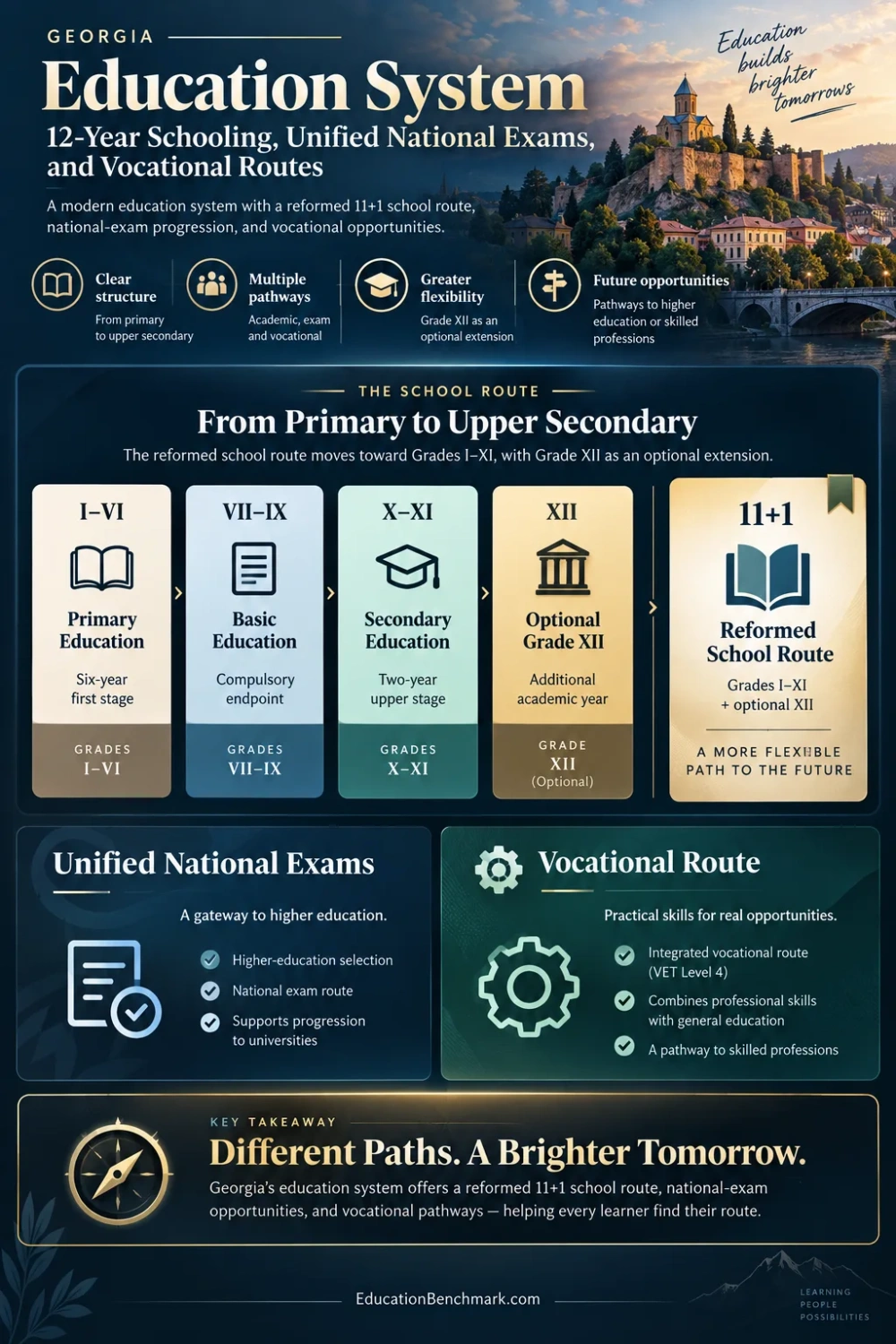
The 2026 reform establishes Grades I–XI as the main general education route, retains an additional Grade XII, and applies separate completion rules to transitional cohorts.
Reformed School Route
Selected stamp: Reformed School Route. Choose another stamp to update the route card.
Georgia's school system is moving from a standard 12-year sequence to an 11+1 general education structure. Law No. 1353 of 4 February 2026 amended the Law on General Education to define complete general education as no fewer than 11 and no more than 12 years: six years of primary education, three years of basic education, two years of secondary education, and an additional Grade XII. The reform changes the school-leaving point for eligible students, while transitional provisions preserve different requirements for some pupils already following the earlier sequence. [a]
Reformed school structure
Georgia's 11+1 Reform Replaces a Fixed 12-Year Route
The term 11+1 describes the reformed route, although it is a shorthand rather than the formal legal name. Grades I–XI form the new main sequence leading to complete general education, while Grade XII remains available as an additional year under the applicable rules.
The amendment was adopted by the Parliament of Georgia on 4 February 2026. It was published in Georgia's Legislative Herald on 5 February 2026. Article 2 defines the revised education levels, Article 6 addresses completion of general education, and Article 62² sets out the transitional arrangements for students affected by the changes. [b]
| Stage | Grades | Length | Position in the route |
|---|---|---|---|
| Primary education | I–VI | 6 years | First compulsory school stage |
| Basic education | VII–IX | 3 years | Completes the compulsory general-education sequence |
| Secondary education | X–XI | 2 years | Main reformed route to complete general education |
| Additional year | XII | 1 year | Optional under the reform timetable, with separate transitional obligations for certain cohorts |
The new structure does not retroactively place every student on an identical 11-year route. The student's academic year and previous grade classification determine which completion requirements apply. A pupil who previously studied Grade X as part of basic education, for example, cannot automatically be treated as having completed the same secondary stage as a student enrolled in Grade X under the revised structure.
The amended law also permits certain foreign-language general education programmes to use different stage durations, provided their total duration remains between 11 and 12 years. This allows variation in programme organization without changing the overall statutory range.
Reform transition
Who Still Needs Grade XII? The 2026–2029 Cohort Transition
Article 62² of the Law on General Education establishes separate arrangements for pupils moving between the former and revised school structures.
Article 62² also provides for annual external-study arrangements after 2028 for people who remain subject to certain earlier Grade XII completion requirements. The law includes provisions for pupils who completed secondary Grade X in 2025–2026 and continue into Grade XI, as well as individual administrative decisions for cases not otherwise covered. [c]
The transition creates an unusual higher-education admission cycle. The Ministry states that Grade XI and Grade XII school-leavers will finish at the same time for the 2028–2029 higher-education intake, and state-university admission quotas are planned to double for that cycle. School-organized preparation for national examinations in Grade XI is also part of the reform arrangements. [d]
These measures concern different cohorts reaching school completion at the same time. They do not mean that every student in the 2026–2027 school year can leave after Grade XI or that an older Grade XII obligation disappears when the revised structure begins operating.
Grade progression
Grades I–XI: Entry Age, Compulsory Boundary, and School Progression
Under the general entry rule introduced by the 2026 reform, a child starts Grade I at age six if the sixth birthday falls on or before 15 September. Assuming uninterrupted annual progression, pupils are usually around ages 6–11 in Grades I–VI, 12–14 in Grades VII–IX, and 15–16 in Grades X–XI.
These ages are estimates rather than separate statutory age requirements for each grade. Actual placement may differ because of entry dates, repeated years, interruptions, transfers, or individual school decisions.
| Grades | Approximate ages | Education level | Main transition |
|---|---|---|---|
| I–VI | About 6–11 | Primary | Progression to Grade VII |
| VII–IX | About 12–14 | Basic | End of compulsory general education; academic or eligible vocational progression follows |
| X–XI | About 15–16 | Secondary | Complete general education under the applicable cohort rules |
| XII | About 17 | Additional secondary year | Optional further study where applicable, or completion of a transitional Grade XII requirement |
For international comparisons, these ages can be used as starting points when checking age-based grade equivalents in another country's system. Grade numbers alone do not establish equivalence, especially during Georgia's transition from the former basic and secondary grade classifications.
The 2026–2027 Grade I Exception
The September 15 entry cutoff has a one-time exception for the 2026–2027 academic year. By parental decision, children who turn six from 16 September through 31 December 2026 may also enter Grade I voluntarily. Parliament described this as a transitional exception rather than a permanent change to the general entry rule. [e]
Primary and basic education form the compulsory part of the general education route. Under the revised structure, Grade IX is the normal completion point for basic general education. Students can then continue through Grades X–XI or meet the education prerequisite for certain vocational programmes.
The National Curriculum covers the official language, mathematics, foreign languages, social studies, sciences, technologies, aesthetic education, and sport. The February 2026 amendment also introduced compulsory uniforms for pupils at the primary level of public schools, subject to the applicable rules and health-related exemption procedure, and revised the arrangements for developing and providing school textbooks. [f]
Assessment Is Not Completely Identical Across Schools
The national curriculum allows schools room in planning teaching and assessment. Curriculum changes introduced greater autonomy in formative and summative assessment; private schools may establish grade thresholds instead of using a graded system, while schools must provide a remedial programme when a pupil's annual grade point average in a subject is below 5.0. [g]
Two different gates
School Completion and the Unified National Exams Are Not the Same Thing
Georgia separates the qualification confirming complete general education from the national selection mechanism used for higher-education admission.
Completion of the applicable general education route leads to an atestati, the document certifying complete general education. An integrated secondary vocational programme can also provide this recognition.
The UNE are prepared and conducted by the National Assessment and Examinations Center and are used for admission and placement into eligible higher-education programmes.
The Unified National Exams are not school graduation examinations. An applicant needs the appropriate general-education status or another legally accepted basis for admission, then participates in the national admissions process.
Under the Higher Education law, the National Assessment and Examinations Center (NAEC) prepares and conducts the UNE. Higher-education institutions assign coefficients to examination subjects for their programmes, so admission is not determined by comparing one unadjusted total score across every course. [h]
How the UNE Route Works
- The student obtains complete general education or another legally accepted basis for admission.
- The applicant registers for the Unified National Exams and takes the subjects relevant to the intended programmes.
- NAEC processes examination results under the national admissions rules.
- Programme-specific subject coefficients affect the ranking used to assign applicants to particular educational programmes.
- The resulting national placement process determines which eligible programme an applicant can enter.
Required examination subjects, minimum conditions, coefficients, programme capacity, and other admission rules can change between cycles. Current university and programme listings take precedence for individual applications.
The 11+1 reform changes the general school-completion route, but it does not make the UNE a substitute for the school-leaving qualification. Students belonging to an earlier cohort must also meet their applicable graduation requirements before relying on that qualification for admission.
Grade IX decision
After Grade IX: General Secondary or Integrated Level 4 VET
Georgia's vocational education structure provides a route after basic education that combines occupational preparation with general-education outcomes.
Continue through the two-year secondary stage, obtain complete general education under the applicable cohort rules, and progress toward UNE or other eligible study.
After basic general education, an eligible secondary vocational programme can integrate secondary general-education learning outcomes with vocational preparation.
Successful completion of the integrated route can provide a Level 4 vocational qualification, a diploma, and documentation certifying complete general education.
Georgia's Vocational Education law places basic vocational programmes at NQF Level 3, secondary vocational programmes at Level 4, and higher vocational programmes at Level 5. Basic VET requires at least basic general education; integrated secondary VET can admit from basic general education, while non-integrated secondary VET and higher VET require complete general education. [i]
This structure makes Grade IX a branching point. A student can remain in general school for Grades X–XI, while an eligible integrated secondary vocational programme offers another way to combine occupational preparation with the outcomes needed for complete general education.
The integrated route does not automatically guarantee entry to higher education. Subsequent admission requirements still apply, and vocational programmes must be authorized to provide the relevant integrated general-education outcomes. A standard vocational programme without that component should not be assumed to award the same school-leaving document.
The 2026 UNE-to-VET Route Adds a Second Admission Channel
A separate 2026 change connects vocational admission directly with the Unified National Exams. Candidates participating in the UNE cycle can select listed vocational education programmes, with the relevant UNE subject result used for admission instead of an additional selection procedure for that channel.
- The vocational programme determines which UNE subject is relevant to its qualification field.
- An applicant using this route must exceed more than half of the minimum competency threshold set for the corresponding UNE subject.
- The Ministry announced more than 10,000 vocational places through the new mechanism, involving both public and private providers.
- The UNE route is additional rather than exclusive: the Ministry stated that the traditional vocational admission rounds would also continue in spring and autumn.
This should not be confused with the integrated Level 4 route available after basic education. The two mechanisms operate at different points: integrated VET is an educational pathway after the basic stage, whereas UNE-to-VET is an admissions channel for candidates participating in the national examination cycle. [j]
Which Rules Need a Cohort-Specific Check?
Georgia's structural reform overlaps with earlier school routes. Several details can change the applicable requirements for an individual student:
- Academic year and current grade: These determine whether the student belongs to the revised Grades X–XI route or remains covered by transitional Grade XII provisions.
- Earlier grade classification: Grade X basic education in 2025–2026 and Grade X secondary education under the reformed structure are treated differently for recognition and progression.
- Grade I birthday: The normal September 15 cutoff and the one-time 2026–2027 exception are different entry rules.
- Higher-education programme: UNE subjects, coefficients, thresholds, capacity, and programme conditions are not necessarily identical across institutions and fields.
- Vocational programme type: Level 3, integrated Level 4, non-integrated Level 4, and Level 5 programmes have different general-education entry conditions.
Moving From Georgia to Another School System
International transfers require a distinction between the student's chronological age, completed grade, and recognized education level. A student who has completed Grade IX under the reformed Georgian structure has completed basic general education, while another student with an older Grade X record may have studied under different stage definitions.
When moving between national school systems, the receiving school may need the student's academic record, the dates of attendance, curriculum coverage, and evidence of the qualification or level completed. An age or grade-number match alone does not establish an official placement decision.
Foreign recognition and school placement are determined by the applicable receiving-country rules. Georgia's 11+1 structure should therefore be assessed together with the student's cohort and actual education record rather than treated as a uniform eleven-year history for every applicant.
Older English-language institutional pages may still describe Georgia as a fixed 12-year system or classify the basic and secondary grades differently. The current consolidated legislation and relevant transitional provisions take precedence when determining school completion, progression, or admission eligibility.
Independent Reference and Verification
Education Benchmark is an independent informational guide and is not affiliated with any ministry of education, school authority, exam board, university, government agency, or official ranking organization. Education rules can change by academic year, cohort, programme, and institution, so consequential enrollment or admission decisions should be checked against current legislation and the relevant ministry, NAEC, school, vocational provider, or higher-education institution.
Sources and Verification
- [a] The Parliament Adopted the Amendments to the Law on General Education — 4 February 2026 — Used for the 2026 reform establishing primary Grades I–VI, basic Grades VII–IX, secondary Grades X–XI, and additional Grade XII. (Reliable because it is the official Parliament of Georgia record of the adopted amendments.)
- [b] Law of Georgia No. 1353 of 4 February 2026 — Amendment to the Law on General Education — Primary legislative source for the revised 11–12 year duration, the stage boundaries, Grade XI school completion, optional Grade XII, and the amended statutory provisions. (Reliable because it is the enacted amendment published by Georgia's official Legislative Herald, Matsne.)
- [c] On General Education — Consolidated Law, Article 62² — Used for the 2025–2026 Grade IX and Grade X recognition arrangements, the exception for students entering secondary Grade X in 2026–2027, remaining Grade XII obligations, and external-study provisions. (Reliable because Matsne provides the official consolidated legislation and transitional statutory text.)
- [d] 2028–2029 State University Admission Quotas Will Double — Used for the planned simultaneous completion of Grade XI and Grade XII cohorts, the associated university admission capacity arrangements, and organized Grade XI examination preparation. (Reliable because it is an official Ministry of Education, Science and Youth announcement.)
- [e] Parliament Adopted Amendments on Grade I Enrollment for the 2026–2027 Academic Year — Used for the temporary provision allowing voluntary Grade I entry for children turning six between September 16 and December 31, 2026. (Reliable because it is the official Parliament of Georgia record of the adopted transitional amendment.)
- [f] On General Education — School Uniform and Textbook Provisions — Used for the 2026 provisions concerning primary-level public school uniforms, applicable exemptions, and the responsibilities for developing and supplying school textbooks. (Reliable because it is the consolidated General Education law published by Georgia's official Legislative Herald.)
- [g] Important Changes Were Made in the National Curriculum — Used for school assessment flexibility, private-school grading provisions, and the remedial-programme threshold below a 5.0 annual subject GPA. (Reliable because it is an official Ministry education-policy notice.)
- [h] On Higher Education — Used for NAEC's role in the Unified National Exams and the effect of programme-specific examination-subject coefficients on admission and placement. (Reliable because it is the Higher Education law published by Georgia's official Legislative Herald.)
- [i] On Vocational Education — Used for NQF Levels 3, 4 and 5, vocational programme entry requirements, and the diploma and complete-general-education outcome of integrated secondary vocational programmes. (Reliable because it is the consolidated Vocational Education law from Georgia's official Legislative Herald.)
- [j] Applicants Can Also Register for Vocational Education Programmes Through the Unified National Examinations — Used for the 2026 UNE-to-VET admission channel, the subject-threshold rule, more than 10,000 announced places, and the continuation of separate spring and autumn vocational admission rounds. (Reliable because it is an official Ministry of Education, Science and Youth announcement.)