Ireland’s Junior Cycle–Leaving Cert Route
An Irish school route shaped by Junior Cycle, optional Transition Year, Leaving Certificate choices, CAO scoring, and parallel further-education or apprenticeship paths.
Primary School
Selected stamp: Primary School. Choose another stamp to update the route card.
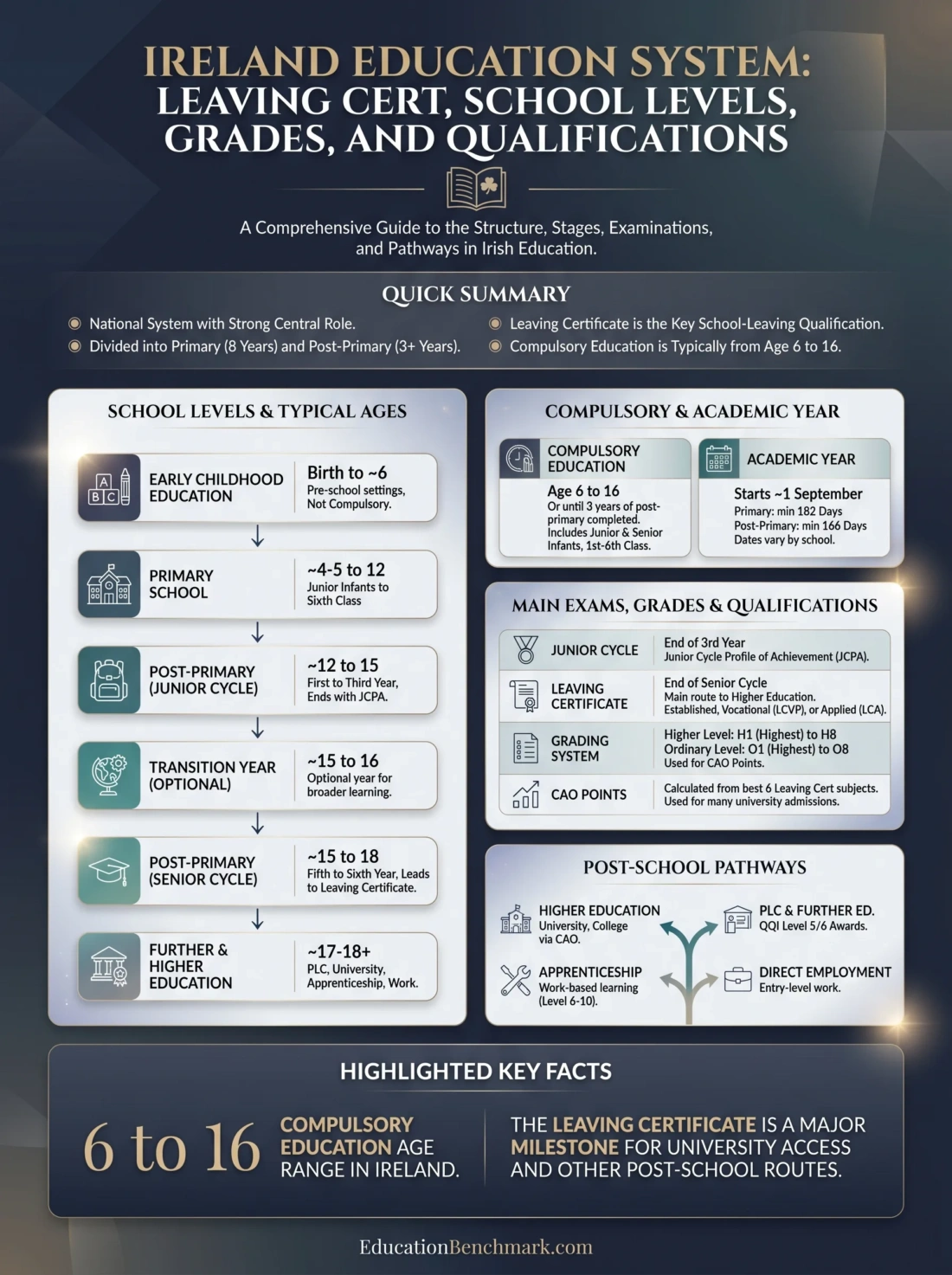
Ireland’s school system in the Republic of Ireland moves from an eight-year primary cycle into a three-year Junior Cycle and then Senior Cycle. Children commonly enter primary school at about age four or five, while post-primary education generally covers ages twelve to eighteen. Education itself becomes compulsory at age six and continues until age sixteen or until the student has completed three years of post-primary education, whichever point comes later.[a]
This page refers to the Republic of Ireland. Northern Ireland has a separate education and qualifications system. Irish terminology can also be misleading when read through another country’s grade structure: Sixth Class is still primary school, Third Year ends Junior Cycle, an optional Transition Year can sit between Third and Fifth Year, and the final school years are normally called Fifth Year and Sixth Year.
From Junior Infants to Sixth Year: The Irish School Sequence
The normal route begins with Junior Infants and Senior Infants, followed by First through Sixth Class. Students then enter post-primary school as First Year students. Junior Cycle occupies First, Second and Third Year. After Third Year, the route can split: some students take Transition Year, while others move directly to Fifth Year.
| Stage | Irish year or class | Typical age | What follows |
|---|---|---|---|
| Primary | Junior Infants | About 4–5 | Senior Infants |
| Primary | Senior Infants | About 5–6 | First Class |
| Primary | First to Sixth Class | About 6–12/13 | First Year of post-primary school |
| Junior Cycle | First to Third Year | About 12/13–15/16 | Transition Year or Fifth Year |
| Transition Year | TY | Often about 15–16 | Fifth Year |
| Senior Cycle | Fifth and Sixth Year | About 15/16–17/18 | Leaving Certificate and post-school routes |
The age column should be read as a normal pattern rather than a placement rule. Starting age and the choice to take Transition Year can shift the age attached to a particular school year.
The phrase “Fourth Year” can also cause confusion. It is commonly associated with Transition Year rather than a compulsory fourth numbered year of ordinary post-primary study. A student who does not take TY can move from Third Year directly to Fifth Year.
Attendance rule
School Entry Age and Compulsory Education Are Different Rules
Junior Infants commonly begins at age four or five, so attendance may start before the legal compulsory-education age.
The legal rule runs from age six to sixteen or until three years of post-primary education have been completed, whichever is later.
Irish post-primary schools operate under national education rules, but schools are not all managed in an identical way. Community colleges, community schools and voluntary secondary schools are among the recognised models, and patrons and boards of management have defined roles. School ethos, subject availability, Transition Year design and programme options can therefore vary even when students are following the same national stage.
Junior Cycle: JCPA, CBAs, and the Current Grade Bands
Junior Cycle is the current name for the first three years of post-primary education. Students encounter subjects, short courses or other learning experiences, Classroom-Based Assessments and state examinations. After completing the cycle, their results and wider achievements are recorded through the Junior Cycle Profile of Achievement (JCPA). The older Junior Certificate was phased out after the revised Junior Cycle subjects and short courses had been introduced.[b]
The JCPA is broader than a final examination certificate. It can record results from state examinations, Classroom-Based Assessments, relevant short courses, wellbeing and other areas of learning. This distinction matters because a student’s Junior Cycle examination descriptor is only one part of the record created across the three years.
The Grade Bands Used From 2025 Onward
Junior Cycle examination bands changed for the 2025 examinations and future years. The top four descriptors were reorganised into fifteen-percentage-point bands, lowering the Distinction boundary and narrowing the previous Merit range.[c]
The highest state-examination descriptor.
The second examination descriptor.
The middle attainment band.
Marks within the achieved range.
A separate lower descriptor band.
The lowest examination band.
Before the 2025 change, Distinction began at 90% and Higher Merit began at 75%. A page still showing those boundaries is describing the previous grading arrangement, not the current bands.
CBA Descriptors Are a Different Scale
Classroom-Based Assessments do not simply reproduce the percentage-based state-examination scale. Teachers review student work against subject-specific Features of Quality, including through Subject Learning and Assessment Review processes. The descriptor language includes Exceptional, Above Expectations, In Line with Expectations and Yet to Meet Expectations.[d]
An “Exceptional” CBA should therefore not be converted into an assumed examination percentage such as 85% or 90%. The CBA and state examination report different forms of assessment and appear within the wider Junior Cycle record.
Transition Year: Why Third Year Can Lead Straight to Fifth Year
Transition Year (TY) sits between Junior Cycle and the two core Leaving Certificate years. It is optional rather than a compulsory stage for every student. Ireland’s revised TY programme describes four broad student-development areas: personal growth, being a learner, civic and community engagement, and career development. Schools design their own TY programmes within the national programme requirements, so subject sampling, projects, work-related learning and other experiences differ between schools.[e]
The TY decision
Two Routes From Third Year to the Leaving Cert Years
The student moves directly from Junior Cycle into the two-year Leaving Certificate stage.
TY adds a separate year before the main two-year Leaving Certificate programme.
The route then leads toward a Leaving Certificate programme or another Senior Cycle programme available to the student.
This is why the Irish year names can appear to “skip” Fourth Year. Fifth Year does not mean that every student has completed four identical post-primary years first. For a student who skips TY, Fifth Year follows Third Year directly.
Leaving Certificate Routes and the 2026 LCVP Transition
The term Leaving Cert is often used as shorthand for the final phase of school, but Senior Cycle contains more than one programme. Leaving Certificate Established (LCE) is the familiar subject-based route. Leaving Certificate Applied (LCA) is a separate applied programme, while the Leaving Certificate Vocational Programme (LCVP) has combined Leaving Certificate study with Link Modules focused on enterprise and preparation for working life.
Senior Cycle routes
LCE, LCA, and the LCVP–LCW Change
Senior Cycle Assessment Is Now Cohort-Specific
Senior Cycle redevelopment is being introduced in stages rather than switching every subject at once. Students who began Fifth Year in 2025 entered revised Business, Biology, Chemistry, Physics, Arabic, Latin and Ancient Greek specifications; Drama, Film and Theatre Studies and Climate Action and Sustainable Development also began in selected schools. For students beginning Fifth Year in 2026, Construction Studies, Engineering, Geography, LCVP Link Modules and Physical Education form the next tranche. English and Accounting, which had originally been scheduled with that tranche, were delayed by at least one year. Revised subjects include externally assessed components that are not traditional written examinations.[f]
Statements such as “the Leaving Cert is now assessed in one new way” are too broad. A student’s assessment arrangement can depend on the subject being taken and the year that student entered Fifth Year.
LCVP and Life, Community and Work
A further change begins in September 2026. The Life, Community and Work (LCW) specification is listed for introduction from September 2026, while the existing 2022 LCVP Programme Statement remains available for examination through June 2027. This creates a transition period in which the student’s cohort determines which programme documentation applies.[g]
Leaving Certificate Applied Uses Its Own Award Language
LCA is not graded as an overall H1–H8 certificate. It is a two-year programme arranged in half-year sessions, with achievement credited across the programme and assessment through modules and specified final examinations. Students who successfully complete it receive an overall Pass, Merit or Distinction. Current arrangements also allow LCA students to access Leaving Certificate Established Mathematics and/or a modern foreign language, subject to school timetabling and programme arrangements.[h]
H1–H8, O1–O8, and F1–F8: Reading Leaving Cert Grades
The main Leaving Certificate grading notation combines a level letter with a grade number. H identifies Higher Level, O identifies Ordinary Level and F identifies Foundation Level where that level applies. The number runs from 1, the highest band, to 8, the lowest. The grading scale introduced in 2017 uses ten-percentage-point bands from Grade 1 through Grade 7, followed by Grade 8 below 30%.[i]
- Grade 1: 90–100%
- Grade 2: 80–89%
- Grade 3: 70–79%
- Grade 4: 60–69%
- Grade 5: 50–59%
- Grade 6: 40–49%
- Grade 7: 30–39%
- Grade 8: below 30%
This produces familiar results such as H1, H4, O2 or O6. The percentage band and the CAO value are separate concepts. A Grade 1 at Ordinary Level, for instance, does not receive the same CAO points as H1 even though both sit in the 90–100% percentage band.
Foundation Level results can also use F1–F8 notation, but Foundation results should not be assumed to carry the Higher or Ordinary Level CAO values. Course recognition of a subject and level can also matter separately from the points attached to it.
How CAO Points Work in an Irish Application
The Central Applications Office (CAO) converts eligible Irish Leaving Certificate results to the common points scale used for many undergraduate applications. The current grid awards 100 points for H1, falling through 88, 77, 66, 56, 46 and 37 for H2 through H7. At Ordinary Level, O1 begins at 56 points. Higher Level Mathematics receives a 25-point bonus for H6 or better. The bonus is included in the final total only when Mathematics, after the bonus, is among the six subjects being counted.[j]
| Higher grade | Points | Ordinary grade | Points |
|---|---|---|---|
| H1 | 100 | — | — |
| H2 | 88 | — | — |
| H3 | 77 | — | — |
| H4 | 66 | — | — |
| H5 | 56 | O1 | 56 |
| H6 | 46 | O2 | 46 |
| H7 | 37 | O3 | 37 |
| H8 | 0 | O4 | 28 |
| — | — | O5 | 20 |
| — | — | O6 | 12 |
| — | — | O7 | 0 |
| — | — | O8 | 0 |
A 500-Point CAO Calculation
Consider a student with seven eligible results:
- Higher Mathematics H2: 88 points + 25-point mathematics bonus = 113
- English H1: 100
- Biology H2: 88
- Irish H3: 77
- History H4: 66
- French H5: 56
- Geography H6: 46
The six highest scores are 113, 100, 88, 77, 66 and 56. Geography is the seventh score and is not counted. The CAO total is therefore 500 points.
Why 625 Is Possible
Six H1 results normally give 600 points. If Higher Level Mathematics is one of those six subjects, the 25-point mathematics bonus raises the total to 625. This is why 625, rather than 600, is commonly described as the highest standard Leaving Certificate CAO score.
A course can require particular subjects, levels or minimum grades before an applicant is ranked by points. A published points cut-off records a competitive admissions outcome; it is not a universal qualification threshold that overrides course requirements.
CAO processes course applications, but individual higher-education institutions set the entry requirements attached to their programmes. Some courses can also use additional assessment or selection arrangements. A points total should therefore be read together with the requirements for the exact course and institution.
NFQ Levels, PLC Courses, and Routes Beyond School
Ireland uses the NFQ to place education and training qualifications across ten levels. The structure runs from introductory awards through school, further-education and higher-education qualifications to Level 10 doctoral awards. It is designed to show the level and type of qualification rather than the school year in which a learner happens to be studying.[k]
The Irish Leaving Certificate is placed across NFQ Levels 4 and 5. QQI’s qualification profile identifies it as the final qualification stage in Irish secondary schooling and notes that it can support progression to further education at Level 5 or above or higher education at Level 6 or above.[l]
“Level 5” in the qualifications system does not mean Fifth Year in secondary school, and “Level 6” does not mean Sixth Year. The two numbering systems describe different things.
Post Leaving Certificate (PLC) courses form one major further-education route. Government information describes PLC programmes as full-time provision for school leavers and adults returning to education, generally leading to QQI Level 5 or Level 6 awards. Selected PLC awards can also provide progression opportunities into higher education.[m]
After school
Leaving Cert Does Not Lead to One Single Next Step
The Leaving Certificate ends the normal secondary-school route but can lead into several different forms of education or training.
These routes can prepare learners for employment, further study or progression to selected higher-education programmes.
Irish higher education includes Higher Certificates, bachelor degrees and postgraduate qualifications at progressively higher NFQ levels.
Apprenticeships combine employment and structured training, with entry requirements and qualification levels varying by programme.
These routes are not a single ladder that every student must climb in the same order. One student may enter a higher-education programme through CAO after Sixth Year. Another may complete a PLC before moving into higher education. Another may enter an apprenticeship or other further-training route. The Irish system therefore combines a school-leaving qualification with several post-school progression mechanisms rather than one compulsory university-entry track.
Where Rules Need to Be Checked Again
Education Benchmark is an independent informational guide and is not affiliated with any ministry of education, school authority, exam board, university, government agency, or official ranking organization.
School programme availability, Senior Cycle subject specifications, assessment arrangements, CAO course requirements and progression rules can change by cohort, school, course or institution. Decisions involving a particular student should be checked against the current Department of Education and Youth, State Examinations Commission, NCCA, CAO, QQI, school, training provider or higher-education institution information that applies to that case.
Sources and Verification
- [a] Education — Used for compulsory education, the normal primary and post-primary age pattern, school models and the Junior Cycle–Senior Cycle sequence. (Reliable because it is an official Department of Education and Youth policy page.)
- [b] Junior Cycle — Used for the current three-year Junior Cycle, Classroom-Based Assessments, state examinations, JCPA and the phasing out of the Junior Certificate. (Reliable because it is an official Department of Education and Youth publication.)
- [c] Minister McEntee announces changes to Junior Cycle grade bands — Used for the Junior Cycle grade-band changes applying from the 2025 examinations onward. (Reliable because it is the official Department announcement of the grading change.)
- [d] SLAR Meetings | NCCA — Used for Classroom-Based Assessment descriptor terminology and the Subject Learning and Assessment Review process. (Reliable because NCCA is the national body responsible for curriculum and assessment advice.)
- [e] Minister Foley welcomes publication of 12 new and revised Leaving Certificate subjects and Senior Cycle programmes — Used for the revised Transition Year programme and its four student-development dimensions. (Reliable because it is an official Department of Education and Youth publication on Senior Cycle changes.)
- [f] Senior Cycle Redevelopment – What it means for me — Used for cohort-specific 2025 and 2026 subject changes, externally assessed components, delayed English and Accounting revisions, and current LCA options. (Reliable because it is the Department’s official student-facing Senior Cycle change page.)
- [g] Leaving Certificate Vocational Programme (LCVP) | Curriculum Online — Used for the LCVP structure, the September 2026 introduction of Life, Community and Work and the examination period for the existing LCVP statement. (Reliable because Curriculum Online is the NCCA’s official curriculum portal.)
- [h] LCA | Curriculum Online — Used for the Leaving Certificate Applied structure, Pass/Merit/Distinction awards and access to LCE Mathematics and modern foreign languages. (Reliable because Curriculum Online is the NCCA’s official curriculum portal.)
- [i] Ministers Bruton, Halligan and Mitchell O’Connor wish almost 121,000 students sitting state examinations good luck — Used for the Leaving Certificate grade structure introduced with the current H, O and F notation. (Reliable because it is an official Department of Education publication describing the state-examination grading scale.)
- [j] Central Applications Office — Used for the current Leaving Certificate points grid and the 25-point Higher Level Mathematics bonus. (Reliable because CAO is the official application body operating the points calculation used for participating higher-education courses.)
- [k] The qualifications system | Quality and Qualifications Ireland — Used for Ireland’s ten-level NFQ structure and its role in describing and comparing qualifications. (Reliable because QQI is Ireland’s national qualifications and quality-assurance authority.)
- [l] QSearch – Qualifications Recognition — Used for the official placement of the Leaving Certificate across NFQ Levels 4 and 5 and its progression context. (Reliable because the qualification profile is published through QQI’s recognition database.)
- [m] Post Leaving Certificate (PLC) — Used for the role of PLC programmes, their typical Level 5 or Level 6 awards and their progression links. (Reliable because it is an official Department of Further and Higher Education, Research, Innovation and Science service page.)