
Iceland School Route Passport
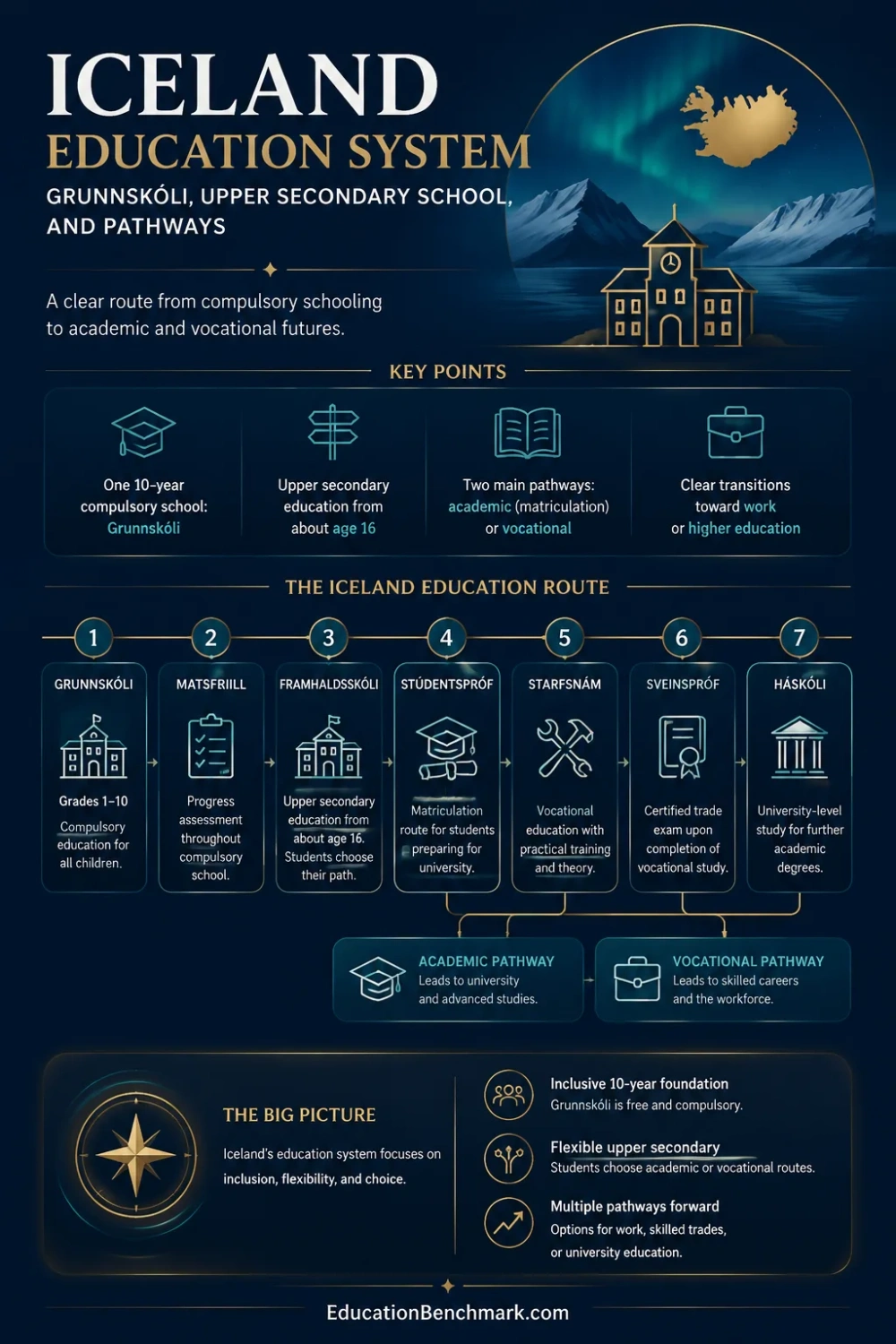
Iceland’s route is shaped by one 10-year Grunnskóli, flexible upper-secondary study, and academic or vocational choices after age 16.
Grunnskóli
Selected stamp: Grunnskóli. Choose another stamp to update the route card.
Iceland’s school route is easiest to understand when Grunnskóli is treated as one ten-year compulsory stage rather than as a primary school followed by a separate lower-secondary institution. Children normally enter compulsory schooling in the calendar year they turn six and remain in it until age 16. Preschool, compulsory school, upper-secondary education and university form the main sequence. The Ministry of Education and Children oversees national education policy and general curricula, while municipalities operate preschools and compulsory schools; individual schools publish their own school curriculum and schedule. The school year normally runs from August to May. [a]
The decisive branching point comes after Grade 10. Upper-secondary education is not compulsory, but Iceland gives young people a continuing right to education, and Framhaldsskóli can lead toward stúdentspróf, vocational qualifications, arts study or preparatory routes. That structure makes the academic and vocational pathways connected rather than fully sealed off from one another.
Grunnskóli Is One Ten-Year Compulsory Route
English-language descriptions of Icelandic education sometimes translate Grunnskóli as “primary school.” The Icelandic stage is broader. It covers Grades 1 through 10, including the years that international classifications would normally separate into primary and lower-secondary education.
The ten grades are commonly described in three internal stages: Grades 1–4 for the youngest pupils, Grades 5–7 for the middle years and Grades 8–10 for adolescents. This division does not create a separate junior-high admission point. The compulsory-school term is at least nine months and 180 school days. Municipal compulsory schools provide education without tuition charges, while private compulsory schools may charge tuition. Older Grunnskóli pupils can also, with the appropriate school arrangements, take distance courses from upper-secondary schools alongside their compulsory studies. [b]
Why the translation matters: a student does not normally finish a separate primary institution and then enter a distinct lower-secondary school at age 12 or 13. Grades 1–10 belong to the same compulsory-school stage, even though the learning experience changes as pupils get older.
School route
Ages, Stages, and Roles Across the Icelandic Route
Ages describe the ordinary route. Individual entry timing, programme length, and admission conditions can differ.
| Stage | Icelandic Term | Typical Timing | Compulsory? | Role in the Route |
|---|---|---|---|---|
| Preschool | Leikskóli | Before compulsory school | No | Early childhood education before entry to Grunnskóli. |
| Compulsory school | Grunnskóli | Grades 1–10, normally ages 6–16 | Yes | One continuous stage covering primary and lower-secondary years. |
| Upper secondary | Framhaldsskóli | Usually entered after Grade 10 | No | Academic, vocational, arts and preparatory programmes. |
| University | Háskóli | After an accepted upper-secondary qualification | No | Degree-level study with institution- and programme-specific admission rules. |
Matsferill: National Assessment During Grunnskóli
Iceland’s current compulsory-school assessment arrangements should not be described using the older assumption that national testing has simply disappeared. Regulation No. 191/2026 provides for mandatory standardised assessment in Icelandic and mathematics for pupils in Grades 4, 6 and 9. The regulation describes these as status-and-progress assessments and also allows optional national assessment tools beyond the mandatory component. [c]
The operational system is Matsferill. Its reading-comprehension and mathematics assessments are available from Grades 4–10, with mandatory use at the specified national checkpoints. Reading-fluency measures are optional. The current system is designed to show where a pupil stands and how learning is progressing, so results can inform teaching, support and additional academic challenge. Reading-comprehension and mathematics assessments are administered during a March testing period, while reading-fluency assessments can occur at several points during the year. [d]
Assessment during compulsory school
What Matsferill Measures in the Student Route
These grades contain the required national standardised assessment points during Grunnskóli.
Status-and-progress results are intended to show both current performance and development over time.
Matsferill operates during compulsory schooling and is not a single examination that awards upper-secondary eligibility.
This distinction affects how the Icelandic route should be read. Assessment is present before the end of Grunnskóli, but the move into upper secondary is not organised around one national Grade 10 examination score.
The Grade 10 Gate Into Framhaldsskóli
After Grade 10, students move from compulsory Grunnskóli into a system where programme choice matters much more. Icelandic upper-secondary education can operate through a class system or a credit-based system and can prepare students either for further study or for vocational qualifications. Upper-secondary education itself is not compulsory, yet young people have a right to schooling until age 18.
A person who has completed compulsory school, has equivalent foundational education, or has reached age 16 can begin upper-secondary study. Admission is handled through school and programme applications rather than one nationwide upper-secondary entrance examination. Individual schools select applicants according to their own criteria, so admission to a particular programme should not be confused with the broader right to upper-secondary education. [e]
After Grunnskóli
The Main Choices After Grade 10
The branches describe programme direction rather than fixed school categories. One upper-secondary school may offer more than one route.
Academic programmes prepare students for matriculation and later higher-education applications.
Vocational programmes prepare students for occupations, workplace learning, professional rights or further study.
Arts routes and preparatory programmes provide alternatives for students with different study goals or prior attainment.
Menntaskóli, Credits, and the Stúdentspróf Route
Icelandic upper-secondary terminology can create a false impression that each school name identifies one fixed track. Schools may be called fjölbrautaskóli, framhaldsskóli, iðnskóli, menntaskóli or verkmenntaskóli, but the government’s description of the sector explicitly notes that a school’s name does not necessarily reveal how it operates or which programmes it offers.
Upper-secondary study may use a bekkjakerfi, where students remain with a class group, or an áfangakerfi, where study is organised around individual courses and students have more freedom over course choice and pace. Academic study generally leads to stúdentspróf, normally over about three years. Vocational programmes can lead toward specific occupations or professional rights, and in most cases students can add further study and also complete stúdentspróf. Arts programmes may also lead to stúdentspróf, while preparatory routes serve students who need another step before entering their intended programme. Some upper-secondary schools provide distance study, evening study or boarding. [f]
Upper-secondary organisation
Bekkjakerfi and Áfangakerfi Do Not Organise Study the Same Way
Students belong to a class group and move through much of the programme with the same cohort.
Students select courses within programme requirements and can have greater control over sequencing and pace.
This is why “three years of high school” is useful only as a broad description of the academic route. Programme requirements, the school’s organisational model and the student’s pace can matter more than a rigid Year 1–Year 2–Year 3 sequence.
Starfsnám, Workplace Learning, and Sveinspróf
Starfsnám covers vocational study within the upper-secondary sector. The route is not limited to classroom instruction. Where workplace learning forms part of an approved programme, students can train with companies or institutions as part of their upper-secondary studies. Iceland’s Workplace Training Fund supports employers taking students in apprenticeships or other programmes where workplace training is a defined course component, reflecting the formal place of work-based learning within vocational education. [g]
For certified trades, sveinspróf is a separate qualification point. A person who passes the relevant journeyman examination and meets the requirements under Iceland’s handicrafts rules can receive a journeyman certificate. The District Commissioner of South Iceland issues these certificates. Holding a journeyman or master certificate also governs the right to use the occupational title in a certified trade. A journeyman certificate alone does not automatically give the holder the right to operate an independent business or take apprentices; a master certificate is required for those functions. [h]
Certified trade route
How the Sveinspróf Route Fits Into Upper Secondary Education
The student completes the school-based parts of an occupational programme.
Training takes place in a workplace when the selected programme requires a work-based component.
Students in relevant certified trades complete the prescribed journeyman examination and other required conditions.
Successful candidates can obtain the formal certificate associated with the certified trade.
Not every vocational programme ends with sveinspróf. The examination belongs to the certified-trade route, so it should not be presented as a universal final exam for all vocational students.
From Stúdentspróf to Háskóli
Stúdentspróf is the clearest academic bridge between upper-secondary school and Háskóli, the Icelandic term for university. University admission is nevertheless not controlled by one common nationwide entrance test. The general route is a matriculation examination or an equivalent qualification, after which each university can apply its own admission rules.
Iceland currently has seven universities: four state institutions and three private non-profit institutions. Universities may set specific admission conditions and can require entrance or status examinations for particular programmes. They may also admit an applicant without the standard matriculation qualification when the institution considers the person to have equivalent maturity and knowledge. Preparatory programmes can provide another route where approved. [i]
Qualification does not equal automatic programme admission: stúdentspróf normally establishes the academic basis for applying to university, but a particular degree may still require specific subjects, language competence, examinations or other conditions.
What Stays National and What Can Change by School
Iceland combines national rules with substantial implementation at municipal, school and institutional level. The compulsory-school age range, the ten-year Grunnskóli structure, national curricula and mandatory national assessment points are set above the individual-school level. Municipalities are central to the operation of Grunnskóli, while schools develop their own schedules and school curricula within the national structure.
Variation becomes more visible after Grade 10. Upper-secondary schools differ in programme mix, admissions criteria, class-based or course-based organisation and the availability of distance, evening or residential study. University requirements vary again by institution and degree programme. A student following the academic route in one school and a student completing workplace-based vocational study in another can therefore both be inside the Icelandic upper-secondary system while experiencing very different forms of education.
The route also allows some movement rather than forcing every student into a permanent academic-versus-vocational choice at 16. Upper-secondary vocational study can lead toward employment or professional rights, while many vocational routes allow additional study toward stúdentspróf. Academic students proceed more directly toward matriculation, but university programmes still make their own admission decisions.
Where official details should be checked: Education Benchmark is an independent informational guide and is not affiliated with any ministry of education, school authority, exam board, university, government agency, or official ranking organization. School admissions, assessment procedures, curricula, occupational qualifications and university entry requirements can change. Decisions involving an application, qualification or individual school route should be verified with the relevant Icelandic authority, school or university.
Sources and Verification
- [a] Studying | Ísland.is — Used for the overall school sequence, compulsory-school age, birth-year rule, school calendar, national policy role and municipal operation of preschool and compulsory school. (Reliable because Ísland.is is Iceland’s official public-service portal.)
- [b] Primary schools | Ísland.is — Used for the Grade 1–10 structure, three internal Grunnskóli stages, 180-day minimum school term, tuition rules and upper-grade distance-study option. (Reliable because it is an official Icelandic public-service education page.)
- [c] Regulation No. 191/2026 on Standardised Assessment in Compulsory Schools — Used for the current mandatory national assessment points in Grades 4, 6 and 9 and the legal scope of standardised assessment. (Reliable because it is the published Icelandic regulation governing the assessment arrangement.)
- [d] Matsferill – The Icelandic Student Assessment Profile — Used for the purpose, administration and interpretation of the current Matsferill assessments. (Reliable because it is published by Iceland’s Directorate of Education and School Services.)
- [e] Application for upper secondary school | Ísland.is — Used for upper-secondary eligibility, the right to schooling until age 18, class and credit systems, and school-specific admission criteria. (Reliable because it is the official national upper-secondary application information page.)
- [f] Framhaldsskólar — Government of Iceland — Used for upper-secondary programme types, school terminology, bekkjakerfi and áfangakerfi, stúdentspróf, vocational progression, distance study and boarding options. (Reliable because it is the Government of Iceland’s education information for the upper-secondary sector.)
- [g] Workplace Training Fund | Ísland.is — Used to verify the formal role of apprenticeships and workplace learning within relevant upper-secondary vocational programmes. (Reliable because it is an official Icelandic public-service page describing the national workplace-training support system.)
- [h] Journeyman’s certificates | Ísland.is — Used for sveinspróf, journeyman-certificate requirements, certified occupational titles and the distinction between journeyman and master rights. (Reliable because the page is provided through the District Commissioner of South Iceland on the official public-service portal.)
- [i] Universities | Ísland.is — Used for the number and status of Icelandic universities and the general relationship between stúdentspróf, equivalent qualifications and institution-specific university admission. (Reliable because it is Iceland’s official public-service information for university education.)