
Ecuador School Route Passport
Follow the four EGB sublevels, Ecuador’s two school-year regimes, and the Bachillerato branch that shapes study after 10th EGB.
EGB Preparatoria
Selected stamp: EGB Preparatoria. Choose another stamp to update the route card.
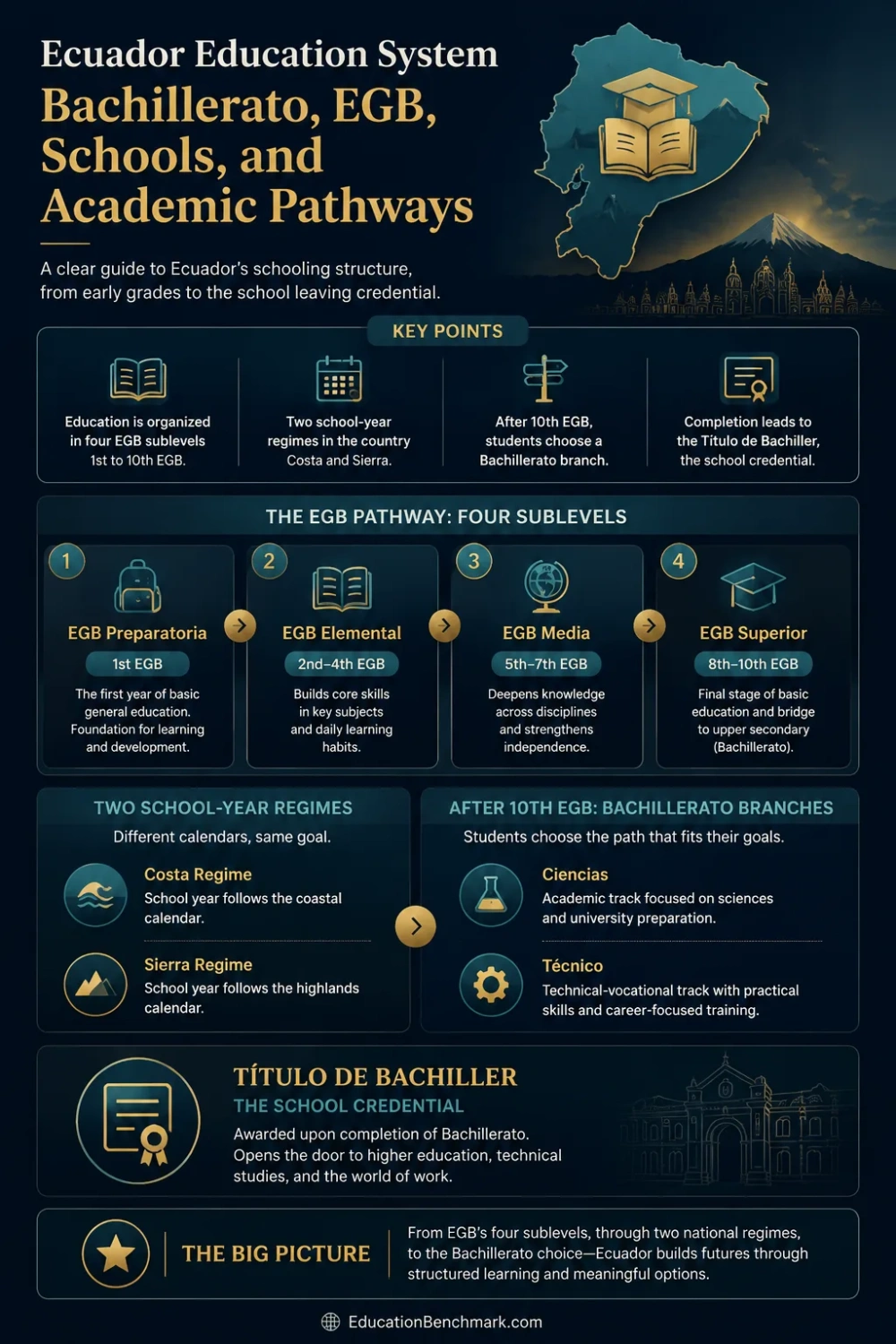
Ecuador’s school structure is easier to understand through its own terminology than through a simple primary-secondary translation. Educación General Básica (EGB) forms a ten-year sequence divided into four named sublevels, and students then move into Bachillerato. This means 10th EGB marks the end of basic education, not the end of the full school route.
The ordinary pathway sits within a national education system that also includes Educación Inicial before EGB and higher education after Bachillerato. Ecuadorian law treats EGB as ten years of education and Bachillerato as the three-year stage that follows it. The legal scope of compulsory education extends through the school levels established in the national system. [b]
EGB structure
The Ten-Year EGB Route: Four Sublevels, Not One Primary Stage
The age bands are standard suggested ages used in Ecuador’s school-level structure. A student’s actual placement can differ because of previous schooling, mobility, delayed entry, or other circumstances. [a]
| Ecuadorian level | Grades or courses | Typical age range | Place in the school route |
|---|---|---|---|
| EGB Preparatoria | 1st EGB | Around age 5 | Formal entry into EGB |
| EGB Elemental | 2nd–4th EGB | About 6–8 | Foundational basic education |
| EGB Media | 5th–7th EGB | About 9–11 | Middle phase of EGB |
| EGB Superior | 8th–10th EGB | About 12–14 | Final EGB phase before Bachillerato |
| Bachillerato | 1st–3rd Bachillerato | About 15–17 | Upper-secondary education |
Preparatoria is already part of EGB. It should not be separated from basic education merely because the usual entry age is close to what some countries call kindergarten. Elemental, Media, and Superior then continue the same EGB sequence through 10th grade.
The distinction becomes especially useful when comparing Ecuador with systems that divide schooling into elementary, middle, and high school. EGB Superior may resemble lower-secondary schooling in an international comparison, but its official position remains inside Educación General Básica.
The upper-secondary decision
From 10th EGB to Bachillerato: Where the Route Splits
Current authorization rules explicitly recognize Bachillerato provision in Ciencias and Técnico forms, alongside authorized specialties or complementary offers where applicable. [c]
Completion of EGB Superior closes the ten-year basic-education sequence and leads into Bachillerato.
The sciences route keeps the emphasis on broad upper-secondary academic preparation.
Technical provision combines common upper-secondary learning with an authorized technical or professional field.
Successful completion of Bachillerato leads to the school-leaving credential used for further study and other post-school routes.
Bachillerato Técnico is not simply a shorter route into employment. The Ministry’s current technical-education portal describes it as complementary training alongside the common curriculum and organizes the offer through technical areas, professional families, and professional figures. Current fields include areas such as technologies, industry, administration and finance, agriculture, tourism, arts, design, sport, and other authorized specializations. [d]
The practical effect is that two students can both be completing Bachillerato while having different portions of their timetable and different applied learning experiences. A student in Ciencias follows the broader academic route. A student in Técnico can develop competencies associated with a particular professional field while remaining in Bachillerato.
What the Technical Route Does Not Mean
Bachillerato Técnico does not make higher education unavailable. The track adds vocational or applied preparation, but students who complete Bachillerato can still continue toward higher education subject to the admission requirements that apply to the institution and program they seek.
Regional calendar structure
Costa–Galápagos and Sierra–Amazonía: One System, Two School-Year Regimes
Ecuador’s current student-transfer system still requires families to distinguish between the Sierra–Amazonía and Costa–Galápagos regimes. [e]
Schools assigned to this regime use the calendar issued for Costa–Galápagos, including its own enrollment, transfer, teaching, holiday, and end-of-year timing.
Schools in this regime operate on a different annual timetable, even though they remain within the same national EGB and Bachillerato structure.
The two regimes are a practical difference, not a separate education system. EGB grades, Bachillerato, national curriculum requirements, and school credentials belong to the Ecuadorian national system in both cases. What changes is the academic calendar.
This matters most during transfers. A family moving from Quito to Guayaquil, or entering Ecuador from another country, should not assume that every school is at the same point in its academic year. Enrollment windows and transfer timing need to be checked for the relevant regime.
Learning priorities
What Ecuador’s Current Curriculum Emphasizes
The Ministry’s current curriculum resources retain a prioritized curriculum with emphasis on communicational, mathematical, digital, and socio-emotional competencies across school levels. [f]
Students are expected to read, communicate, interpret information, and express ideas across learning contexts rather than treat language skills as isolated tasks.
Mathematical competence is treated as usable reasoning that supports problem solving and the application of knowledge in different situations.
Current curriculum resources give digital competence a defined place alongside traditional subject knowledge and classroom learning.
Learning also includes the ability to manage relationships, emotions, communication, decision making, and participation in school life.
The national curriculum still contains recognizable subject areas such as Lengua y Literatura, Matemática, Ciencias Naturales, Estudios Sociales, and foreign-language learning. The competency emphasis changes how these areas are expected to contribute to broader student development rather than replacing subject teaching.
Other cross-curricular material in the current resource system addresses themes such as digital citizenship, sustainability, financial education, and road safety and mobility. Their presence is useful when comparing Ecuador with education systems that describe curriculum only through a fixed list of subjects.
School provision
Fiscal, Fiscomisional, Municipal, and Particular Schools
Ecuadorian education law distinguishes public, municipal, fiscomisional, and particular institutions and places them within the national education system. It also requires a national curriculum across the regulated school sectors. [g]
Fiscomisional is especially easy to lose in an English-language description of Ecuador. It cannot be translated cleanly as simply “public” or “private.” The legal model places these institutions in private law and nonprofit operation while allowing total or partial state financing under specified conditions.
Particular schools can differ in educational model, languages, additional programs, extracurricular provision, or authorized study plans, but private status does not remove them from national supervision. International or binational offers can also operate within the regulated system when properly authorized.
Ecuador’s school structure also recognizes intercultural and bilingual education. The legal design allows national curriculum requirements to be applied with attention to the country’s cultural and linguistic diversity, so a description limited to Spanish-medium fiscal schools would leave out part of the national education structure.
Assessment, Promotion, and the Título de Bachiller
Assessment in Ecuador should not be understood as a single final test that determines the whole school career. Ministry guidance for ordinary education describes evaluation activities as contextualized, relevant, and flexible, with assessment forming part of the teaching and learning process. [h]
Students accumulate school records as they progress through EGB and Bachillerato, and promotion decisions operate within the rules that apply to the level and school year. Where a learner has academic difficulties, the applicable evaluation rules can provide additional assessment or recovery processes. Exact grading thresholds and procedures should be checked against the rules in force for the relevant school year rather than copied from older summaries of the Ecuadorian system.
After successful completion of the upper-secondary level and its applicable graduation requirements, the student receives the Título de Bachiller. Ecuador maintains an official service through which the credential can be consulted and certified. [i]
What Readers Often Confuse
A certificate showing completion of 10th EGB confirms the end of Educación General Básica. It is not the same credential as the Título de Bachiller, which belongs to the completion of the later Bachillerato stage.
After Bachillerato: University and Technical-Technological Routes
A Título de Bachiller or legally recognized equivalent is part of the entry requirement for Ecuadorian higher education. For public higher education, admission operates within the Sistema de Nivelación y Admisión, while higher-education institutions carry out admission processes for their available places under the rules that apply to the system. Current government guidance also provides a differentiated route for some Bachillerato Técnico graduates who seek public technical or technological study in the same field of knowledge. [j]
Post-school progression
Where a Bachiller Can Continue
- University or polytechnic degree study: students apply to degree-level higher education and meet the admission rules of the relevant process and institution.
- Technical or technological higher education: students can pursue applied third-level programs through institutes and other authorized higher-education providers.
- Employment: a graduate may enter work directly, particularly where prior technical training provides an occupational skill base.
- Later progression: technical, technological, and degree routes can lead to further qualifications according to higher-education regulations and institutional requirements.
Ecuador’s higher-education terminology distinguishes third-level technical-technological education from third-level degree education. The technical-technological side includes qualifications such as técnico superior and tecnólogo superior, while degree-level study covers university or polytechnic qualifications such as licenciatura and professional degrees. [k]
This is why Bachillerato Técnico should not be presented as a dead end. Its immediate emphasis is more applied than the Ciencias route, but post-school progression depends on the credential held, the field selected, available programs, and the admission rules in force.
Entering Ecuadorian Schools With Studies From Abroad
For students arriving from another education system, converting a foreign grade directly into an Ecuadorian grade by age alone can produce the wrong result. Ecuador has an official process for the recognition of studies completed abroad. It covers approved grades or courses so that national and foreign students can enter the Sistema Nacional de Educación at the appropriate point. [l]
For recognition of studies in EGB Elemental, EGB Media, EGB Superior, or Bachillerato, academic documentation is checked through the applicable official mechanism. Where no official digital verification method exists, legalization or apostille requirements can apply. For students entering public education, the competent district authority determines the corresponding Ecuadorian grade or course based on equivalence.
Transfer logic
Why the Ecuadorian Grade Name Matters in a Transfer
A student arriving with several years of completed schooling is not placed merely by translating “middle school” or “high school” into Spanish. The Ecuadorian authority or school must identify the equivalent EGB or Bachillerato point, while the applicable Costa–Galápagos or Sierra–Amazonía calendar can affect the timing of enrollment and transfer.
Families transferring a completed foreign upper-secondary qualification face a related but different process: a foreign secondary or Bachillerato-equivalent credential may need homologation before it can function as an Ecuadorian Título de Bachiller for higher-education or other formal purposes.
Sources and Verification
Education rules can change through legislation, ministerial agreements, annual school calendars, assessment instructions, and higher-education admission procedures. Exact enrollment dates, transfer periods, graduation rules, and admission steps should therefore be checked with the relevant official authority, school, or higher-education institution before an important decision is made.
Education Benchmark is an independent informational guide and is not affiliated with any ministry of education, school authority, exam board, university, government agency, or official ranking organization.
- [a] Reglamento General a la Ley Orgánica de Educación Intercultural — Used for the standard EGB sublevel, grade, and suggested-age mapping. (Reliable because it is an official Ecuadorian education evaluation authority publication of the education regulation.)
- [b] Ley Orgánica de Educación Intercultural (LOEI) — Used for the legal structure of ten-year EGB, three-year Bachillerato, and the compulsory school route. (Reliable because it is an official Ecuadorian education authority copy of the national education law.)
- [c] Emisión de renovación de autorización del funcionamiento de instituciones educativas particulares, fiscomisionales y municipales — Used to verify the current recognition of Bachillerato in Ciencias and Técnico forms in authorized school provision. (Reliable because it is Ecuador’s official government services portal.)
- [d] Bachillerato Técnico — Used for the purpose, organization, professional families, and current fields within technical Bachillerato. (Reliable because it is the official national education authority’s Bachillerato Técnico page.)
- [e] Traslado estudiantes — Used to verify the active distinction between the Sierra–Amazonía and Costa–Galápagos school regimes. (Reliable because it is the official Ecuadorian education student-transfer service.)
- [f] Currículo – Recursos Educativos Digitales — Used for the current curriculum emphasis on communicational, mathematical, digital, and socio-emotional competencies. (Reliable because it is the national education authority’s official curriculum resource portal.)
- [g] Ley Orgánica de Educación Intercultural — Used for fiscal, municipal, fiscomisional, and particular institution categories and the national curriculum requirement across regulated provision. (Reliable because it is an official National Assembly legal publication.)
- [h] INSTRUCTIVO DE EVALUACIÓN ESTUDIANTIL DE LOS SERVICIOS EDUCATIVOS ORDINARIOS — Used for the approach to student assessment in ordinary educational services. (Reliable because it is an official Ministry educational resource and evaluation instruction.)
- [i] Consultas del certificado de Título de Bachiller — Used to verify the Título de Bachiller as the credential issued after successful completion of Bachillerato and the official certificate-checking service. (Reliable because it is Ecuador’s official government services portal.)
- [j] Inscripción para la obtención de un cupo para el acceso a la educación superior — Used for current public higher-education admission rules, the Bachiller credential requirement, and the differentiated provision for some Bachillerato Técnico graduates. (Reliable because it is an official Ecuadorian government service describing current higher-education access.)
- [k] Preguntas Frecuentes – Instituciones de Educación Superior — Used for Ecuador’s current higher-education levels, including third-level technical-technological and degree education. (Reliable because it is an official higher-education information service.)
- [l] Reconocimiento de estudios realizados en el exterior — Used for recognition of foreign school studies, document verification, and grade or course equivalence for entry into Ecuador’s national education system. (Reliable because it is the official Ecuadorian government procedure for studies completed abroad.)