
Peru School Route Passport
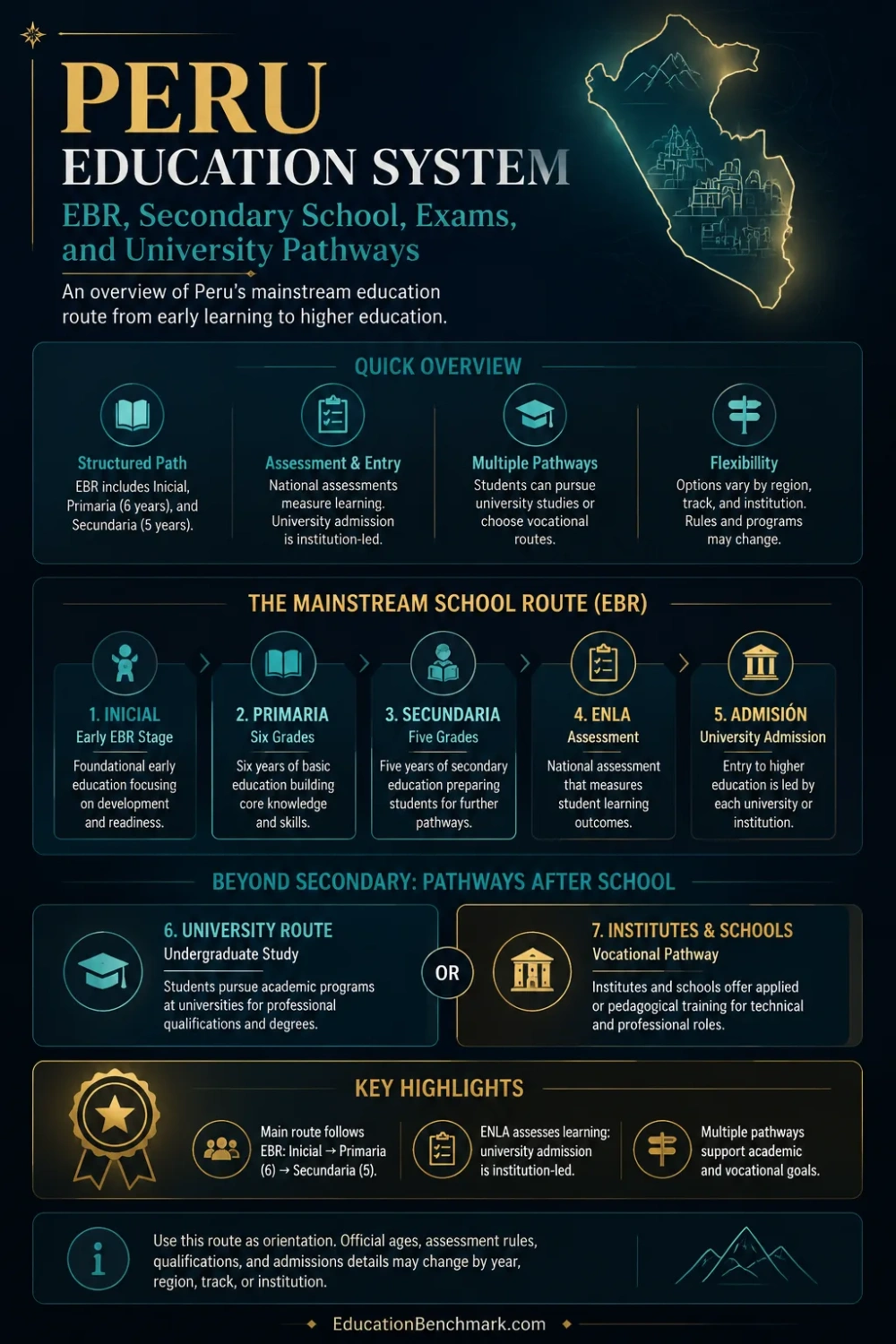
Peru’s mainstream route moves through Inicial, six years of Primaria and five years of Secundaria before higher-education routes branch by institution.
Educación Inicial
Selected stamp: Educación Inicial. Choose another stamp to update the route card.
Peru’s mainstream school route is Educación Básica Regular (EBR), which connects Educación Inicial, Educación Primaria, and Educación Secundaria under the national curriculum. The structure matters because several terms used in Peru do not map neatly onto labels such as “middle school,” “high school diploma,” or “national entrance exam.” Peru’s official EBR curriculum programs organize expected learning by age in Inicial and by grade in Primaria and Secundaria. [a]
EBR: The Route From Inicial to Secundaria
EBR is not one school level. It is the regular basic-education route that links the main school stages. Peru’s General Education Law sets the national basis for the education system and treats basic education as compulsory; public education provided by the State is free under the law. National rules sit alongside decentralized administration, so schools and education-management bodies carry out the system within national policy rather than every locality creating a separate school structure. [b]
Minedu uses a normative age as a reference for determining the grade in which a student should enrol, calculated as of 31 March each year. The normal age pattern is therefore best read as a reference route, not a guarantee that every student of a given age will be in the same grade. [c]
EBR school route
Levels, Grades, and the Usual Age Pattern
Normative ages are enrolment references. Individual placement can differ because of prior schooling, delayed entry, interrupted study, or other recognized circumstances.
| EBR level | Structure | Usual normative ages | Next step |
|---|---|---|---|
| Educación Inicial | Age-based early education; Cycle II covers the years before primary entry | About 3–5 for the pre-primary Cycle II route | Educación Primaria |
| Educación Primaria | 1.º to 6.º grade | About 6–11 | Educación Secundaria |
| Educación Secundaria | 1.º to 5.º grade | About 12–16 | Higher education, training, or work |
For cross-country coding, Education by Country’s 2026 compulsory-education table lists Peru with an official entrance age of 3 and 14 years of compulsory education, giving a theoretical exit age of 17. That comparison is useful for understanding the legal span, while Minedu’s normative-age and enrolment rules remain the better reference for placing an individual student in a specific grade. [d]
The national curriculum is competency-based. That means progress is described through competencies, capacities, standards, and expected performances rather than by treating the curriculum as a simple checklist of subjects. Schools still teach recognizable areas such as communication, mathematics, science, social learning, physical education, arts, and other curriculum areas, but the official language of progression is built around what students can demonstrate over time.
Why Peru’s Secundaria Is a Five-Year EBR Stage
Educación Secundaria is the third level of EBR and lasts five grades. Minedu’s secondary curriculum describes it as the continuation of the competencies developed in earlier basic education and links it to preparation for citizenship, further study, and working life. [e]
For an international reader, the safest translation is usually “secondary education,” not a forced split into U.S.-style middle school and high school. The local sequence is simply 1.º, 2.º, 3.º, 4.º, and 5.º de secundaria. The curriculum also organizes secondary learning across Cycle VI and Cycle VII, so grade progression is part of one five-year EBR level rather than two nationally separate school diplomas.
What Students Study During Secundaria
Secondary education continues the national competency curriculum across subject areas rather than shifting into a single examination-preparation track. Students encounter mathematics, communication, science and technology, social sciences, citizenship and civic development, English, arts and culture, physical education, education for work, and other areas provided in the official study plan.
This helps explain why the end of Secundaria should not be described as a single “final exam year.” School completion rests on the student’s progression and recorded achievement across the school program. National learning assessments and university admission examinations belong to different parts of the system.
AD, A, B, and C Describe Competency Progress
Peru’s basic-education evaluation rules use a literal scale to communicate the level a student has reached in relation to expected competencies. The underlying evaluation norm is the Norma que regula la Evaluación de las Competencias de los Estudiantes de Educación Básica. [f]
Competency reporting
What AD, A, B, and C Mean
These labels describe achievement relative to expected competency development; they should not be converted mechanically into an A–F grading scale.
The student demonstrates learning beyond the level expected for the grade or age.
The student demonstrates the expected level of competency within the planned period.
The student is approaching the expected level and still needs support to reach it.
The student shows limited progress toward the expected level and needs more time and support.
Promotion, recovery needs, or remaining in the same grade are therefore tied to levels reached across competencies rather than to one national pass-or-fail examination. The evaluation norm was amended by RVM N.° 048-2024-MINEDU, so current school decisions should be checked against the latest Minedu rules rather than an older grading explainer. [g]
ENLA Is Not a Graduation or University Entrance Test
The acronym ENLA stands for Evaluación Nacional de Logros de Aprendizaje de Estudiantes. Its role is national learning measurement, not the award of a secondary-school qualification and not the allocation of university places.
For ENLA 2026, Minedu ordered a regional sample-based assessment covering students in 4th and 6th grade of Primaria and 2nd grade of Secundaria in public and private EBR schools. The selected grades and sampling design show why ENLA should not be treated as an examination taken by every fifth-year secondary student before graduation. [h]
Assessment distinctions
School Assessment, ENLA, and Admission Do Different Jobs
The practical distinction is simple: classroom assessment follows the individual learner, ENLA measures learning under a national assessment design, and university admission is a separate post-secondary selection process.
Leaving Secundaria: CLA, School Records, and the Bachiller Trap
After Secundaria, school records matter because universities, scholarship programs, employers, or other institutions may ask for evidence of prior study. Minedu’s Constancia de Logros de Aprendizaje (CLA) is a virtual, free document that records an EBR student’s educational trajectory from 2013 onward. Identicole also distinguishes the CLA from the Certificado de Estudios (CE), which is the official study certificate issued through the school process; the platform explains when each can be requested and how the CLA can be used to certify the recorded trajectory. [i]
This distinction matters in international comparisons because “bachillerato” can mean upper secondary education in other Spanish-speaking systems. Using that label for Peru’s regular secondary completion can make a student appear to hold a university credential that they do not have. SUNEDU’s degree-recognition information explicitly lists bachiller among academic degrees with university rank. [j]
University Admission Is Set by Each University
Peru does not use one shared national university entrance examination that produces a single score for all universities. The University Law provides the legal basis for admission, while each university establishes the modalities and rules governing its ordinary admission process. Admission is tied to defined vacancies and merit within the institution’s process. The law also recognizes specific access categories and permits universities to regulate other lawful forms of entry. [k]
The ordinary route commonly includes a knowledge examination, while an institution may add or structure other assessments and admission modalities under its rules. This creates an institution-led admission model: national law sets the legal boundaries, but the applicant must read the rules of the university and program they are actually applying to.
Admission route
From 5.º de Secundaria to a University Place
The exact examination, calendar, fee, documents, and special admission categories depend on the university.
Complete the EBR secondary route and obtain the academic records required for the application.
Admission rules are attached to the institution, program, intake, and admission modality.
Submit the required documents and complete the assessment specified by that university.
Applicants are ranked under the rules and vacancy limits of the relevant admission process.
Reaching a vacancy and completing enrolment starts the undergraduate university route.
Special Admission Routes Do Not Create One National Alternative Exam
Some applicants may enter through categories for prior higher education, high school merit, or other legally recognized circumstances. These routes still depend on the applicable university rules, available places, document checks, and any evaluation required for that modality. A “special route” should not be read as a universal shortcut that works identically across all institutions.
Universities, IES, EESP, and Beca 18 After Secundaria
University is only one formal post-secondary route. Peru also regulates Institutos de Educación Superior (IES) and Escuelas de Educación Superior (EES); pedagogical schools are commonly identified as EESP. These institutions operate under a separate legal and licensing structure from universities and can provide technological, applied, or teacher-education routes. Minedu’s institutional-licensing information for this sector explains the role of Law N.° 30512 and the licensing of higher-education institutes and schools. [l]
Beca 18 adds a funding and selection layer, but it does not replace admission to higher education. For the 2026 competition, PRONABEC states that an applicant must already have entered an eligible higher-education institution, campus, and study program for the 2026 academic year. The scholarship process also uses its own Examen Nacional de Preselección (ENP) in the selection scoring. That ENP belongs to Beca 18; it is not Peru’s universal university entrance examination. [m]
Post-secondary branches
Three Decisions That Should Stay Separate
Admission, institution type, and scholarship selection can interact, but they are not the same decision.
Apply under the university’s admission rules, then enter undergraduate study if a vacancy is obtained.
Follow the admission and qualification route of the institute or higher-education school and its authorized program.
Meet PRONABEC’s scholarship rules in addition to the admission conditions of an eligible higher-education program.
MINEDU, SUNEDU, and Where Rules Can Vary
The school side and university side should not be treated as if they are managed by one admissions office. MINEDU sets national education policy and basic-education rules, while schools and decentralized education-management bodies handle implementation and administration within their responsibilities. Higher-education institutes and schools also sit within Minedu’s regulatory area under their own rules. SUNEDU maintains university licensing and degree-registration functions relevant to the university sector.
Institution status can change, so university verification should use the live SUNEDU record rather than a copied list. SUNEDU’s licensed-university page reported 106 universities with a current institutional licence as of 31 July 2026. The same page identifies the institution, licensing date, resolution, location, and management type, making it more useful for verification than an old third-party university directory. [n]
Education Benchmark is an independent informational guide and is not affiliated with any ministry of education, school authority, exam board, university, government agency, or official ranking organization. Its role is to explain the structure in a readable form, not to replace the current rules issued by the institution responsible for a specific enrolment, examination, scholarship, or admission process.
Sources and Verification
- [a] Programas curriculares de la Educación Básica Regular — Used for the EBR level structure and the way national curriculum expectations are organized by age and grade. (Reliable because it is an official Minedu curriculum page.)
- [b] Ley N.° 28044 — Used for the national legal basis of Peru’s education system, basic education, and public provision. (Reliable because it is the official Minedu record of the General Education Law.)
- [c] Edades normativas — Used for normative-age placement and the 31 March age reference used in school enrolment. (Reliable because it is an official Minedu guidance page with the normative-age document.)
- [d] Compulsory Education Worldwide (2026): Years, Ages, and Enforcement by Country — Used for cross-country coding of Peru’s compulsory-schooling entrance age, duration, and theoretical exit age. (Useful as a secondary comparison source because the table states its indicator definitions and underlying World Bank source.)
- [e] Programa Curricular de Educación Secundaria — Used for the five-grade Secundaria structure and its curriculum role within EBR. (Reliable because it is Minedu’s official secondary curriculum publication page.)
- [f] Resolución Viceministerial N.° 094-2020-MINEDU — Used for the official competency-evaluation norm underlying basic-education assessment. (Reliable because it is an official Minedu legal record.)
- [g] Resolución Viceministerial N.° 048-2024-MINEDU — Used to verify the later amendment to the competency-evaluation norm. (Reliable because it is the official Minedu record of the amending resolution.)
- [h] Resolución Ministerial N.° 285-2026-MINEDU — Used for the official 2026 ENLA grades, EBR coverage, and regional sample-based design. (Reliable because it is the Minedu resolution ordering ENLA 2026.)
- [i] Trayectoria Educativa – Identicole — Used for the CLA, Certificado de Estudios, coverage from 2013, and school-record procedures. (Reliable because Identicole is a Minedu education-information service.)
- [j] Procedimiento de Reconocimiento de Grados y Títulos Extranjeros — Used to verify that bachiller is treated as a university academic degree. (Reliable because SUNEDU is the official university degree-registration and recognition authority.)
- [k] Ley Universitaria — Used for the current legal basis of university admission, vacancies, merit order, and institution-set admission modalities. (Reliable because it is the official consolidated University Law published through Diario Oficial El Peruano.)
- [l] Licenciamiento Institucional — Used for IES and EES regulation and licensing under Law N.° 30512. (Reliable because it is an official Minedu higher-education licensing page.)
- [m] Beca 18 – PRONABEC — Used for 2026 Beca 18 admission eligibility and the role of the Examen Nacional de Preselección in scholarship selection. (Reliable because it is PRONABEC’s official Beca 18 competition page.)
- [n] Lista de universidades licenciadas — Used for the current count and status of institutionally licensed universities. (Reliable because SUNEDU maintains the official licensing list.)