
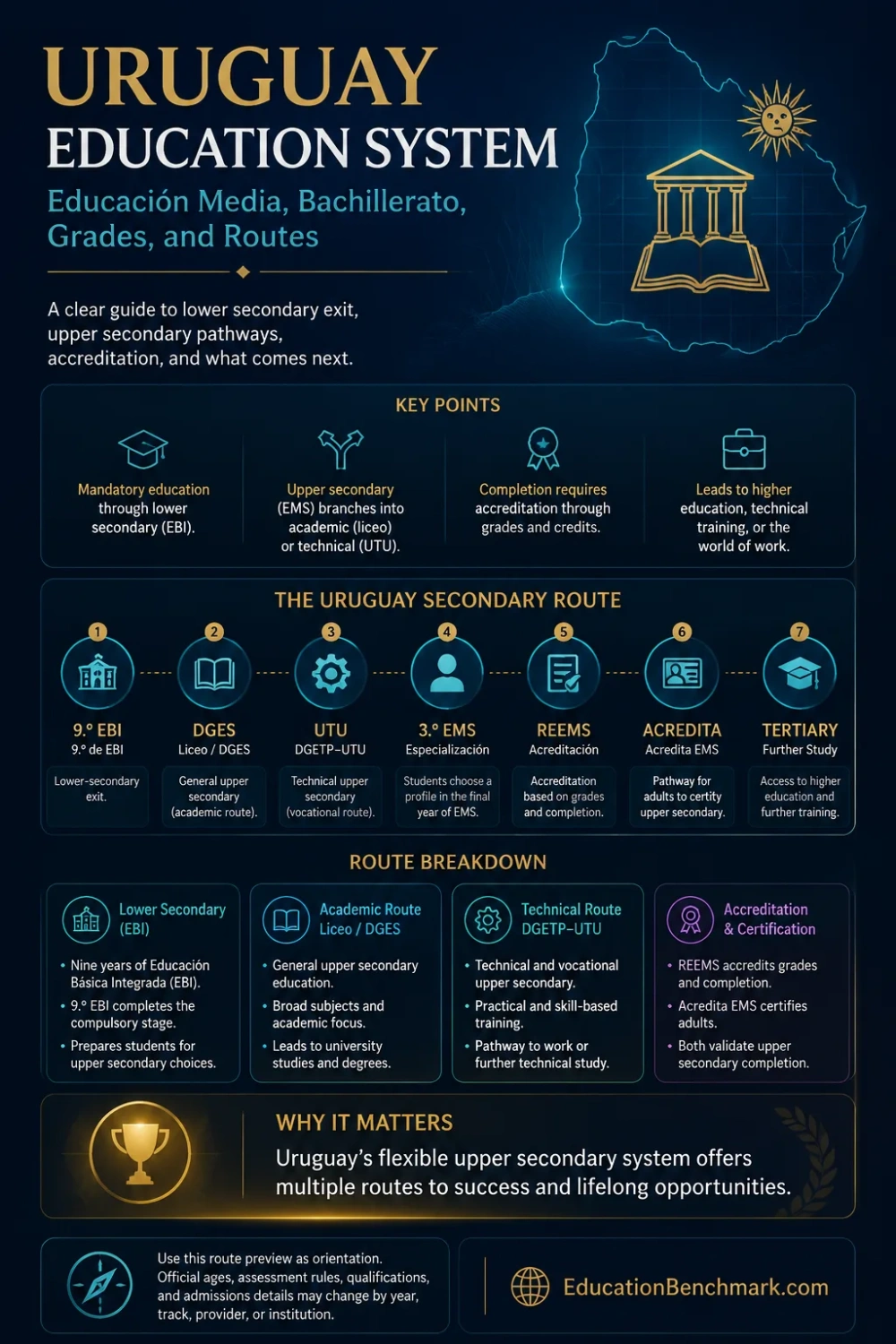
Uruguay Secondary Route Passport
Uruguay’s secondary route turns at 9.º EBI, then branches through liceo or UTU before EMS accreditation and further study.
9.º de EBI
Selected stamp: 9.º de EBI. Choose another stamp to update the route card.
Uruguay’s secondary route becomes much clearer once its numbering is separated from its stage names. The current Educación Básica Integrada (EBI) route reaches 7.º, 8.º and 9.º; after that, Educación Media Superior (EMS) begins again at 1.º rather than continuing to a formal “10.º.” ANEP identifies 7.º–9.º as the current EBI lower-secondary sequence.[a]
That reset also explains why bachillerato, EMS, liceo, and UTU can appear together in descriptions of the same student route. They describe stages, providers, or route types rather than four consecutive school levels.
Why Uruguay Reaches 9.º and Then Returns to 1.º EMS
The national pathway places initial education before six grades of primary school, followed by secondary education in two three-year cycles. The government’s education pathway presents initial education at ages 3–5, primary from about age 6, secondary from about age 12, and tertiary education from about age 18.[b]
Grade sequence
From Primary School to Educación Media Superior
Ages are orientation points, not promises that every student reaches each grade at the same age.
| Uruguayan stage | Grade structure | Usual position in the route | Approximate international reading |
|---|---|---|---|
| Educación Inicial | Three levels | Ages 3–5; compulsory from age 4 | Early childhood / pre-primary |
| Educación Primaria | 1.º–6.º | Starts from about age 6 | Grades 1–6 |
| 3.er ciclo de EBI / Educación Media Básica | 7.º–9.º | Lower secondary; secondary begins from about age 12 | Grades 7–9 |
| Educación Media Superior | 1.º–3.º EMS | Three years after the lower-secondary cycle | Roughly Grades 10–12 |
| Educación Terciaria | Institution and course dependent | Normally follows completed secondary education | University and other tertiary study |
The international-grade column is only a stage comparison. It is not an automatic credential equivalence. For enrollment, recognition, or transfer, the receiving school or institution determines how prior study is treated.
Uruguay’s compulsory route also extends farther than primary school. Article 7 of the General Education Law makes education compulsory for ages 4 and 5 in initial education, throughout primary education, and through both basic and upper secondary education.[c] This is why EMS is not merely an optional “college-prep” add-on to the school system.
Why “Educación Media Básica” Still Appears
Current ANEP material uses Educación Básica Integrada (EBI) for the integrated basic-education plan, while official offer and accreditation material can still use Educación Media Básica (EMB) for the lower-secondary level. In practical route terms, the stage that matters here ends at 9.º. It is followed by EMS.
Decision after lower secondary
The Choice After 9.º: Liceo / DGES or DGETP–UTU
Upper secondary is not one single course. Students can continue through general secondary education or a technical-professional route.
The lower-secondary sequence ends and the student moves into Educación Media Superior.
EMS combines common study with exploratory, deepening, elective, and later specialization components.
EMS combines general learning with technical-technological or professional content linked to an orientation.
Eligibility then depends on the completed profile and the admission rules of the receiving course or institution.
Plan EMS 2023 does not treat DGES and DGETP as disconnected worlds. Its first-grade programs use común, equivalente, and específico curriculum criteria across the two modalities, while preserving content that belongs to each route.[d] In DGETP, the technical-technological space is already tied to orientations such as information technology, robotics, laboratory sciences, management, tourism, sustainable design, and agrarian study.
From 1.º to 3.º EMS Under Plan 2023
The three EMS grades are better understood as a progression in choice rather than three copies of the same curriculum. In DGES, 1.º establishes a broad base; 2.º introduces clearer exploratory and deepening choices; 3.º places more weight on specialization. DGETP follows the same three-grade EMS span but develops technical routes through its own curriculum spaces.
DGES progression
Explore, Deepen, Then Specialize
Common, equivalent, and route-specific curriculum spaces establish the first upper-secondary year.
DGES groups exploration and deepening around Ciencias y Tecnología, Ciencias Sociales y Humanidades, and Creativo-Artístico.
DGES offers profiles in Ciencias y Tecnología, Ciencias de la Vida, Ciencias Sociales y Humanidades, Creativo Artístico, and General.
ANEP’s current 2.º and 3.º program listings show those DGES tracks alongside detailed DGETP programs for technical orientations.[e] A school’s actual offer can be narrower than the national menu, so a curriculum option should not be assumed to exist at every liceo or UTU center.
What Bachillerato Tecnológico and Bachillerato Técnico Profesional Mean in UTU
“UTU” is often used as shorthand for Uruguay’s technical-professional education route. At upper-secondary level, it should not be reduced to a simple “work instead of university” choice. DGETP programs mix general education with technical-technological or professional learning, and the exact balance depends on the orientation.
UTU route names
Two Current Bachillerato Labels to Recognize
A current DGETP upper-secondary route with technical-technological study attached to the chosen orientation.
A current DGETP upper-secondary route in the professional branch; its exact curriculum and progression depend on the plan and orientation.
The names matter when reading older material. ANEP reports that, from 2024 and more deeply in 2025, Educación Media Tecnológica courses were transformed into Bachillerato Tecnológico, while Educación Media Profesional courses were transformed into Bachillerato Técnico Profesional.[f] Older EMT or EMP references therefore need to be read in their plan and year context rather than treated as the only current labels.
How Grades Become Accreditation Under REEMS
Uruguay’s current EMS evaluation rules do more than attach a number to a subject. REEMS pairs the 1–10 numerical scale with five avance levels, then uses those levels within accreditation, attendance, progression, and transfer rules.[g]
REEMS evaluation
The 1–10 Scale and Its Official Avance Levels
For 2.º and 3.º EMS, Avance moderado or higher accredits the curriculum unit under the ordinary accreditation rule.
| Numerical grade | Official level | 2.º–3.º unit status |
|---|---|---|
| 9–10 | Avance destacado | Accrediting level |
| 7–8 | Avance significativo | Accrediting level |
| 5–6 | Avance moderado | Accrediting level |
| 3–4 | Avance escaso | Learning process continues |
| 1–2 | Avance mínimo | Learning process continues |
A 5 Can Accredit a Unit Without Meaning “The Whole Year Is Passed”
A grade of 5 falls inside Avance moderado, the lowest accrediting band shown for a curriculum unit in the 2.º–3.º rules. But whole-grade progression is a separate question. First-grade outcomes can involve total or partial accreditation, pending units, support, or repetition under rules that differ between DGES and DGETP. Acompañamiento Pedagógico Específico (APE) is one support mechanism used when learning remains unresolved. In 2.º and 3.º, accreditation is handled by curriculum unit, and students may continue with pending units when the progression conditions are met.
Attendance Has Its Own Effect in 2.º and 3.º EMS
For the ordinary 2.º–3.º accreditation process, REEMS sets a minimum attendance of 75% of the classes that should have been taught in the curriculum unit. Students below that threshold can be enabled to take an accreditation test from February. Academic performance and attendance therefore need to be read as separate parts of the rule.
Changing Between DGES and DGETP Is Possible
REEMS also allows students who have totally or partially accredited 1.º EMS to enroll in the next grade in either DGES or DGETP, subject to the stated progression conditions. A student moving from DGETP to 2.º DGES does not require leveling under the general rule. A student moving from DGES to 2.º DGETP must complete leveling for the route-specific technical-technological component, but that requirement does not itself block enrollment.
What Readers Often Confuse
Calificación is the numerical evaluation. Nivel de avance is the official learning descriptor. Acreditación means the required learning has been validated under the applicable rule. Pasaje de grado concerns progression to the next grade. They are connected, but they are not interchangeable terms.
What 3.º EMS Can Open at Udelar and Other Tertiary Institutions
Completing EMS is the main school-leaving threshold for ordinary tertiary progression, but the chosen bachillerato profile does not produce one universal admission result. Some courses accept a wide range of completed bachilleratos; others specify subject or specialization backgrounds.
Current admission information from the Universidad de la República’s Faculty of Economic Sciences and Administration shows the difference clearly. Contador Público accepts a completed bachillerato in any general-secondary or UTU orientation, while the degrees in Administration and Economics list selected secondary and UTU profiles. The Statistics degree accepts a general-secondary or UTU bachillerato that includes Mathematics in the final year.[h]
The practical lesson is narrower than “orientation decides the future” or “orientation never matters.” It can matter for direct eligibility, but the effect is course-specific. A student comparing 3.º EMS options should therefore check the receiving degree’s current entry conditions before treating two bachillerato profiles as interchangeable.
Acredita EMS Adds a Separate Adult Certification Route in 2026
Uruguay introduced Acredita EMS as a national upper-secondary accreditation route for the first time in 2026. It is aimed at adults who are outside formal education and allows prior knowledge and competencies developed across life experiences to be assessed for EMS certification.[i]
Adult route distinction
Regular EMS and Acredita EMS Are Not the Same Path
For the inaugural 2026 call, applicants must have fully accredited Educación Media Básica, equivalent to 9.º of formal education. The general age threshold is 27 or older. People aged 24–27 can also qualify if they meet the stated lower-secondary condition and had no enrollment in formal educational activities during the immediately preceding school year. Registration runs from 14 July to 2 September 2026, with two assessment dates scheduled for 28 November and 5 December 2026.
Those dates and eligibility conditions belong to the 2026 call, not to an unchanging rule. The same caution applies to school offerings, curriculum choices, transfer provisions, and university admissions: an enrollment or qualification decision should be checked against the current ANEP, DGES, DGETP–UTU, school, or receiving-institution rule.
Education Benchmark is an independent informational guide and is not affiliated with any ministry of education, school authority, exam board, university, government agency, or official ranking organization.
Sources and Verification
- [a] ANEP: EBI Plan 2023 for grades 7.º, 8.º and 9.º — Supports the current EBI lower-secondary grade sequence. (Reliable because it is an official ANEP education-offer record.)
- [b] Uruguay government education pathway — Supports the national stage sequence, starting ages, six-grade primary structure, two secondary cycles, and tertiary position. (Reliable because it is an official Uruguay government information page.)
- [c] General Education Law No. 18,437, Article 7 — Supports the legal scope of compulsory education. (Reliable because IMPO is Uruguay’s official legal publication and information authority.)
- [d] ANEP: first-grade EMS 2023 programs — Supports the common, equivalent, and route-specific curriculum organization across DGES and DGETP. (Reliable because it is official ANEP curriculum documentation.)
- [e] ANEP: second- and third-grade EMS 2023 programs — Supports the DGES exploratory, deepening, and specialization routes and current DGETP program listings. (Reliable because it is official ANEP curriculum documentation.)
- [f] ANEP technical-professional education monitor 2024–2025 — Supports the transition from EMT to Bachillerato Tecnológico and from EMP to Bachillerato Técnico Profesional. (Reliable because it is an official ANEP monitoring publication.)
- [g] ANEP: Reglamento de Evaluación del Estudiante de Educación Media Superior — Supports the 1–10 scale, avance levels, accreditation, attendance, progression, and DGES–DGETP transfer rules described here. (Reliable because it is the official ANEP EMS evaluation regulation.)
- [h] Udelar FCEA admission requirements — Supports the worked comparison showing that accepted bachillerato profiles differ by degree. (Reliable because it is the official admissions page of a Universidad de la República faculty.)
- [i] ANEP: 2026 Acredita EMS call — Supports the first Acredita EMS call, its purpose, 2026 eligibility conditions, registration window, and test dates. (Reliable because it is the official ANEP call notice.)