
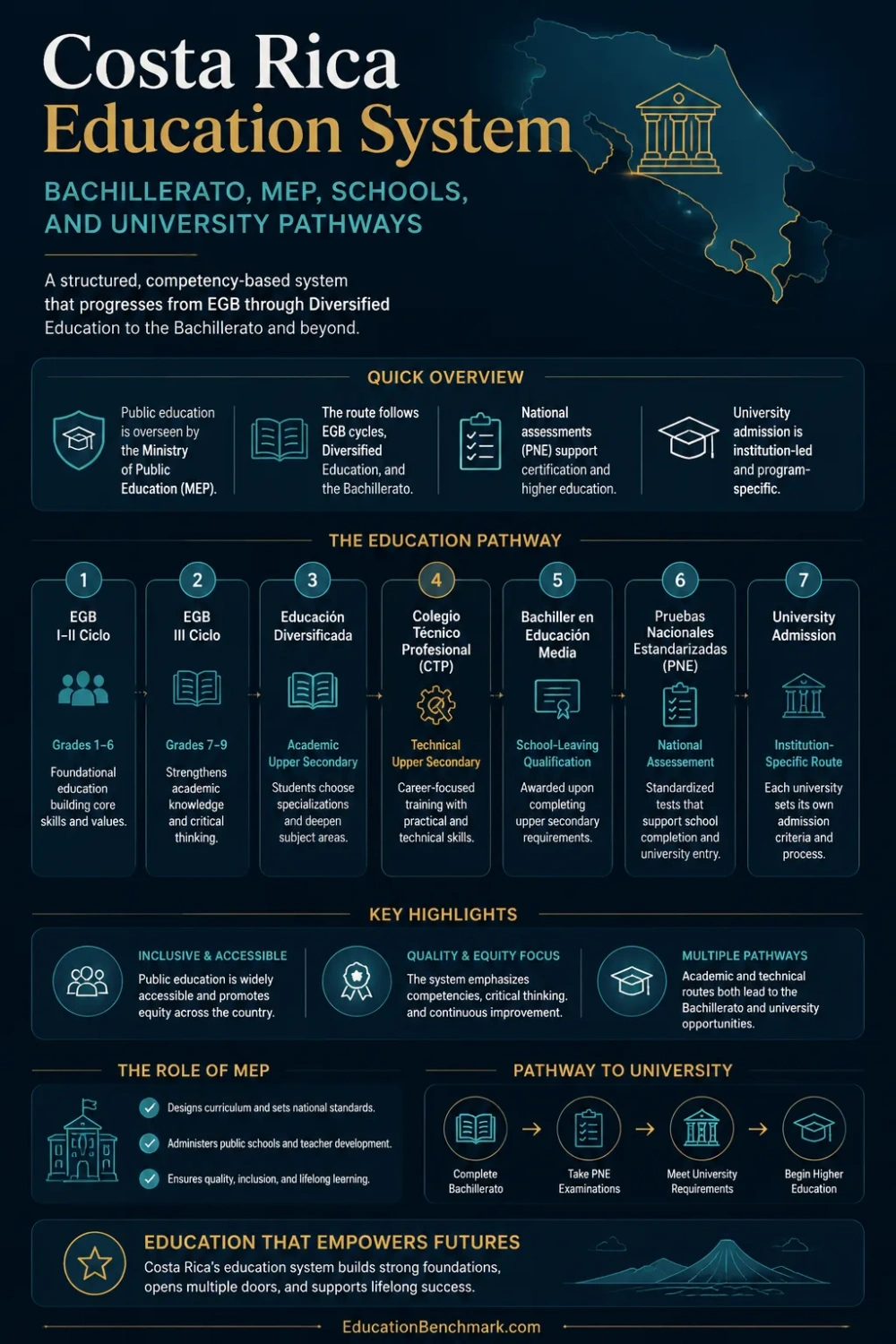
Costa Rica Route Passport: EGB, Bachillerato, and University Entry
The Costa Rican route is shaped by three EGB ciclos, Educación Diversificada, a separate technical branch, national assessment, and institution-led university admission.
I and II Ciclo
Selected stamp: I and II Ciclo. Choose another stamp to update the route card.
Costa Rica organises school education around locally used stages rather than a simple elementary–middle–high school sequence. The Ministerio de Educación Pública (MEP) uses I Ciclo and II Ciclo for the first six grades of Educación General Básica, followed by III Ciclo and then Educación Diversificada. [a] The structure becomes especially important near the end of Grade 9, when students move toward academic or technical upper-secondary routes.
School sequence
The I–II–III Ciclo Route Before Educación Diversificada
Costa Rican grade labels are easier to interpret when EGB and upper-secondary education are separated by their official local terms.
| Costa Rican stage | Normal grade range | Position in the route |
|---|---|---|
| Educación Preescolar | Before Grade 1 | Includes preschool stages such as Materno Infantil and Transición. |
| I Ciclo | Grades 1–3 | First part of Educación General Básica. |
| II Ciclo | Grades 4–6 | Completes the primary-level portion of EGB. |
| III Ciclo | Grades 7–9 | Lower-secondary stage within EGB. |
| Educación Diversificada académica | Grades 10–11 | Academic upper-secondary pathway. |
| Educación Diversificada técnica | Grades 10–12 | Technical upper-secondary pathway, commonly associated with CTPs. |
Preschool entry is also governed through MEP age-cutoff rules. Recent enrolment instructions distinguish entry conditions for Materno Infantil, Transición, and first grade, which generally place children around ages four, five, and six respectively at those transition points. [b] Exact eligibility depends on the official cutoff applied to the relevant school year, so age should not be inferred from the table alone.
The legal school route should likewise not be reduced to “six years of primary school.” Costa Rican schooling continues through EGB and Educación Diversificada, while MEP rules determine current enrolment, progression, assessment, and certification arrangements.
Grade 9 decision point
Where the Route Splits: Academic Colegio or Colegio Técnico Profesional
After III Ciclo, the normal academic route and the technical route differ most clearly in duration and programme content.
Students normally continue through Grades 10 and 11 in an academic upper-secondary programme before secondary completion.
Both routes can lead toward the school-level Bachiller qualification when the applicable academic and assessment conditions are met.
The technical route extends through Grade 12 and combines general education with preparation in an occupational specialty.
A Colegio Técnico Profesional (CTP) is not simply a shorter job-training alternative to academic secondary school. Technical Educación Diversificada extends through Grades 10, 11, and 12, and qualifying students can combine the Bachiller en Educación Media route with a Técnico Medio qualification. [c] That makes the technical branch both a school-completion route and a possible bridge to employment or further study.
The technical specialty itself depends on the CTP. Programme availability should therefore be treated as school-specific rather than assumed to be identical nationwide.
Qualification decoder
Bachillerato Means Two Different Qualifications in Costa Rica
The same root term appears at both school and university level, but the qualifications are not equivalent.
A school-leaving qualification associated with completing Educación Diversificada and the applicable assessment requirements.
A university-level academic degree. It comes after secondary school and should not be read as another name for the high-school qualification.
This distinction matters when reading university documents. Costa Rican higher education uses degree labels that can include Bachillerato, Licenciatura, Maestría, and Doctorado, while secondary-school records refer to the Bachiller en Educación Media. CONESUP documentation for the private university sector reflects these university-level degree categories. [d]
A statement that a student “has a Bachillerato” is therefore incomplete without context. In a school-admission record it may concern secondary completion; in a university transcript it may describe a completed higher-education degree.
Assessment and certification
From the Old Bachillerato Exams to the Pruebas Nacionales Estandarizadas
Older descriptions of Costa Rican education often refer to Pruebas de Bachillerato as though they were still the current national school-leaving examination model. The present system uses the Pruebas Nacionales Estandarizadas (PNE), administered within the national assessment structure associated with the Dirección de Gestión y Evaluación de la Calidad (DGEC). [e]
The PNE should not be described as a university entrance examination. It belongs to the school assessment and certification side of the system. Universities can impose their own separate admission procedures after secondary education.
Current secondary calculation
How the School Record and PNE Fit Together
The student's school-based presentation grade forms the larger share under the current secondary calculation described by DGEC.
The corresponding summative national standardized assessment supplies the remaining share of the calculation.
DGEC's July 2026 circular sets out this 60% presentation grade and 40% summative PNE weighting for secondary education reporting. [f] Because assessment rules can be revised between cohorts, this ratio should be checked again when it affects an individual student's certification.
MEP and DGEC therefore perform different functions within the same school system. MEP is the national education ministry responsible for the school structure and educational administration, while DGEC is closely associated with national evaluation and certification processes such as the PNE. This distinction also explains why a school assessment document and a university admission document may come from entirely different institutions.
School provision
Public, Private, and State-Subsidised Schools in MEP Records
Costa Rican administrative data can distinguish more than a simple public-versus-private split.
MEP school census documentation distinguishes public, private, and private institutions receiving state subsidy in its administrative classification. [g] That third category is easy to miss in international summaries that reduce every school system to only public and private providers.
School ownership also does not determine university admission by itself. The more relevant questions are whether the student completes a recognised secondary route, obtains the required qualification, and meets the admission conditions of the institution or programme pursued next.
After secondary school
From Bachiller en Educación Media to UCR, UNA, TEC, and Other Universities
Costa Rica does not use one identical admission formula for every university.
Students first need the secondary-school credential required by the university and admission cycle concerned.
The next gate can include aptitude testing, school-record components, programme competition, or another university-specific method.
Meeting general admission conditions may be separate from obtaining a place in a particular programme or campus.
UCR and UNA: The PAA Route
The Universidad de Costa Rica (UCR) admission process uses the Prueba de Aptitud Académica (PAA), and the admission system also covers the PAA route used with the Universidad Nacional (UNA). [h] This is a higher-education admission mechanism, not another name for the PNE taken within the school system.
The distinction between eligibility and placement also matters. UCR's 2026–2027 admission instructions state that applicants competing for a degree programme and campus for 2027 must hold the Bachiller en Educación Media diploma under the applicable process. [i] Programme access can still depend on the admission result and the places available.
TEC: A Different Admission Calculation
The Tecnológico de Costa Rica (TEC) illustrates why “Costa Rica has one university entrance exam” is too simple. For the 2027 admission process, TEC states that its admission score combines 60% from the PAA and 40% from the Educación Diversificada average. [j] Applicants should use the formula published for their own admission year because institutional rules can change.
Private universities follow their own authorised admission and programme arrangements. A school-leaving qualification can establish basic academic eligibility, but individual universities and programmes may still request specific records, selection steps, recognition procedures, or other documentation.
Alternative completion routes
Bachillerato por Madurez and Distance Routes Back to Secondary Completion
The standard daytime academic or technical colegio is not the only route to a secondary credential. Costa Rica also maintains formal alternatives for people who need to complete secondary education outside the normal school progression.
Bachillerato por Madurez Suficiente
Bachillerato por Madurez Suficiente is an established DGEC route for adults seeking the secondary Bachiller qualification through an alternative examination process. Current DGEC information sets programme-specific eligibility and examination requirements, including prior completion requirements and minimum-age rules. [k]
Educación Diversificada a Distancia
Educación Diversificada a Distancia provides another route for young people and adults who need to complete upper-secondary studies outside the standard colegio sequence. DGEC publishes the programme requirements, subjects, registration conditions, and assessment information for this modality. [l]
These options matter because an interrupted school history does not always mean starting the entire school route again. The correct pathway depends on the learner's previous completed level, age, records, and the rules of the programme used for completion.
Reading Costa Rican credentials correctly
What Changes by Year, School, Track, or University
Some parts of the Costa Rican system are structurally stable: EGB uses ciclos, Educación Diversificada follows III Ciclo, technical colegios extend the upper-secondary route, and Bachiller terminology appears at both school and university level. Operational details are more changeable.
- Preschool and first-grade age cutoffs can depend on the school-year enrolment rules.
- PNE implementation, weighting, scheduling, and certification instructions can be revised.
- CTP specialties depend on the technical school and programme available.
- University admission formulas and application dates can change between admission cycles.
- Admission to a university may not guarantee admission to every degree programme or campus.
- Adult and distance completion routes apply their own eligibility and examination rules.
Education Benchmark is an independent informational guide and is not affiliated with any ministry of education, school authority, exam board, university, government agency, or official ranking organization. For enrolment, certification, examination, recognition, or university admission decisions, the current instructions issued by the relevant school, MEP, DGEC, university, or other responsible authority should be checked directly.
Sources and Verification
- [a] MEP Primero y Segundo Ciclos — Used for the I Ciclo and II Ciclo structure within Educación General Básica. (Reliable because it is an official Ministerio de Educación Pública source.)
- [b] MEP pre-enrolment information for preschool, primary, and secondary education — Used for preschool and first-grade entry timing and age-cutoff context. (Reliable because it is an official MEP enrolment notice.)
- [c] MEP technical education document — Used for the Grade 10–12 technical Educación Diversificada route and the relationship between technical study and secondary qualifications. (Reliable because it is an official MEP publication.)
- [d] CONESUP Frequently Asked Questions — Used to distinguish university Bachillerato and other higher-education degree levels from the secondary-school Bachiller. (Reliable because CONESUP is the official body associated with Costa Rica's private university sector.)
- [e] DGEC Pruebas Nacionales Estandarizadas — Used for the current PNE assessment structure and terminology. (Reliable because DGEC is the official MEP evaluation authority responsible for national assessment information.)
- [f] DGEC 2026 circular on secondary presentation grades — Used for the 60% presentation-grade and 40% summative-PNE weighting described for secondary reporting. (Reliable because it is an official 2026 DGEC circular.)
- [g] MEP 2025 School Census Guide — Used for MEP administrative distinctions between public, private, and state-subsidised private educational centres. (Reliable because it is an official MEP school census document.)
- [h] UCR Admission Information — Used for the UCR admission process and the Prueba de Aptitud Académica route associated with UCR and UNA applicants. (Reliable because it is published by the Universidad de Costa Rica admissions authority.)
- [i] UCR 2026–2027 Admission Process Instructions — Used for the secondary Bachiller requirement within the 2027 UCR degree-programme and campus admission process. (Reliable because it is an official UCR admission instruction document.)
- [j] TEC Admission Examination — Used for TEC's admission-test structure and the 2027 admission-score calculation. (Reliable because it is published by Tecnológico de Costa Rica.)
- [k] DGEC Bachillerato por Madurez Suficiente — Used for the adult Bachillerato completion route and its programme requirements. (Reliable because it is the official DGEC programme page.)
- [l] DGEC Educación Diversificada a Distancia — Used for the distance upper-secondary completion route and its assessment context. (Reliable because it is the official DGEC programme page.)