Australia Education Route Passport
Follow the jurisdiction-led route from Foundation through Year 12 certification, ATAR selection, vocational study, and tertiary entry.
State and Territory Rules
Selected stamp: State and Territory Rules. Choose another stamp to update the route card.
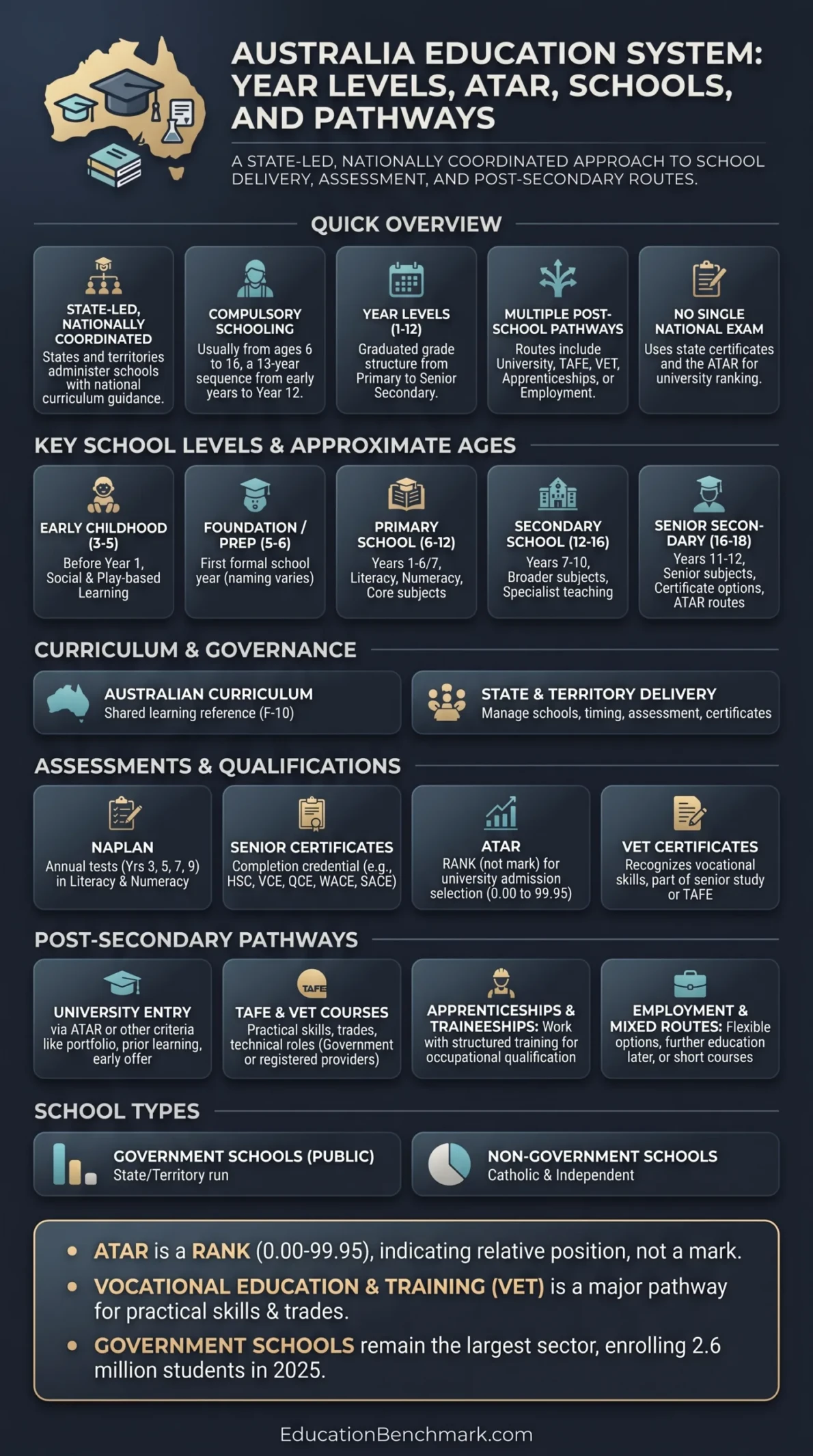
Australia uses a nationally connected but locally administered education system. Formal schooling normally runs for 13 years, from Foundation to Year 12. Schooling usually begins at about age five, legal participation commonly extends from about age six to 17, and approved education, training, or work arrangements may apply after Year 10. The exact rule belongs to the relevant state or territory, not to a single national school authority. [a]
The broad route is easy to recognise: primary school, secondary school, senior secondary certification, then university, vocational study, an apprenticeship, employment, or a mixture of these. The detail is less uniform. A family moving between states may encounter a different name for the first school year, a different enrolment cut-off, another Year 12 certificate, and a different tertiary admissions body.
Who Sets the Rules: Commonwealth, States, Territories, and School Sectors
Governance stack
National bodies create shared reference points, while states, territories, sectors, and schools carry different operational duties.
Provides school funding, supports national agreements, and participates in national policy without owning or operating government schools.
Own and manage government schools, register non-government schools, set enrolment rules, and administer local curriculum and certification arrangements.
ACARA maintains the Australian Curriculum and national reporting work, while national assessment arrangements connect jurisdictions.
Systems and schools translate jurisdiction rules into subject offerings, classroom practice, student support, assessment, and reporting.
Under Australia’s constitutional arrangements, state and territory governments provide school education, own and manage government schools, and register non-government schools. The Commonwealth contributes funding and national policy but does not run schools. This division explains why two students can follow the same Year 1–12 labels yet face different enrolment dates, senior subject rules, or graduation conditions. [b]
An independent country profile describes the same system as a set of connected stages—early childhood, school education, vocational education and training, and higher education—with national reference points and state or territory delivery. That connected view is useful because Australian students can combine senior school subjects with VET, move from a diploma into degree study, or enter tertiary education through routes other than a recent-school-leaver ATAR. [c]
Foundation to Year 12: The 13-Year School Route
Year-level sequence
Ages are typical rather than universal. Birth-date cut-offs, delayed entry, acceleration, and jurisdiction rules can shift the pattern.
| Stage | Common year levels | Typical ages | Route note |
|---|---|---|---|
| Preschool or kindergarten program | Before formal school | About 3–5 | Early childhood provision sits before the formal Foundation-to-Year-12 sequence. |
| Foundation year | Foundation, Prep, Kindergarten, Reception, Pre-primary, or Transition | About 5–6 | The local name and enrolment cut-off depend on the state or territory. |
| Primary school | Foundation to Year 6 | About 5–12 | The sequence builds literacy, numeracy, subject knowledge, and general learning capabilities. |
| Secondary school | Years 7–10 | About 12–16 | Subject choice usually widens, especially toward Years 9 and 10. |
| Senior secondary school | Years 11–12 | About 16–18 | Students work toward a jurisdiction certificate and may also complete ATAR-eligible or VET studies. |
Study Australia presents the normal school sequence as Foundation and Years 1–6, Years 7–10, and senior secondary Years 11–12, with preschool commonly serving children before formal school entry. The age bands in the table are orientation ranges, not enrolment guarantees. [d]
The Australian Curriculum covers Foundation to Year 10. It sets expected content and achievement standards across eight learning areas, while states, territories, and non-government authorities decide implementation timing, classroom practice, and supporting resources. Version 9.0 was released in 2022 and jurisdictions began implementation on their own schedules from 2023. [e]
Years 11 and 12 are different. Senior secondary courses are approved and administered through state and territory authorities, and the qualification awarded at the end is local to that jurisdiction. This is why “Year 12” describes a common stage but not one identical national program.
Year 7 Is the Secondary Starting Point, but Local Names Still Differ
Year 7 now marks the opening of secondary schooling across Australia, giving the national route a more consistent division: Foundation–Year 6 for primary and Years 7–12 for secondary. A school may still be organised as primary, secondary, combined, senior college, or another approved campus type. The year label does not always reveal the building or system structure.
The first formal year creates more confusion than Year 7. “Kindergarten” can mean the first year of primary school in one place and an early childhood program in another. “Prep,” “Reception,” “Pre-primary,” “Transition,” and “Foundation” may describe corresponding points in the route. Families comparing schools should therefore match the child’s date of birth and completed learning to the receiving jurisdiction’s enrolment rules rather than relying on the local label alone.
Reading an Interstate Transfer Record
A transfer decision usually considers the student’s current year, age, completed curriculum, school reports, subject sequence, and the receiving school’s timetable. In senior secondary years, subject equivalence and certificate credit become more important because jurisdictions use different course names and completion rules.
NAPLAN, Classroom Assessment, and Student Reporting
NAPLAN—the National Assessment Program–Literacy and Numeracy—is an annual national assessment for students in Years 3, 5, 7, and 9. It covers reading, writing, language conventions, and numeracy. Results help families, schools, systems, and governments examine progress against national proficiency standards. NAPLAN is not a school-leaving examination, a Year 10 qualification, or a direct university entrance test. [f]
Most student assessment happens outside NAPLAN. Teachers use classwork, assignments, practical tasks, projects, tests, performances, and other evidence required by the relevant course. Reports may use grades, achievement levels, marks, written comments, or combinations of these. The scale is not uniform across every school system, so an “A” or a numerical result should be read with the school’s reporting explanation.
Promotion from one year to the next is usually managed through school and system policy rather than a single national promotion examination. Where learning support, acceleration, repeating a year, or an adjusted program is considered, the decision is local and should be checked with the school and jurisdiction authority.
HSC, VCE, QCE, SACE, TCE, WACE, NTCET, and the ACT Certificate
Australia does not award one national Year 12 diploma. Each state or territory administers a Senior Secondary Certificate of Education or corresponding award. These certificates certify senior schooling; they are related to, but separate from, ATAR calculation. Jurisdictions also recognise VET within senior secondary study, although the credit pattern and certificate rules differ. [g]
Certificate equivalence map
The names below identify the main jurisdiction award. Completion requirements must be checked with the issuing authority.
| Jurisdiction | Main certificate | Common abbreviation | Route distinction |
|---|---|---|---|
| Australian Capital Territory | ACT Senior Secondary Certificate | ACT SSC | Schools and colleges may also issue a tertiary entrance statement for eligible students. |
| New South Wales | Higher School Certificate | HSC | Course marks certify achievement; the ATAR is calculated separately for eligible students. |
| Northern Territory | Northern Territory Certificate of Education and Training | NTCET | Credit, subject standards, literacy, and numeracy conditions apply. |
| Queensland | Queensland Certificate of Education | QCE | A credit pattern and literacy and numeracy requirements support the award. |
| South Australia | South Australian Certificate of Education | SACE | The program uses Stage 1 and Stage 2 studies with credit and compulsory elements. |
| Tasmania | Tasmanian Certificate of Education | TCE | The award can be reached through senior secondary and vocational learning combinations. |
| Victoria | Victorian Certificate of Education | VCE | Unit sequences and satisfactory completion rules shape the certificate. |
| Western Australia | Western Australian Certificate of Education | WACE | Breadth, achievement, literacy, numeracy, and course-pattern requirements apply. |
A senior certificate answers, “Has the student met the jurisdiction’s completion conditions?” An ATAR answers a different question: “Where does an eligible student rank relative to the relevant age cohort for tertiary selection?” A student may receive a senior certificate without receiving an ATAR, and some students complete VET-heavy or non-ATAR programs that lead to work, training, or later tertiary entry.
What ATAR Measures—and What It Does Not
ATAR stands for Australian Tertiary Admission Rank. It is a rank, not a percentage score and not a mark out of 100. Jurisdictional bodies calculate ATARs from eligible senior secondary results so that tertiary providers can compare applicants who studied different subject combinations. UAC explains that ATARs are calculated within each state, while equivalent ranks remain comparable across jurisdictions. [h]
ATAR decision sequence
From Senior Results to a Course Offer
The student works toward the local senior certificate and selects subjects that may or may not be ATAR eligible.
The local admissions authority applies its published calculation method and produces an ATAR for eligible students.
Adjustment factors, prerequisites, portfolios, auditions, interviews, or tests may also affect course assessment.
An offer depends on course rules, applicant demand, available places, and the evidence required for that intake.
A Worked Reading of ATAR and Selection Rank
Suppose a student receives an ATAR of 82.00. This does not mean the student answered 82 percent of assessment questions correctly. It represents a relative position in the cohort used for ranking. If a university applies adjustment factors for an eligible subject, location, or equity circumstance, the institution may assess the applicant with a higher selection rank. The ATAR itself does not change.
Course entry figures should also be read carefully. Institutions set their own admission requirements, and many use prerequisites or additional evidence. The lowest selection rank can change each year because the number of places, applicant demand, and the applicant pool change. Portfolios, auditions, interviews, questionnaires, tests, prior study, or pathway programs may be used with or instead of a recent-school-leaver rank. [i]
TAFE, VET, Apprenticeships, and School-Based Training
Vocational education and training, usually shortened to VET, covers job-related and technical learning delivered by TAFE institutes, other registered training organisations, some schools, and workplace-linked programs. Qualifications range through certificates, diplomas, and advanced diplomas. A VET qualification can support direct employment, further vocational study, or entry and credit toward some higher education courses. [j]
Post-Year-10 route contrast
Academic, VET, and Apprenticeship Routes Can Overlap
An Australian School-based Apprenticeship combines senior secondary subjects, paid work, and on- and off-the-job vocational training. It is undertaken part-time while the student remains at school and can continue after school if the full training requirements are not yet complete. Employment hours, release arrangements, and administration differ between states and territories. [k]
TAFE is not a single national institution. It is a common name used by public vocational providers organised within state and territory systems. Private and community providers may also deliver nationally recognised VET when properly registered. A provider’s status, course code, workplace component, licensing connection, and credit agreement should be checked before enrolment.
University Entry Beyond a Single Rank
Recent Year 12 applicants often apply through a state or territory tertiary admissions centre, although application arrangements differ by institution and course. ATAR may be central for many courses, but it is not the only evidence used across Australian higher education.
- Selection rank: an ATAR combined with eligible adjustment factors used by an institution for a course decision.
- Prerequisite: a required senior subject or result that must be met before the applicant can be considered.
- Additional selection criteria: a portfolio, audition, interview, test, questionnaire, personal statement, or other course-specific evidence.
- VET or prior study route: a certificate, diploma, advanced diploma, associate degree, or completed tertiary study considered for admission or credit.
- Enabling or preparation route: non-degree study designed to prepare applicants who do not enter directly from Year 12.
- International qualification route: an overseas or International Baccalaureate result converted or assessed under the relevant admissions process.
Universities and other higher education providers set course entry requirements, while Australia’s national higher education regulator maintains the register of approved providers and accredited courses. Provider registration confirms regulatory status; it does not make every course identical or create one national admissions formula. [l]
Government, Catholic, Independent, and International Schools
Australian school reporting commonly separates schools into government, Catholic, and independent sectors. In 2025, 69.6 percent of schools were government schools, 18.2 percent Catholic, and 12.2 percent independent. Sector labels describe governance and affiliation; they do not by themselves identify a school’s curriculum detail, admissions process, fees, student profile, or academic program. [m]
School provision
How the Main School Sectors Differ
Where Rules May Differ and How to Verify Them
The most stable part of the Australian route is the Foundation-to-Year-12 sequence. Many details around it remain local: enrolment cut-offs, compulsory participation wording, school zones, calendars, senior subject combinations, certificate credit, ATAR eligibility, adjustment factors, vocational funding, apprenticeship contracts, and university prerequisites.
A Practical Verification Order
- Check the state or territory education department for school starting age, enrolment, attendance, and calendar rules.
- Check the local curriculum or certification authority for Year 11–12 subjects, certificate conditions, and assessment.
- Check the relevant tertiary admissions centre for ATAR calculation, selection ranks, adjustment factors, and application rounds.
- Check the university, TAFE institute, training provider, or apprenticeship authority for current course-specific requirements.
Education Benchmark is an independent informational guide and is not affiliated with any ministry of education, school authority, exam board, university, government agency, or official ranking organization. It does not provide school placement, admissions, legal, or visa advice. Rules that affect an individual application should be confirmed with the responsible authority, school, training provider, admissions centre, or university.
Sources and Verification
- [a] National Report on Schooling in Australia 2024 — Used for the 13-year school route, typical starting and completion ages, compulsory participation, and state or territory responsibility. (Reliable because ACARA is Australia’s statutory curriculum, assessment, and reporting authority.)
- [b] How schools are funded – Department of Education, Australian Government — Used for the division of duties between the Commonwealth and state or territory governments. (Reliable because it is an Australian Government Department of Education page.)
- [c] Australia Education System (2026): Structure, Quality, and Performance — Used for the connected-stage description linking school education, VET, and higher education. (Useful as an independent country education reference that identifies its underlying data sources.)
- [d] Schools | Study Australia — Used for the normal Foundation-to-Year-12 stage sequence and typical preschool context. (Reliable because Study Australia is an Australian Government service.)
- [e] Australian Curriculum – Department of Education, Australian Government — Used for Foundation-to-Year-10 curriculum scope, learning areas, achievement standards, and jurisdiction implementation. (Reliable because it is an Australian Government education source.)
- [f] NAP – NAPLAN — Used for NAPLAN year levels, purpose, and national literacy and numeracy assessment scope. (Reliable because it is the official National Assessment Program site.)
- [g] Senior Secondary Certificates – ACACA — Used for state and territory Year 12 certificate names and the recognition of VET within senior secondary awards. (Reliable because ACACA represents the statutory curriculum, assessment, and certification authorities.)
- [h] ATAR – Australian Tertiary Admission Rank – UAC — Used to distinguish ATAR from subject marks and explain interstate comparability. (Reliable because UAC calculates and publishes ATAR information for New South Wales and supports ACT arrangements.)
- [i] Admission criteria – UAC — Used for selection ranks, prerequisites, adjustment factors, additional criteria, and non-ATAR pathways. (Reliable because UAC is a tertiary admissions centre publishing current applicant rules.)
- [j] Vocational Education and Training (VET) and TAFE | Study Australia — Used for VET qualification levels and progression from vocational study to work or higher education. (Reliable because Study Australia is an Australian Government service.)
- [k] Australian School-based Apprenticeships — Used for the combination of school subjects, paid work, vocational training, and jurisdiction variation. (Reliable because it is an Australian Government apprenticeships publication updated in October 2025.)
- [l] FAQS | Tertiary Education Quality and Standards Agency — Used for TEQSA’s national regulatory role and the official higher education provider register. (Reliable because TEQSA is Australia’s national higher education regulator.)
- [m] School numbers — Used for the 2025 distribution of government, Catholic, and independent schools. (Reliable because ACARA reports national school statistics drawn from the official schools collection.)